Portrait of Jan Baptist Weenix

The 78 Most Famous Jan Baptist Weenix Paintings, a Gallery Selection

Updated November 2026 · ranked by our popularity score (searches, visits and orders for each work) · 86 works by Jan Baptist Weenix in our catalogue

In short

Of all the originals Jan Baptist Weenix left, the most famous is Tobit, asleep under a vine, is blinded (1642), in the collection of the Museum Boijmans Van Beuningen, Rotterdam. Close behind it come Italian landscape with shelter and antiques ruins (1658) and Still Life with a Dead Swan (1651). Our catalog holds 86 works by Jan Baptist Weenix; the gallery has kept the 78 the world admires most, each shown with its date, its museum and its story.

1621 – 1659, Amsterdam Dutch golden age Most works: Bavarian State Painting Collections

Jan Baptist Weenix's top 10 paintings: the gallery's choice

1
Tobit, asleep under a vine, is blinded (1642) by Jan Baptist Weenix

Tobit, asleep under a vine, is blinded

1642 · Oil On Canvas · Museum Boijmans Van Beuningen, Rotterdam

A single man reclines in the heavy shade of a vine. He is Tobit, lost to a deep, unsuspecting sleep. The air around him feels thick, weighted by the muted tones of ochre and forest green. Sunlight does not flood this scene; instead, it pierces through the foliage in sharp, controlled beams, illuminating the textures of his slumped posture and the coarse fabric of his clothing. He rests amidst a…

2
Italian landscape with shelter and antiques ruins (1658) by Jan Baptist Weenix

Italian landscape with shelter and antiques ruins

1658 · Oil On Panel · Mauritshuis, The Hague

The oil on panel painting titled Italian landscape with shelter and antiques ruins was executed by the artist Jan Baptist Weenix in 1658. This landscape painting depicts a specific pastoral setting within an Italianate environment. The scene is populated by a group of peasants and various livestock, including sheep and goats. These figures are situated near a rustic cottage and several ancient architectural ruins that occupy the landscape.

3
Still Life with a Dead Swan (1651) by Jan Baptist Weenix

Still Life with a Dead Swan

1651 · Oil On Canvas · Detroit Institute of Arts, Detroit

The painting Still Life with a Dead Swan by Jan Baptist Weenix captures a heavy, silent moment of the hunt. Created about 1651, the work presents a collection of fallen game as a trophy of the chase. A white swan rests at the center, its pale plumage a stark contrast to the darker forms surrounding it. This central figure is accompanied by a turkey, two partridges, and a small finch,…

4
Tobit Sleeping Under the Vine (1641) by Jan Baptist Weenix

Tobit Sleeping Under the Vine

1641 · Oil · Museum Catharijneconvent, Utrecht

In this work, titled Tobit Sleeping Under the Vine, we encounter a significant piece by the Dutch Golden Age painter Jan Baptist Weenix. Created around 1642, the painting belongs to the Baroque period, a time when the interplay of light and shadow began to define the dramatic tension of Northern European art. Weenix, born in Amsterdam, Netherlands, brought a disciplined approach to his subjects, often blending meticulous observation with a…

5
The Scissors Grinder (1641) by Jan Baptist Weenix

The Scissors Grinder

The air feels heavy with the scent of damp stone and the rhythmic, metallic scrape of steel against stone. Under a vast, expansive sky, a group of figures gathers within the skeletal remains of a classical ruin. A man leans into his work, operating a grinding wheel that cuts through the quietude of the scene. Beside him, a woman sits in repose, while a small child stands close by, watching…

6
Hunters Near Ruins (1648) by Jan Baptist Weenix

Hunters Near Ruins

1648 · Oil On Canvas · Cleveland Museum of Art, Cleveland

Hunters Near Ruins is an oil on canvas painting by Jan Baptist Weenix. The work is dated 1648. This piece belongs to the Dutch Golden Age, a period during which the artist developed a specific approach to landscape and human figures.

7
Portrait of René Descartes (1647) by Jan Baptist Weenix

Portrait of René Descartes

1647 · Oil · Centraal Museum, Utrecht

In this 1647 oil painting, Jan Baptist Weenix captures the French philosopher René Descartes. The subject appears in a medium close-up, his presence defined by a heavy, somber stillness. He is an elderly man, his face marked by the weight of thought and the passage of years. A bright white collar cuts through the darkness of his attire, framing a pale countenance that emerges from a deep, umber shadow.

8
Monument at a Harbour (1648) by Jan Baptist Weenix

Monument at a Harbour

1648 · Oil · Statens Museum For Kunst, Copenhagen

The composition relies on strong vertical elements, primarily through imposing columns and a central, highly ornate pedestal topped with a large urn. These structures anchor the scene, providing a sense of scale against the scattered human figures in the foreground and middle ground. Through a use of deep recession, the perspective draws the eye past a colonnade toward a distant, hazy horizon where the masts of ships are visible.

9
Harbour with Antique Ruins (1648) by Jan Baptist Weenix

Harbour with Antique Ruins

1648 · Oil On Canvas · Nationalmuseum, Stockholm

The scene unfolds in 1648, a moment captured in the oil on canvas known as Harbour with Antique Ruins. This work belongs to the hand of Jan Baptist Weenix, an artist who brings the weight of history into a living, breathing maritime setting. The painting presents a world where the weathered stone of classical antiquity meets the constant, rhythmic movement of a working harbor. It is a vision of a…

10
The Angel Raphael Leaving Tobias's Family (1648) by Jan Baptist Weenix

The Angel Raphael Leaving Tobias's Family

1648 · Oil · Nationalmuseum, Stockholm

In "The Angel Raphael Leaving Tobias's Family" by Jan Baptist Weenix, a divine departure unfolds with sudden, celestial energy. The scene captures the exact moment the Angel Raphael ascends toward the heavens, leaving the family below in a state of profound awe and reverence. A powerful diagonal movement pulls the eye from the lower left foreground upward toward the upper left, where the angelic figure climbs into a swirling formation…

The Jan Baptist Weenix selection continues, 11 to 78

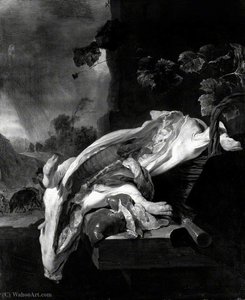
11vegetable-sellers at the house-door, 5 figures (1646) by Jan Baptist Weenixvegetable-sellers at the house-door, 5 figures1646 12caravane near the shore (1646) by Jan Baptist Weenixcaravane near the shore1646 13Mother and Child (1647) by Jan Baptist WeenixMother and Child1647 14Circumcision of Moses' son (1640) by Jan Baptist WeenixCircumcision of Moses' son1640 · National Museum in Warsaw 15Still Life with Game, Hunter and Two Dogs (1652) by Jan Baptist WeenixStill Life with Game, Hunter and Two Dogs1652 · Bavarian State Painting Collections 16Butterfly Dog and Dead Bird (1649) by Jan Baptist WeenixButterfly Dog and Dead Bird1649 · Museum Mayer van den Bergh 17Pleasure boating (1650) by Jan Baptist WeenixPleasure boating1650 18The Sleeping Shepherdess (1658) by Jan Baptist WeenixThe Sleeping Shepherdess1658 · National Gallery of Ireland 19Roman Tinker (1656) by Jan Baptist WeenixRoman Tinker1656 · Städel Museum 20The love letter (1650) by Jan Baptist WeenixThe love letter1650 · National Museum of Art, Architecture and Design 21Italian Harbour (1651) by Jan Baptist WeenixItalian Harbour1651 · Hermitage Museum 22Italian Peasants among Ruins (1650) by Jan Baptist WeenixItalian Peasants among Ruins1650 · Detroit Institute of Arts 23Sleeping girl (1656) by Jan Baptist WeenixSleeping girl1656 · Bavarian State Painting Collections 24Rest on the Flight into Egypt (1657) by Jan Baptist WeenixRest on the Flight into Egypt1657 · Museum Boijmans Van Beuningen 25Merry Company on a Ferry (1649) by Jan Baptist WeenixMerry Company on a Ferry1649 · Museum Gouda 26Battle at the foot of the mountain. (1650) by Jan Baptist WeenixBattle at the foot of the mountain.1650 · National Museum in Warsaw 27Christina Lepper de Kempenaer and Her Children (1653) by Jan Baptist WeenixChristina Lepper de Kempenaer and Her Children1653 28Italian port scene, 1649 (1649) by Jan Baptist WeenixItalian port scene, 16491649 · Centraal Museum 29Italian Landscape with Horsemen by a Spring (1657) by Jan Baptist WeenixItalian Landscape with Horsemen by a Spring1657 · Centraal Museum 30Before the walls of Rome (1650) by Jan Baptist WeenixBefore the walls of Rome1650 · National Museum in Wrocław 31Portrait of a man with a letter (1650) by Jan Baptist WeenixPortrait of a man with a letter1650 · Agnes Etherington Art Center 32A Landscape with a Ford (1660) by Jan Baptist WeenixA Landscape with a Ford1660 · Regional Gallery in Liberec 33In the Campagna (1669) by Jan Baptist WeenixIn the Campagna1669 · National Gallery of Ireland 34Dead Fowl Being Eaten by a Cat (1653) by Jan Baptist WeenixDead Fowl Being Eaten by a Cat1653 · Städel Museum 35Departure of an Oriental Entourage (1647) by Jan Baptist WeenixDeparture of an Oriental Entourage1647 · The Louvre 36Display of Dead Game (1641) by Jan Baptist WeenixDisplay of Dead Game1641 · Petit Palais 37Dead Game (1641) by Jan Baptist WeenixDead Game1641 38River Landscape with a Ferry (1650) by Jan Baptist WeenixRiver Landscape with a Ferry1650 · Montreal Museum of Fine Arts 39Still Life with Dead Game and Poultry (1656) by Jan Baptist WeenixStill Life with Dead Game and Poultry1656 · Centraal Museum 40Still Life with Fowl (1650) by Jan Baptist WeenixStill Life with Fowl1650 · Museum of Fine Arts Ghent (MSK) 41Marine with a Venetian Bucintoro (1650) by Jan Baptist WeenixMarine with a Venetian Bucintoro1650 · Staatliche Kunsthalle Karlsruhe 42The Dutch Ambassador on his Way to Isfahan, Jan Baptist Weenix, 1653 - 1659 (1659) by Jan Baptist WeenixThe Dutch Ambassador on his Way to Isfahan, Jan Baptist Weenix, 1653 - 16591659 · Rijksmuseum 43After the Hunt, Jan Baptist Weenix, c. 1656 (1656) by Jan Baptist WeenixAfter the Hunt, Jan Baptist Weenix, c. 16561656 · Rijksmuseum 44Still Life with White Mouse (1680) by Jan Baptist WeenixStill Life with White Mouse1680 · Ernest Zmeták Art Gallery 45Still Life with Game by Jan Baptist WeenixStill Life with GameHarvard Art Museums 46The Ford in the River (1647) by Jan Baptist WeenixThe Ford in the River1647 · Hermitage Museum 47Harbor View with Rider in Oriental Dress, by Jan Baptist WeenixHarbor View with Rider in Oriental Dress,Groninger Museum 48The Holy Women at the Tomb by Jan Baptist WeenixThe Holy Women at the TombNational Gallery of Ireland 49An Italian Seaport by Jan Baptist WeenixAn Italian SeaportRoyal Museum of Fine Arts Antwerp 50Architectural interior with foreign shippers, ruins and a shipyard beyond by Jan Baptist WeenixArchitectural interior with foreign shippers, ruins and a shipyard beyond 51Study of a sheep by Jan Baptist WeenixStudy of a sheep 52A pig's carcase by Jan Baptist WeenixA pig's carcase 53The Tinker and His Dog by Jan Baptist WeenixThe Tinker and His Dog 54Landscape with Peasants and Animals by Jan Baptist WeenixLandscape with Peasants and Animals 55Dead Partridge (1650) by Jan Baptist WeenixDead Partridge1650 · Mauritshuis 56Goat Lying Down, Jan Baptist Weenix, 1645 - 1660 (1660) by Jan Baptist WeenixGoat Lying Down, Jan Baptist Weenix, 1645 - 16601660 · Rijksmuseum 57A Dog and a Cat near a partially disembowelled Deer, Jan Baptist Weenix, 1645 - 1660 (1660) by Jan Baptist WeenixA Dog and a Cat near a partially disembowelled Deer, Jan Baptist Weenix, 1645 - 16601660 · Rijksmuseum 58Still Life with Dead Poultry, Lidded Pitcher and Passglas by Jan Baptist WeenixStill Life with Dead Poultry, Lidded Pitcher and PassglasBavarian State Painting Collections 59Game-piece by Jan Baptist WeenixGame-pieceNational Gallery of Ireland 60Dead game and hunting tackle in landscape by Jan Baptist WeenixDead game and hunting tackle in landscape 61Hound with a Joint of Meat and a Cat Looking on by Jan Baptist WeenixHound with a Joint of Meat and a Cat Looking on 62Bouquet of flowers by Jan Baptist WeenixBouquet of flowersGemäldegalerie 63Shipping in Harbour by Jan Baptist WeenixShipping in Harbour 64Herons and Lapwings by Jan Baptist WeenixHerons and Lapwings 65Still Life of Dead Game in a Landscape with a Huntsman by Jan Baptist WeenixStill Life of Dead Game in a Landscape with a Huntsman 66An italian port scene by Jan Baptist WeenixAn italian port scene 67Shepherds and Flocks among Classical Ruins by Jan Baptist WeenixShepherds and Flocks among Classical Ruins 68A Coast Scene with Classical Ruins by Jan Baptist WeenixA Coast Scene with Classical RuinsWallace Collection 69Still Life with Dead Game by Jan Baptist WeenixStill Life with Dead Game 70Hounds and an Owl with Dead Birds and Sculptures in a Landscape by Jan Baptist WeenixHounds and an Owl with Dead Birds and Sculptures in a Landscape 71Still Life with Dead Birds by Jan Baptist WeenixStill Life with Dead Birds 72Family in a Mediterranean Seaport by Jan Baptist WeenixFamily in a Mediterranean Seaport 73Figures near a Seaport by Jan Baptist WeenixFigures near a SeaportScottish National Gallery 74A Huntsman cutting up a Dead Deer, with Two Deerhounds by Jan Baptist WeenixA Huntsman cutting up a Dead Deer, with Two DeerhoundsNational Gallery 75Ancient Ruins by Jan Baptist WeenixAncient RuinsSzépművészeti Múzeum 76Figures among ruins by Jan Baptist WeenixFigures among ruinsThe Kremer Collection 77Ancient Ruins (detail) by Jan Baptist WeenixAncient Ruins (detail)Szépművészeti Múzeum 78Girl as Shepherdess (1650) by Jan Baptist WeenixGirl as Shepherdess1650 · Musée de Picardie

Jan Baptist Weenix's famous paintings, period by period

The subjects that held Jan Baptist Weenix's eye

The four subjects that come back most often in these originals, each with its finest example.

The museums that keep Jan Baptist Weenix's originals

The 8 museums that hold the most of the paintings on this page.

Museum City Works by Jan Baptist Weenix Paintings from this list
Bavarian State Painting Collections, MunichBavarian State Painting Collections Munich 4 The Scissors Grinder, Still Life with Game, Hunter and Two Dogs, Sleeping girl
Centraal Museum, UtrechtCentraal Museum Utrecht 4 Portrait of René Descartes, Italian port scene, 1649, Italian Landscape with Horsemen by a Spring
National Gallery of Ireland, Dublin CityNational Gallery of Ireland Dublin City 4 The Sleeping Shepherdess, In the Campagna, The Holy Women at the Tomb
Rijksmuseum, AmsterdamRijksmuseum Amsterdam 4 The Dutch Ambassador on his Way to Isfahan, Jan Baptist Weenix, 1653 - 1659, After the Hunt, Jan Baptist Weenix, c. 1656, Goat Lying Down, Jan Baptist Weenix, 1645 - 1660
Museum Boijmans Van Beuningen, RotterdamMuseum Boijmans Van Beuningen Rotterdam 2 Tobit, asleep under a vine, is blinded, Rest on the Flight into Egypt
Mauritshuis, The HagueMauritshuis The Hague 2 Italian landscape with shelter and antiques ruins, Dead Partridge
Detroit Institute of Arts, DetroitDetroit Institute of Arts Detroit 2 Still Life with a Dead Swan, Italian Peasants among Ruins
Nationalmuseum, StockholmNationalmuseum Stockholm 2 Harbour with Antique Ruins, The Angel Raphael Leaving Tobias's Family

Jan Baptist Weenix year by year: the originals that define each

From 1640 to 1659, Jan Baptist Weenix worked for 20 years: the selection follows that long career year by year, through its finest originals.

Works per year

Pick a year to see its originals.

Collectors' questions about Jan Baptist Weenix's paintings

Which work is Jan Baptist Weenix most famous for?Reveal the answer

Tobit, asleep under a vine, is blinded (1642), Museum Boijmans Van Beuningen, Rotterdam. Italian landscape with shelter and antiques ruins (1658) and Still Life with a Dead Swan (1651) come next.

What age was Jan Baptist Weenix when Tobit, asleep under a vine, is blinded was made?Reveal the answer

21 years old: Tobit, asleep under a vine, is blinded dates from 1642, and Jan Baptist Weenix was born in 1621.

What are the ten most famous Jan Baptist Weenix paintings?Reveal the answer

Tobit, asleep under a vine, is blinded, Italian landscape with shelter and antiques ruins, Still Life with a Dead Swan, Tobit Sleeping Under the Vine, The Scissors Grinder, Hunters Near Ruins, Portrait of René Descartes, Monument at a Harbour, Harbour with Antique Ruins and The Angel Raphael Leaving Tobias's Family. The ranking above gives each one's year and museum.

How many paintings did Jan Baptist Weenix leave?Reveal the answer

Our catalog holds 86 works by Jan Baptist Weenix, dated from 1640 to 1659.

In which museums do Jan Baptist Weenix's masterpieces hang?Reveal the answer

Mostly in Bavarian State Painting Collections (Munich), Centraal Museum (Utrecht) and National Gallery of Ireland (Dublin City). The museum table above lists them all.

In which years did Jan Baptist Weenix paint the most famous works?Reveal the answer

In 1650: 11 of the 78 works on this page were made then, Pleasure boating among them.

What are the first and the last famous originals of Jan Baptist Weenix?Reveal the answer

On this page, the earliest is Circumcision of Moses' son (1640) and the latest The Dutch Ambassador on his Way to Isfahan, Jan Baptist Weenix, 1653 - 1659 (1659).

Which subjects did Jan Baptist Weenix choose most often?Reveal the answer

Landscape (18), Ruins (17) and Sky (13), across the 78 works on this page.

Which technique did Jan Baptist Weenix use most?Reveal the answer

Oil On Canvas, for 30 of the 78 works on this page.

To which art movement does Jan Baptist Weenix belong?Reveal the answer

Dutch golden age and Baroque, judging by the originals on this page.

Which Jan Baptist Weenix works hang at the Bavarian State Painting Collections?Reveal the answer

The Scissors Grinder, Still Life with Game, Hunter and Two Dogs and Sleeping girl: the Bavarian State Painting Collections, Munich holds 4 of the works on this page.

Jan Baptist Weenix: life and work

The Visionary of the Dutch Golden Age

Jan Baptist Weenix stands as a singular figure within the Dutch Golden Age, celebrated for his distinctive blend of meticulous observation and imaginative vision. Though his artistic output was relatively modest compared to contemporaries like Rembrandt or Vermeer, Weenix’s contribution to Dutch art history is undeniable—particularly his groundbreaking exploration of Italian landscapes infused with human figures, establishing a stylistic precedent that would resonate throughout subsequent generations. Born in Amsterdam near the bustling harbor in 1621, Weenix descended from a family of architects, a lineage that likely shaped his formative years amidst the intellectual and structural ferment of the era.

Despite facing personal challenges—accounts suggest he struggled with speech due to a medical condition—Weenix possessed an ardent passion for literature and art, fostered by a mother who proactively arranged for him to apprentice under Jan Micker, Rembrandt’s brother-in-law. This early training instilled in him a disciplined approach to drawing and observation that would become the hallmarks of his oeuvre. He further honed his skills at Utrecht under the guidance of Abraham Bloemaert and returned to Amsterdam to study with Claes Corneliszoon Moeyaert, cementing his grounding in the prevailing artistic currents of the Netherlands.

A Journey Through Light and Landscape

The trajectory of Weenix’s career was profoundly altered by his travels, most notably his journey to Rome in 1643 alongside Nicolaes Pieterszoon Berchem. This excursion allowed him to encounter the vibrant intellectual and artistic milieu of the Bentvueghels guild, an experience that propelled him towards a more expansive stylistic range. In Rome, he embraced the Italianate style, characterized by warm, golden light and classical landscapes that contrasted beautifully with the cooler, more somber tones of traditional Dutch painting. This period of Roman influence allowed him to master the art of the "Italianate landscape," where the rugged beauty of southern Europe was reimagined through a Northern European lens.

His work during this era often blended the grandeur of classical settings with intimate, human elements. Whether depicting harbor scenes that whispered of maritime commerce or expansive vistas that evoked a sense of timelessness, Weenix possessed a unique ability to capture the atmosphere of a place. His mastery was not limited to vast horizons; he was equally adept at capturing the quiet, often visceral reality of life through his still lifes. His depictions of dead game and animals were marked by a startling realism, where every texture—from the coarse fur of a hunting dog to the delicate sheen of feathers—was rendered with breathtaking precision.

Legacy of Realism and Artistry

The significance of Jan Baptist Weenix lies in his ability to bridge the gap between the gritty realism of Dutch tradition and the idealized beauty of the Italianate movement. His versatility allowed him to navigate diverse subject matters, from the dramatic tension found in works like After the Hunt to the quiet, almost somber intensity of his animal studies. Through his brush, the viewer is invited into a world where the boundaries between the observed natural world and the imagined classical past are beautifully blurred.

As we reflect on his life and work, several key elements define his enduring importance:

  • Stylistic Innovation: He was a pioneer in integrating Italianate landscape elements into the Dutch tradition, creating a new visual language for his contemporaries.
  • Technical Mastery: His disciplined training allowed for an extraordinary level of detail in both large-scale landscapes and intimate still lifes.
  • Versatility: His ability to move seamlessly between harbor scenes, hunting motifs, and animal portraits demonstrates a rare breadth of talent.
  • Historical Impact: As a member of the Bentvueghels, he helped foster the international exchange of artistic ideas that defined the 17th-century art world.

Though his life was relatively short, ending in 1661, the imprint left by Jan Baptist Weenix remains visible in the evolution of landscape painting. He taught future generations how to look at the horizon not just as a boundary, but as a canvas for light, history, and human emotion.