Portrait of Jacques Courtois

The 78 Most Famous Jacques Courtois Paintings, a Gallery Selection

Updated November 2026 · ranked by our popularity score (searches, visits and orders for each work) · 79 works by Jacques Courtois in our catalogue

In short

Of all the originals Jacques Courtois left, the most famous is Cavalry Skirmish (1648), in the collection of the Bavarian State Painting Collections, Munich. Close behind it come Cavalry in Attack (1648) and Meeting of Horsemen (1650). Our catalog holds 79 works by Jacques Courtois; the gallery has kept the 78 the world admires most, each shown with its date, its museum and its story.

1621 – 1676, Saint-Hippolyte Baroque Most works: Bavarian State Painting Collections

Jacques Courtois's top 10 paintings: the gallery's choice

1
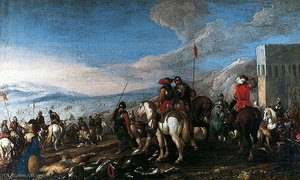
Cavalry Skirmish (1648) by Jacques Courtois

Cavalry Skirmish

In "Cavalry Skirmish" by Jacques Courtois, the composition follows a dynamic and horizontal arrangement. The scene depicts a military engagement set within an open landscape. Above the combatants, a vast, cloudy sky occupies the upper half of the frame. This large expanse of atmosphere provides a backdrop to the intense movement occurring on the ground. The perspective is positioned at eye-level with the combatants, placing the viewer within the immediate…

2
Cavalry in Attack (1648) by Jacques Courtois

Cavalry in Attack

In "Cavalry in Attack" by Jacques Courtois, the viewer is thrust into the heart of a sudden, violent skirmish. The composition centers on a single equestrian figure caught in a moment of explosive energy. This soldier, seen in profile, wears the heavy, period-appropriate military attire of the mid-17th century, including a helmet and a sash that billows behind him like a flag in a gale. He is mid-action, leaning into…

3
Meeting of Horsemen (1650) by Jacques Courtois

Meeting of Horsemen

1650 · Oil On Canvas

The oil painting titled Meeting of Horsemen is a work by the artist Jacques Courtois. Created about 1650, the piece captures a specific moment of military tension. It depicts a military gathering or skirmish, focusing on the presence of cavalrymen in a landscape of movement and dust.

4
Cuirassiers Engaged with Turkish Horsemen (1650) by Jacques Courtois

Cuirassiers Engaged with Turkish Horsemen

1650 · Oil On Canvas

In Cuirassiers Engaged with Turkish Horsemen, Jacques Courtois presents a scene of intense military engagement, likely depicting a clash from the Ottoman-Habsburg wars. The composition is horizontally oriented, utilizing a high horizon line to emphasize the vastness of the landscape stretching toward a hazy, distant horizon. This structural choice allows the viewer to focus on the immediate chaos of the skirmish. A low-angle view places us directly within the fray,…

5
Hold-Up (1655) by Jacques Courtois

Hold-Up

1655 · Oil On Canvas · Statens Museum For Kunst, Copenhagen

In this 1655 oil on canvas, we find ourselves thrust into the immediate, frantic heart of a woodland struggle. The composition is defined by a sense of sudden upheaval, where the quiet of the forest has been shattered by a violent encounter. At the center of this turmoil, a white horse provides a stark, luminous focal point, its brightness cutting through the earthy, muted tones of the surrounding woods. The…

6
Moses' Battle (1650) by Jacques Courtois

Moses' Battle

1650 · Oil On Canvas

The air thickens with the dust of a thousand hoofbeats as the scene erupts in a whirlwind of motion. We are thrust into the very heart of a massive, dynamic conflict where the distinction between man and beast blurs amidst the turmoil. Horses rear with primal energy, their muscular flanks catching a sudden, dramatic light that cuts through the gloom of the battlefield. Soldiers lunge and twist, their limbs contorted…

7
Horsemen in Combat, Man with a Pistol (1650) by Jacques Courtois

Horsemen in Combat, Man with a Pistol

1650 · Oil On Canvas · Government Art Collection, London

In Horsemen in Combat, Man with a Pistol, Jacques Courtois plunges the viewer directly into the heart of a chaotic Baroque cavalry skirmish. The scene erupts from an eye-level perspective, placing the observer within the immediate fray of the struggle. A crowded mid-ground teems with the frantic movement of horses and riders, creating a sense of overwhelming momentum. The violence of war takes center stage as soldiers clash amidst a…

8
Self-portrait (1675) by Jacques Courtois

Self-portrait

1675 · Oil On Canvas · Vasari Corridor, Florence

This oil painting, titled Self-portrait, was executed by the artist Jacques Courtois. The work dates to about 1675. It depicts the painter in a bust-length composition, presenting his own likeness against a backdrop of a turbulent, cloudy sky and a low horizon line. The subject is positioned slightly off-center, facing toward the viewer's right while turning his gaze back toward the observer.

9
Rocky valley (1650) by Jacques Courtois

Rocky valley

1650 · Oil On Canvas · Art Gallery of South Australia, Adelaide

To gaze upon Jacques Courtois's "Rocky Valley" is to step through a veil into an idealized vision of rural tranquility. This magnificent landscape, dating from 1650, immediately envelops the viewer in a sense of profound peace. The composition centers around a picturesque valley floor, bisected by the gentle flow of a river—a timeless artery of life and movement. Dominating the middle ground is a stately church, its tall tower rising…

10
Cavalry Encounter (1780) by Jacques Courtois

Cavalry Encounter

1780 · Oil On Canvas · Kunsthistorisches Museum, Vienna

In Jacques Courtois's Cavalry Encounter, the air thickens with the immediate chaos of military combat. A sudden, violent clash erupts as horses and riders collide in a frantic struggle for dominance. The scene captures a moment of pure kinetic energy, where the distinction between order and pandemonium vanishes. Every movement suggests a struggle that is unfolding right before the eyes, pulling the viewer into the heart of the fray. Tension…

The Jacques Courtois selection continues, 11 to 78

11A Battle (1648) by Jacques CourtoisA Battle1648 · Bavarian State Painting Collections 12Battle of Cavalry (1648) by Jacques CourtoisBattle of Cavalry1648 · Bavarian State Painting Collections 13Cavalry Skirmish (1648) by Jacques CourtoisCavalry Skirmish1648 · Bavarian State Painting Collections 14Cavalry Skirmish (1648) by Jacques CourtoisCavalry Skirmish1648 · Bavarian State Painting Collections 15Cavalry Skirmish (1648) by Jacques CourtoisCavalry Skirmish1648 · Bavarian State Painting Collections 16Cavalry Skirmish (1648) by Jacques CourtoisCavalry Skirmish1648 · Bavarian State Painting Collections 17Cavalry in Attack (1648) by Jacques CourtoisCavalry in Attack1648 · Bavarian State Painting Collections 18Battle Piece (1648) by Jacques CourtoisBattle Piece1648 · Bavarian State Painting Collections 19Withdrawal of the Cavalry (1648) by Jacques CourtoisWithdrawal of the Cavalry1648 · Bavarian State Painting Collections 20Cavalry Skirmish (1648) by Jacques CourtoisCavalry Skirmish1648 · Bavarian State Painting Collections 21Cavalry Skirmish (1648) by Jacques CourtoisCavalry Skirmish1648 · Bavarian State Painting Collections 22Cavalry Battle (1648) by Jacques CourtoisCavalry Battle1648 · Bavarian State Painting Collections 23Cavalry Skirmish (1648) by Jacques CourtoisCavalry Skirmish1648 · Bavarian State Painting Collections 24Cavalry Skirmish (1648) by Jacques CourtoisCavalry Skirmish1648 · Bavarian State Painting Collections 25Equestrian battle against Orientals in front of a pyramid (1648) by Jacques CourtoisEquestrian battle against Orientals in front of a pyramid1648 · Bavarian State Painting Collections 26The rearguard of a cavalry engagement (1648) by Jacques CourtoisThe rearguard of a cavalry engagement1648 · Bavarian State Painting Collections 27Storming of a castle (1648) by Jacques CourtoisStorming of a castle1648 · Bavarian State Painting Collections 28Cavalry engagement on a bridge (1648) by Jacques CourtoisCavalry engagement on a bridge1648 · Bavarian State Painting Collections 29A Cavalry Skirmish (1639) by Jacques CourtoisA Cavalry Skirmish1639 · Royal Collection 30battle (1648) by Jacques Courtoisbattle1648 · Museo Bardini 31Cavalry Combat (1650) by Jacques CourtoisCavalry Combat1650 32Cavalry Combat (1650) by Jacques CourtoisCavalry Combat1650 33Battle (1650) by Jacques CourtoisBattle1650 · Musées de Sens 34March of Troops (1650) by Jacques CourtoisMarch of Troops1650 · Opera House 35Battle of Horsemen (1650) by Jacques CourtoisBattle of Horsemen1650 · Opera House 36The battle (1650) by Jacques CourtoisThe battle1650 · National Gallery of Armenia 37Battle Scene (1655) by Jacques CourtoisBattle Scene1655 · Statens Museum For Kunst 38Battle Scene with Turkish Cavalry (1655) by Jacques CourtoisBattle Scene with Turkish Cavalry1655 · Statens Museum For Kunst 39Joshua Suspending the Motion of the Sun (1650) by Jacques CourtoisJoshua Suspending the Motion of the Sun1650 40Horsemen in Combat, Man with a Red Flag (1650) by Jacques CourtoisHorsemen in Combat, Man with a Red Flag1650 · Government Art Collection 41Cavalry Battle between Christians and Turks (1660) by Jacques CourtoisCavalry Battle between Christians and Turks1660 42Cavalry Attack (1660) by Jacques CourtoisCavalry Attack1660 · Academy of Fine Arts Vienna 43Cavalry Battle between Christians and Turks (1660) by Jacques CourtoisCavalry Battle between Christians and Turks1660 · Academy of Fine Arts Vienna 44Soldiers on the March (1665) by Jacques CourtoisSoldiers on the March1665 · Royal Collection 45A Battle Scene by Jacques CourtoisA Battle SceneDetroit Institute of Arts 46Battle of the Milvian Bridge by Jacques CourtoisBattle of the Milvian BridgeBavarian State Painting Collections 47Horseman Firing a Pistol at another Horseman by Jacques CourtoisHorseman Firing a Pistol at another HorsemanStatens Museum For Kunst 48The Battle of Mongiovino by Jacques CourtoisThe Battle of MongiovinoGalleria degli Uffizi 49Moses Victory over the Amalekites by Jacques CourtoisMoses Victory over the AmalekitesBavarian State Painting Collections 50After the Battle by Jacques CourtoisAfter the BattleBavarian State Painting Collections 51Cavalry Skirmish by Jacques CourtoisCavalry SkirmishBavarian State Painting Collections 52Meeting of Riders by Jacques CourtoisMeeting of RidersKunsthistorisches Museum 53Cavalry Attack by Jacques CourtoisCavalry AttackMuseum of Fine Arts Ghent (MSK) 54Cavalry Engagements by Jacques CourtoisCavalry EngagementsVictoria and Albert Museum 55Cavalry by Jacques CourtoisCavalryDetroit Institute of Arts 56Battle in front of a fortress wall by Jacques CourtoisBattle in front of a fortress wallBavarian State Painting Collections 57Battle Scene by Jacques CourtoisBattle SceneStatens Museum For Kunst 58After the Battle by Jacques CourtoisAfter the BattleFine Arts Museums of San Francisco 59Mountainous landscape by Jacques CourtoisMountainous landscapeGemäldegalerie 60Battle Scene by Jacques CourtoisBattle SceneWalker Art Gallery 61Conversion of Saint Paul by Jacques CourtoisConversion of Saint Paul 62North African Battle Scene by Jacques CourtoisNorth African Battle SceneVanderbilt Museum of Art 63Battle scene by Jacques CourtoisBattle sceneЙоркський художній музей 64Battle scene by Jacques CourtoisBattle scene 65A battle by Jacques CourtoisA battleScottish National Gallery 66A battle scene by Jacques CourtoisA battle scene 67Skirmish by Jacques CourtoisSkirmish 68A skirmish by Jacques CourtoisA skirmish 69Battle scene by Jacques CourtoisBattle sceneЙоркський художній музей 70A battle scene by Jacques CourtoisA battle scene 71Landscape with Horsemen by Jacques CourtoisLandscape with HorsemenShipley Art Gallery 72A Battle Scene with a Bridge by Jacques CourtoisA Battle Scene with a Bridge 73Battle between Knights and Turks by Jacques CourtoisBattle between Knights and Turks 74Battle piece by Jacques CourtoisBattle piece 75Horsemen in Combat by Jacques CourtoisHorsemen in Combat 76A cavalry skirmish by Jacques CourtoisA cavalry skirmish 77Battle piece by Jacques CourtoisBattle piece 78Battle between Christians and Moslems by Jacques CourtoisBattle between Christians and MoslemsMuseo del Prado

The subjects that held Jacques Courtois's eye

The four subjects that come back most often in these originals, each with its finest example.

The museums that keep Jacques Courtois's originals

The 8 museums that hold the most of the paintings on this page.

Museum City Works by Jacques Courtois Paintings from this list
Bavarian State Painting Collections, MunichBavarian State Painting Collections Munich 25 Cavalry Skirmish, Cavalry in Attack, A Battle
Statens Museum For Kunst, CopenhagenStatens Museum For Kunst Copenhagen 5 Hold-Up, Battle Scene, Battle Scene with Turkish Cavalry
Government Art Collection, LondonGovernment Art Collection London 2 Horsemen in Combat, Man with a Pistol, Horsemen in Combat, Man with a Red Flag
Kunsthistorisches Museum, ViennaKunsthistorisches Museum Vienna 2 Cavalry Encounter, Meeting of Riders
Royal Collection, LondonRoyal Collection London 2 A Cavalry Skirmish, Soldiers on the March
Opera House, VersaillesOpera House Versailles 2 March of Troops, Battle of Horsemen
Academy of Fine Arts Vienna, ViennaAcademy of Fine Arts Vienna Vienna 2 Cavalry Attack, Cavalry Battle between Christians and Turks
Detroit Institute of Arts, DetroitDetroit Institute of Arts Detroit 2 A Battle Scene, Cavalry

Jacques Courtois decade by decade: the original that defines each

Works per decade

Pick a decade to see the original that defines it.

Collectors' questions about Jacques Courtois's paintings

Which work is Jacques Courtois most famous for?Reveal the answer

Cavalry Skirmish (1648), Bavarian State Painting Collections, Munich. Cavalry in Attack (1648) and Meeting of Horsemen (1650) come next.

What age was Jacques Courtois when Cavalry Skirmish was made?Reveal the answer

27 years old: Cavalry Skirmish dates from 1648, and Jacques Courtois was born in 1621.

What are the ten most famous Jacques Courtois paintings?Reveal the answer

Cavalry Skirmish, Cavalry in Attack, Meeting of Horsemen, Cuirassiers Engaged with Turkish Horsemen, Hold-Up, Moses' Battle, Horsemen in Combat, Man with a Pistol, Self-portrait, Rocky valley and Cavalry Encounter. The ranking above gives each one's year and museum.

How many paintings did Jacques Courtois leave?Reveal the answer

Our catalog holds 79 works by Jacques Courtois, dated from 1639 to 1675.

In which museums do Jacques Courtois's masterpieces hang?Reveal the answer

Mostly in Bavarian State Painting Collections (Munich), Statens Museum For Kunst (Copenhagen) and Government Art Collection (London). The museum table above lists them all.

In which years did Jacques Courtois paint the most famous works?Reveal the answer

In 1640s: 21 of the 78 works on this page were made then, Cavalry Skirmish among them.

What are the first and the last famous originals of Jacques Courtois?Reveal the answer

On this page, the earliest is A Cavalry Skirmish (1639) and the latest Self-portrait (1675).

Which subjects did Jacques Courtois choose most often?Reveal the answer

Horse (38), Soldier (37) and Sky (37), across the 78 works on this page.

Which technique did Jacques Courtois use most?Reveal the answer

Oil On Canvas, for 33 of the 78 works on this page.

To which art movement does Jacques Courtois belong?Reveal the answer

Baroque, judging by the originals on this page.

Which Jacques Courtois works hang at the Bavarian State Painting Collections?Reveal the answer

Cavalry Skirmish, Cavalry in Attack and A Battle: the Bavarian State Painting Collections, Munich holds 25 of the works on this page.

Jacques Courtois: life and work

Early Life and Formation in a World of Conflict

Jacques Courtois, born Giacomo Cortese in Saint-Hippolyte near Besançon in 1621, emerged into a Europe perpetually shadowed by war. His origins lay within the Franche-Comté region—a territory contested between France and Spain—and this early exposure to political instability and military presence would indelibly shape his artistic trajectory. The Courtois family, though of modest means with his father Jean-Pierre being a painter himself, possessed an ambition that propelled young Jacques towards Italy around 1636 alongside his brothers Guillaume and Jean-François. This journey wasn’t merely geographical; it was a deliberate immersion into the heart of European artistic innovation. Before dedicating himself fully to painting, Courtois remarkably spent three years as a soldier in the Spanish army. This experience proved pivotal, providing him with firsthand observation of battle scenes—the chaos, the brutality, and the intricate details of military life that would later become his signature subject matter. He meticulously sketched marches, skirmishes, landscapes scarred by conflict, and the diverse costumes of soldiers, building a visual library that set him apart from contemporaries who often relied on second-hand accounts or imaginative reconstructions.

Rome: A Crucible of Style and Subject Matter

The arrival in Rome around 1639-1640 marked a turning point. Courtois initially found refuge within the monastery of Santa Croce in Gerusalemme, secured through the patronage of Abbot Don Ilarione Rancati, who also commissioned his first significant work—a fresco depicting the miracle of the loaves and fishes. However, it was his encounter with Pieter van Laer, nicknamed “Bamboccio,” that profoundly influenced his artistic direction. Van Laer’s genre scenes, characterized by their earthy realism and anecdotal depictions of Roman life, resonated with Courtois, leading him to join the circle of *Bamboccianti*. This group of Northern European painters in Rome rejected idealized classicism in favor of a more direct, observational approach. Yet, Courtois didn't simply mimic Van Laer’s style; he synthesized it with his own unique experiences and burgeoning talent for dynamic composition. He also studied under prominent artists like Guido Reni and Francesco Albani during his time in Bologna, absorbing their techniques but ultimately forging a path distinctly his own. This period saw the development of his signature “small battle piece”—intense, smoke-filled scenes teeming with action—a format that would become remarkably popular and enduring throughout the 18th century.

The Leading Battle Painter of His Age

Courtois rapidly established himself as the preeminent battle painter in Rome during the mid-17th century. His canvases weren’t merely depictions of warfare; they were dramatic narratives, often contrasting Christian and Muslim forces in vividly rendered cavalry engagements. He possessed an exceptional ability to capture movement, energy, and the sheer pandemonium of combat. His compositions are characterized by a low horizon line, which intensifies the sense of scale and immerses the viewer within the fray. The figures—soldiers, horses, weaponry—are meticulously detailed, reflecting his earlier military training. He skillfully employed chiaroscuro to heighten the drama, contrasting areas of light and shadow to emphasize key moments of action and create a palpable atmosphere of tension. While many artists focused on heroic generals or grand strategies, Courtois often centered his attention on the individual soldier, portraying both the valor and the brutality of war with unflinching realism. His works appealed to a broad clientele—nobility, military officials, and art collectors—who sought dynamic depictions of conflict that celebrated martial prowess and historical events.

Later Life, Religious Devotion, and Enduring Legacy

Despite his success as a battle painter, Courtois underwent a profound spiritual transformation later in life, becoming a Jesuit in 1672. This decision didn’t lead to an abandonment of art; rather, he continued painting while embracing his new religious vocation. His artistic output during this period reflects a subtle shift towards more contemplative themes, though battle scenes remained central to his practice. He died in Rome in 1676, leaving behind a substantial body of work that significantly influenced subsequent generations of battle painters. While often overshadowed by other prominent artists of the Baroque era due to his relative isolation from mainstream Italian art circles and his origins outside the major artistic centers, Courtois’s impact is undeniable. His dynamic compositions, meticulous detail, and unflinching portrayal of warfare established him as a leading figure in military art history. His works continue to captivate viewers with their energy, drama, and historical significance, offering a compelling glimpse into the world of 17th-century conflict and the artistry that sought to capture its essence.

Influences and Lasting Impact

  • Pieter van Laer (Bamboccio): Influenced Courtois’s realistic approach and focus on everyday life, though Courtois adapted this style to his own subject matter of battle scenes.
  • Guido Reni & Francesco Albani: Provided technical training in composition and figure painting during his time in Bologna.
  • His Military Experience: The three years spent as a Spanish soldier were crucial, providing firsthand knowledge of battle tactics, weaponry, and the atmosphere of conflict.
  • Michelangelo Cerquozzi: A leading Italian battle painter whose work Courtois both admired and surpassed in terms of dynamism and detail.
Courtois’s legacy extends beyond his individual paintings. He established a recognizable format for battle scenes—the small-scale, intensely detailed composition—that was widely imitated by other artists throughout the 18th century. His emphasis on realism and dramatic narrative influenced generations of military painters, shaping how warfare was depicted in art for decades to come. His works serve as valuable historical documents, offering insights into the weaponry, tactics, and costumes of the period. Furthermore, his ability to capture the human drama of conflict—the valor, brutality, and chaos—continues to resonate with viewers today, solidifying his place as a significant figure in art history.