Portrait of Giorgio Morandi

The 49 Most Famous Giorgio Morandi Paintings, Each One of a Kind

Updated November 2026 · ranked by our popularity score (searches, visits and orders for each work) · 49 works by Giorgio Morandi in our catalogue

In short

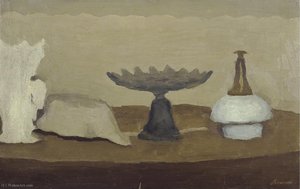
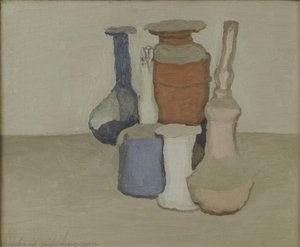
Untitled (865) is the Giorgio Morandi painting that draws the most eyes. After it, the eye goes to Self Portrait (1924) and Still Life (1950). Among the 49 works of Giorgio Morandi in our catalog, these 49 are the most famous, each a unique original presented with its year, its museum and the reason it endures.

1890 – 1964, Bologna Most works: Bavarian State Painting Collections

Top 10 paintings by Giorgio Morandi, through the gallery's eye

4
Natura morta metafisica (1918) by Giorgio Morandi

Natura morta metafisica

1918 · Oil On Canvas · Fondazione Magnani-Rocca, Traversole

In the quiet, shadowed corners of early 20th-century modernism, few works possess the unsettling magnetism of Giorgio Morandi’s Natura morta metafisica. Painted in 1918, this masterpiece serves as a profound departure from the serene, minimalist still lifes for which Morandi later became globally renowned. Instead, we are presented with a composition that breathes with the tension of Surrealism and the fractured geometry of Cubism. At first glance, the eye is…

Giorgio Morandi's famous paintings, numbers 11 to 49

The subjects that held Giorgio Morandi's eye

The four subjects that come back most often in these originals, each with its finest example.

The museums that keep Giorgio Morandi's originals

The 7 museums that hold the most of the paintings on this page.

Museum City Works by Giorgio Morandi Paintings from this list
Bavarian State Painting Collections, MunichBavarian State Painting Collections Munich 3 Still Life, Still Life, Still Life with Bottles
The Phillips Collection, Washington, D.C.The Phillips Collection Washington, D.C. 2 Still Life, Still Life
Pinacoteca di Brera, MilanPinacoteca di Brera Milan 1 Self Portrait
Fondazione Magnani-Rocca, TraversoleFondazione Magnani-Rocca Traversole 1 Natura morta metafisica
Thyssen-Bornemisza Museum, MadridThyssen-Bornemisza Museum Madrid 1 Flowers
Israel Museum, JerusalemIsrael Museum Jerusalem 1 Still Life with Bottles
Galleria Civica di Arte Moderna e Contemporanea Torino, TurinGalleria Civica di Arte Moderna e Contemporanea Torino Turin 1 Still life

Giorgio Morandi across the decades: one unique original for each

Works per decade

Pick a decade to see the original that defines it.

Giorgio Morandi's paintings: questions for the gallery

What is the single most famous work of Giorgio Morandi?Reveal the answer

Untitled (865). Self Portrait (1924) and Still Life (1950) come next.

Which ten paintings by Giorgio Morandi are the most famous?Reveal the answer

Untitled (865), Self Portrait, Still Life, Natura morta metafisica, Still life, Autoritratto, Still Life with Bottles and Pitcher, Still life with Drapery, Still Life of Vases on a Table and Houses of Campiaro in Grizzana. The ranking above gives each one's year and museum.

How many works by Giorgio Morandi are known?Reveal the answer

Our catalog holds 49 works by Giorgio Morandi, dated from 1915 to 1962.

Where can the most famous Giorgio Morandi originals be seen?Reveal the answer

Mostly in Bavarian State Painting Collections (Munich), The Phillips Collection (Washington, D.C.) and Pinacoteca di Brera (Milan). The museum table above lists them all.

During which period did Giorgio Morandi create the best-known paintings?Reveal the answer

In 1950s: 12 of the 49 works on this page were made then, Still Life among them.

Which famous Giorgio Morandi painting is the earliest, and which the latest?Reveal the answer

On this page, the earliest is Still Life with Bottles and Pitcher (1915) and the latest Still Life (1962).

What subjects did Giorgio Morandi favour?Reveal the answer

Still life (5), Italian art (4) and Geometric forms (3), across the 49 works on this page.

What materials did Giorgio Morandi paint with most?Reveal the answer

Oil On Canvas, for 2 of the 49 works on this page.

What Giorgio Morandi originals can I see at the Bavarian State Painting Collections?Reveal the answer

Still Life, Still Life and Still Life with Bottles: the Bavarian State Painting Collections, Munich holds 3 of the works on this page.

Giorgio Morandi: a portrait of the artist

A Life Submerged in Stillness

Giorgio Morandi, a name synonymous with quiet contemplation and subtle beauty, was an Italian painter and printmaker who dedicated his life to exploring the profound within the seemingly mundane. Born in Bologna in 1890, he remained deeply rooted in his native city throughout his existence, rarely venturing beyond its familiar landscapes. This geographical steadfastness mirrored a thematic consistency in his art—an unwavering focus on still life that would define his legacy. Morandi’s early life was marked by loss; the death of his father when he was young placed a significant responsibility upon him to support his mother and sisters, a circumstance that perhaps fostered an introspective nature reflected in his work. He entered the Accademia di Belle Arti di Bologna in 1907, initially excelling within its traditional framework, but soon began to diverge, seeking a more personal artistic language. His self-taught mastery of etching techniques, inspired by artists like Rembrandt, would become another crucial facet of his creative output alongside painting.

From Futurism to Metaphysics and Beyond

Morandi’s artistic journey wasn't one of abrupt revolutions but rather a gradual distillation of form and feeling. A pivotal trip to Florence in 1910 exposed him to the Renaissance masters—Giotto, Masaccio, Piero della Francesca, and Paolo Uccello—whose influence can be discerned in his early compositions’ careful attention to volume and spatial relationships. He briefly flirted with Futurism in 1914, drawn to its energy and dynamism, but quickly moved beyond its tenets, finding it ultimately incompatible with his own burgeoning aesthetic sensibilities. A more significant period of experimentation occurred between 1918 and 1922 when he engaged with the Metaphysical painting movement alongside Giorgio de Chirico and Carlo Carrà. This association encouraged a deeper exploration of form, space, and the enigmatic qualities of everyday objects, laying the groundwork for his signature style. However, Morandi ultimately transcended these influences, forging a path uniquely his own—one characterized by an almost monastic dedication to simplicity and nuance.

The Poetry of Ordinary Objects

Morandi’s art is defined by its singular focus: still life. He painted vases, bottles, jars, boxes, and occasionally landscapes with relentless consistency, yet never with repetition. Each arrangement was a new exploration of form, light, and color. His mastery lay not in depicting objects as they *are*, but rather in revealing their inherent presence—their weight, texture, and the subtle interplay of shadows that define their volume. He stripped away extraneous detail, reducing forms to their essential geometry, yet imbuing them with a profound sense of atmosphere. Subtle tonal variations were his hallmark; he employed muted palettes – grays, browns, ochres, and creams – to create an almost ethereal quality, evoking a feeling of quietude and introspection. A defining characteristic of his later work was the creation of an atmospheric haze that enveloped his subjects, softening edges and unifying the composition. This wasn’t merely about depicting objects; it was about capturing the *feeling* of being in their presence—the stillness of light, the weight of silence. He sought to find the universal within the particular, elevating humble objects to a level of poetic significance.

Legacy and Enduring Influence

Throughout his prolific career – encompassing over 1350 oil paintings, 133 etchings, and countless drawings and watercolors – Morandi received significant recognition, participating in prestigious exhibitions like the Venice Biennale and the Quadriennale in Rome. He was awarded first prize at the São Paulo Bienal in 1957, a testament to his growing international acclaim. However, perhaps his most lasting impact lies not in accolades but in his influence on subsequent generations of artists. His quiet, contemplative style anticipated the minimalist movement of the late 20th century, inspiring artists who sought to reduce painting to its essential elements. Morandi’s work offered a powerful counterpoint to the anxieties and upheavals of the modern world, providing viewers with a refuge—a space for contemplation and inner peace. He demonstrated that profound beauty could be found not in grand narratives or dramatic gestures, but in the subtle nuances of everyday life. His legacy continues to resonate today, reminding us of the power of stillness, simplicity, and the enduring allure of the ordinary.