The Enigma of Paolo Uccello: Bridging Gothic Tradition & Renaissance Innovation
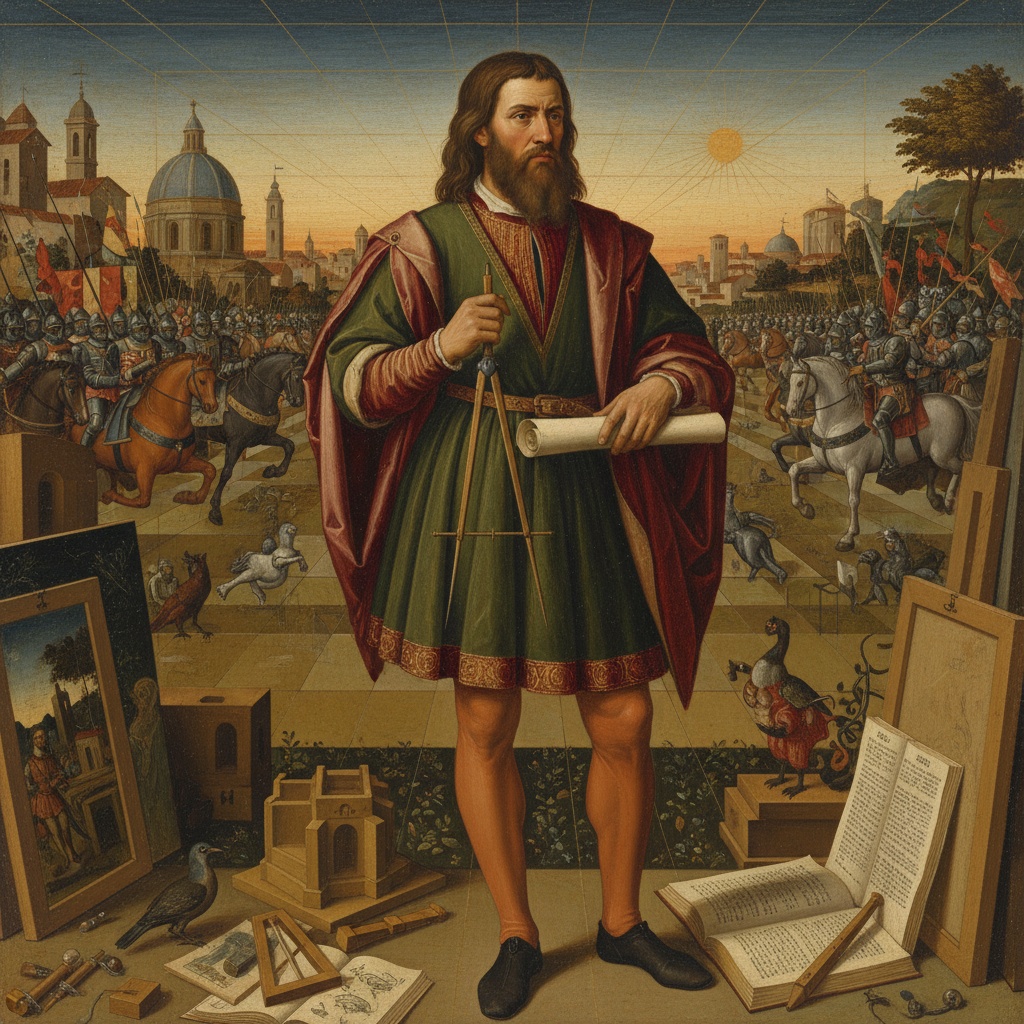
Paolo Uccello, a name that resonates with both admiration and a touch of mystification, occupies a unique position in the annals of Renaissance art. Born Paolo di Dono in 1397, near Florence, he wasn’t simply *a* painter; he was an obsessive investigator of visual space, a man captivated by the mathematical underpinnings of perception. While his contemporaries were increasingly embracing the humanist ideals and classical realism that defined the High Renaissance, Uccello remained tethered to the decorative elegance of the late Gothic style – yet, within this seemingly contradictory framework, he forged a path toward groundbreaking innovations in perspective. Giorgio Vasari, in his seminal Lives of the Most Excellent Painters, Sculptors, and Architects, famously portrayed Uccello as so consumed by his pursuit of perspective that he neglected all else, staying up late into the night lost in calculations. This anecdote, whether entirely accurate or not, speaks to a profound intellectual curiosity that set him apart.
Uccello’s early training under Lorenzo Ghiberti, creator of the magnificent bronze doors for the Florence Baptistery, undoubtedly shaped his aesthetic sensibilities. He absorbed the refined narrative style and sculptural composition characteristic of Ghiberti's workshop. However, Uccello wasn’t merely a follower; he possessed an independent spirit that led him to question established conventions. His friendship with Donatello further exposed him to the burgeoning Renaissance focus on realism and anatomical accuracy, yet his artistic trajectory remained distinctly his own – a fascinating synthesis of tradition and experimentation.
A Master of Perspective: Unveiling Uccello’s Mathematical Approach to Art
Linear or point-projection perspective (from Latin perspicere 'to see through') is one of two types of graphical projection perspective in the graphic arts; the other is parallel projection. Linear perspective is an approximate representation, gener...
The defining characteristic of Paolo Uccello's work is undoubtedly his pioneering exploration of linear perspective. Before the formalization of the principles by artists like Brunelleschi and Alberti, perspective was often intuitive and inconsistent. Uccello approached it as a rigorous mathematical problem, meticulously calculating vanishing points, horizon lines, and foreshortening to create an illusion of depth on a two-dimensional surface. This wasn’t simply about achieving realism; for Uccello, perspective was a means of ordering the world, imposing structure onto chaos. He believed that understanding the laws governing visual space was akin to unlocking divine secrets.
His dedication bordered on obsession. Vasari's account, though perhaps embellished, highlights this intense focus. Uccello wasn’t content with simply *representing* depth; he sought to *understand* it fundamentally. This pursuit led him to develop unique techniques for depicting receding planes and spatial relationships. He employed a variety of methods – from careful geometric constructions to the use of diminishing scale – all aimed at creating a convincing, albeit often stylized, sense of three-dimensionality.
‘St. George and the Dragon’ & ‘The Battle of San Romano’: Iconic Works and Their Revolutionary Techniques
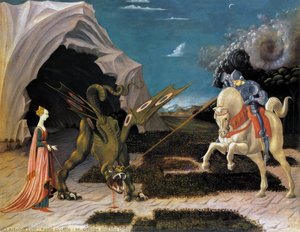 St. George and the Dragon
Discover Paolo Uccello’s ‘St. George & Dragon’! A Renaissance masterpiece showcasing innovative perspective & vibrant color. Own a stunning reproduction of this iconic 1456 artwork.
Perhaps no work exemplifies Uccello's mastery of perspective more vividly than ‘St. George and the Dragon’ (1456). The painting, commissioned for a Florentine family chapel, depicts the legendary saint slaying the dragon in a landscape that is both fantastical and meticulously constructed. The composition is striking: the receding ground plane, the carefully foreshortened lances and armor, and the dynamic arrangement of figures all contribute to a sense of depth and movement. However, it’s not merely the technical skill that captivates; it's the vibrant color palette and the decorative details – remnants of his Gothic training – that imbue the scene with a unique character.
The three panels representing The Battle of San Romano (c. 1456) further showcase Uccello’s innovative approach. These paintings, originally commissioned for the Palazzo Medici, depict episodes from a Florentine military victory. What sets these works apart is their unconventional treatment of space and form. The figures are arranged in fragmented compositions, almost as if viewed through multiple perspectives simultaneously. This creates a sense of dynamism and energy, but also challenges traditional notions of realism. Uccello prioritized clarity and visual impact over strict anatomical accuracy, resulting in a style that is both captivating and slightly unsettling.
Beyond Battles: Exploring Uccello's Frescoes and Religious Paintings
While ‘St. George’ and ‘San Romano’ are arguably his most famous works, Uccello’s artistic output extended far beyond these iconic battle scenes. His frescoes in the Chiostro Verde of Santa Maria Novella, depicting scenes from the Creation and the Fall, reveal a fascination with animal life and stylized landscapes. These early works demonstrate his commitment to decorative patterns and vibrant color schemes – hallmarks of the late Gothic tradition. The Scenes from the Life of Noah, also found in Santa Maria Novella, further illustrate this aesthetic sensibility.
His fresco of the *Funerary Monument to Sir John Hawkwood* (1436) in Florence Cathedral is another significant example of his unique style. The painting depicts the English mercenary leader as a heroic figure, but its composition and perspective are unconventional, creating a sense of theatrical grandeur rather than realistic representation. Uccello’s religious paintings, such as ‘The Birth of the Virgin’, demonstrate his ability to blend traditional iconography with his innovative techniques, resulting in works that are both devotional and visually striking.
Uccello’s Legacy: Influence on Renaissance Artists and Modern Interpretations
 Wikipedia: Paolo Uccello
Paolo Uccello ( oo-CHEL-oh, Italian: [ˈpaːolo utˈtʃɛllo]; 1397 – 10 December 1475), born Paolo di Dono, was an Italian Renaissance painter and mathematician from Florence who was notable for his pioneering work on visual perspective in art. In his bo...
Paolo Uccello's influence on subsequent generations of artists is often subtle but profound. While he didn’t establish a formal school of followers, his exploration of perspective inspired luminaries like Piero della Francesca, Leonardo da Vinci, and Albrecht Dürer to further investigate the mathematical principles governing visual space. His emphasis on clarity and compositional structure also resonated with later Renaissance painters.
In the 20th century, Uccello’s work experienced a renewed appreciation, particularly among Surrealist artists who admired his fragmented compositions and dreamlike imagery. His paintings were seen as precursors to modern abstraction, anticipating the deconstruction of form and space that characterized much of contemporary art. Today, Paolo Uccello stands as a testament to the power of intellectual curiosity and the enduring allure of artistic innovation. His work continues to captivate and inspire, reminding us that true mastery lies not in simply replicating reality but in understanding its underlying principles.
Discover more exceptional Renaissance masterpieces and explore the world of fine art reproductions at OriginalUniqueArt.com – where history comes to life on canvas.