Portrait of Fernando Botero

The 100 Most Famous Fernando Botero Paintings, Each One of a Kind

Updated October 2026 · ranked by our popularity score (searches, visits and orders for each work) · 279 works by Fernando Botero in our catalogue

In short

The President and First Lady is the Fernando Botero painting that draws the most eyes. After it, the eye goes to la collectionneuse and la famille. Among the 279 works of Fernando Botero in our catalog, these 100 are the most famous, each a unique original presented with its year, its museum and the reason it endures.

1932 – 2023, Medellín Boterismo Most works: National Museum of Colombia

Top 10 paintings by Fernando Botero, through the gallery's eye

1
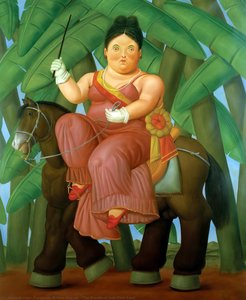
The President and First Lady by Fernando Botero

The President and First Lady

Oil On Canvas

To stand before a work by Fernando Botero is not merely to observe paint on canvas; it is to encounter a celebration of form itself. His signature style, often termed Boterismo, immediately arrests the viewer with its magnificent exaggeration. Here, in "The President and First Lady," this characteristic volume takes center stage. The figures—the woman poised elegantly upon the horse, the attendant figures flanking the scene—are rendered with a delightful,…

2
la collectionneuse by Fernando Botero

la collectionneuse

Oil On Canvas

The gaze of the viewer meets the presence of la collectionneuse, a work that carries the unmistakable weight and volume of its creator. Fernando Botero, born in Medellín, Colombia, on April 19, 1932, breathes life into this scene through his singular way of seeing the world. The canvas holds a quiet, heavy energy that feels as though it has always existed in this specific, rounded state.

3
la famille by Fernando Botero

la famille

Oil On Canvas

To stand before Fernando Botero’s depiction of la famille is to be enveloped in an atmosphere of profound, almost monumental warmth. This painting transcends a mere portrait; it is a celebration of connection, a visual ode to the enduring bond that ties generations together. The composition centers on a family unit—a mother seated between her two children, all gathered beneath the sheltering canopy of a tree. Botero masterfully captures not…

4
scene de famille by Fernando Botero

scene de famille

Oil On Canvas

To gaze upon Fernando Botero’s Scene de Famille is to be enveloped in an atmosphere of profound, yet utterly comfortable, domesticity. This painting transcends a mere depiction; it captures the very essence of togetherness—the quiet moments shared between loved ones that form the bedrock of human experience. The composition centers around a family unit of four—a man, a woman, and two children—all settled into a tableau of relaxed intimacy. Botero’s…

5
mona lisa by Fernando Botero

mona lisa

Oil On Canvas

Introduction to the Artist and his Style Fernando Botero Angulo, a renowned Colombian figurative artist, is celebrated for his unique style characterized by voluminous, exaggerated forms. His work has been exhibited worldwide and can be found in prestigious museums such as the Metropolitan Museum of Art in New York City and the Museo de Arte Moderno in Bogotá. At AllPaintingsStore.com, we offer handmade oil paintings reproductions of famous artwork, including…

6
Frank Lloyd et sa famille à paradise island by Fernando Botero

Frank Lloyd et sa famille à paradise island

Oil On Canvas

In this scene, we find ourselves on a tropical shore, observing a quiet moment shared by a family of four. Two adults and two children are positioned amidst the soft sands of paradise island, their presence anchored to the landscape. There is a certain weight to the figures; they do not merely occupy the beach but seem to emerge from it, their rounded silhouettes mirroring the organic curves of the…

7
les musiciens by Fernando Botero

les musiciens

Oil On Canvas

The scene unfolds through les musiciens, a work that carries the unmistakable presence of its creator, Fernando Botero. Created in 1986, this piece captures a moment of quiet musicality. The artist, who was born in Medellín, Colombia, in 1932, brings a specific sense of weight and volume to the figures within the frame. Every shape feels substantial, as if the air in the room has a physical density that holds…

8
Dog Turning a Corner (1980) by Fernando Botero

Dog Turning a Corner

1980 · Oil On Canvas

In the masterful hands of Fernando Botero, a simple street corner is transformed into a theatrical stage where life unfolds with exaggerated grace and exuberant color. Dog Turning a Corner invites the viewer into a sun-drenched village scene, captured with the unmistakable warmth that defines the Colombian master's vision. The painting presents a bustling tableau of small-town life, where yellow buildings glow under an unseen sun, casting a nostalgic radiance…

9
Walk in the hills (1977) by Fernando Botero

Walk in the hills

1977 · Oil On Canvas

In the vast landscape of twentieth-century Latin American art, few figures command attention with as much whimsical gravity as Fernando Botero. His 1977 masterpiece, Walk in the hills, serves as a profound window into the artist's signature aesthetic, often referred to as "Boterismo." At first glance, the painting presents a scene of quietude: a solitary figure, draped in heavy, dark garments and crowned with a black hat, stands amidst the…

10
July 20th (1984) by Fernando Botero

July 20th

1984 · Acrylic On Canvas · National Museum of Colombia, Bogota

Fernando Botero’s “July 20th,” painted in 1984, isn't merely a depiction of two figures on a street; it’s a carefully constructed tableau brimming with quiet drama and subtle social commentary. The painting immediately arrests the eye with its monumental scale – a characteristic hallmark of Botero’s signature style, often referred to as “Boterismo.” Here, however, the exaggeration isn't purely for spectacle. Instead, it serves to amplify the emotional weight of…

Fernando Botero's famous paintings, numbers 11 to 100

11Quatre Musiciens by Fernando BoteroQuatre Musiciens 12couple dansant by Fernando Boterocouple dansant 13monna lisa by Fernando Boteromonna lisa 14danse en colombie by Fernando Boterodanse en colombie 15tablao flamenco by Fernando Boterotablao flamenco 16le chasseur by Fernando Boterole chasseur 17pastèques et oranges by Fernando Boteropastèques et oranges 18orange by Fernando Boteroorange 19tête de christ by Fernando Boterotête de christ 20oranges by Fernando Boterooranges 21nature morte à la soupe verte by Fernando Boteronature morte à la soupe verte 22les soeurs by Fernando Boteroles soeurs 23untitled (1533) by Fernando Boterountitled (1533) 24Mona Lisa, Age Twelve (1959) by Fernando BoteroMona Lisa, Age Twelve1959 25Camera degli Sposi (Homage to Mantegna) II (1961) by Fernando BoteroCamera degli Sposi (Homage to Mantegna) II1961 26The Street (1980) by Fernando BoteroThe Street1980 27quatre femmes by Fernando Boteroquatre femmes 28The First Lady (1969) by Fernando BoteroThe First Lady1969 · Bavarian State Painting Collections 29The Widower (1968) by Fernando BoteroThe Widower1968 30Title translation: The Family (1992) by Fernando BoteroTitle translation: The Family1992 · Museum of Latin American Art 31untitled (1026) by Fernando Boterountitled (1026) 32untitled (5715) by Fernando Boterountitled (5715) 33mademoiselle Rivière (d'après Ingres) by Fernando Boteromademoiselle Rivière (d'après Ingres) 34autoportrait by Fernando Boteroautoportrait 35Louis XIV et Marie-Antoinette en visite à Medellin by Fernando BoteroLouis XIV et Marie-Antoinette en visite à Medellin 36autoportrait en coquistador espagnol by Fernando Boteroautoportrait en coquistador espagnol 37matador by Fernando Boteromatador 38sans titre by Fernando Boterosans titre 39la cuisine by Fernando Boterola cuisine 40le pape Léon X (d'après Raphael) by Fernando Boterole pape Léon X (d'après Raphael) 41cardinal by Fernando Boterocardinal 42baigneuse sur la plage by Fernando Boterobaigneuse sur la plage 43rubens et sa femme by Fernando Boterorubens et sa femme 44Federico da Montefeltro (d'après Piero della Francesca) by Fernando BoteroFederico da Montefeltro (d'après Piero della Francesca) 45jeune fille sur l'ane by Fernando Boterojeune fille sur l'ane 46street by Fernando Boterostreet 47Donna con cane by Fernando BoteroDonna con cane 48I coniugi Arnolfini da Van Eyck by Fernando BoteroI coniugi Arnolfini da Van Eyck 49pedro à cheval by Fernando Boteropedro à cheval 50mort de Pablo Escobar by Fernando Boteromort de Pablo Escobar 51les couturières by Fernando Boteroles couturières 52Battista Sforza (d'après Piero della Francesca) by Fernando BoteroBattista Sforza (d'après Piero della Francesca) 53danseuse à la barre by Fernando Boterodanseuse à la barre 54untitled (3654) by Fernando Boterountitled (3654) 55untitled (5210) by Fernando Boterountitled (5210) 56untitled (4876) by Fernando Boterountitled (4876) 57untitled (7047) by Fernando Boterountitled (7047) 58untitled (3817) by Fernando Boterountitled (3817) 59la dolorosa by Fernando Boterola dolorosa 60untitled (4978) by Fernando Boterountitled (4978) 61le poète by Fernando Boterole poète 62untitled (8837) by Fernando Boterountitled (8837) 63untitled (1250) by Fernando Boterountitled (1250) 64untitled (889) by Fernando Boterountitled (889) 65autoportrait le jour de la communion by Fernando Boteroautoportrait le jour de la communion 66petite fille au jardin by Fernando Boteropetite fille au jardin 67autoportrait le jour de la 1ère communion by Fernando Boteroautoportrait le jour de la 1ère communion 68portrait d'une jeune indienne by Fernando Boteroportrait d'une jeune indienne 69mona lisa à l'age de douze ans by Fernando Boteromona lisa à l'age de douze ans 70prêtre allongé by Fernando Boteroprêtre allongé 71nature morte de fruits by Fernando Boteronature morte de fruits 72The Life of Honorius III (1961) by Fernando BoteroThe Life of Honorius III1961 73Still Life on Blue (1961) by Fernando BoteroStill Life on Blue1961 74Sailor Boy (1969) by Fernando BoteroSailor Boy1969 · Tucson Museum of Art 75The Prima Donna (1967) by Fernando BoteroThe Prima Donna1967 · Royal Museum of Fine Arts Antwerp 76The Presidential Family (1967) by Fernando BoteroThe Presidential Family1967 77The Hunter (1980) by Fernando BoteroThe Hunter1980 78Guitar Lesson (1960) by Fernando BoteroGuitar Lesson1960 · National Museum of Colombia 79la toilette. (1989) by Fernando Boterola toilette.1989 80hommage à Bonnard by Fernando Boterohommage à Bonnard 81rubens et sa femme by Fernando Boterorubens et sa femme 82chambre avec jeux d'enfants by Fernando Boterochambre avec jeux d'enfants 83le bain des évêques dans un fleuve by Fernando Boterole bain des évêques dans un fleuve 84l'étude de vermeer by Fernando Boterol'étude de vermeer 85Venus Sleeping by Fernando BoteroVenus Sleeping 86untitled (3028) by Fernando Boterountitled (3028) 87untitled (4139) by Fernando Boterountitled (4139) 88untitled (9460) by Fernando Boterountitled (9460) 89untitled (1762) by Fernando Boterountitled (1762) 90untitled (5988) by Fernando Boterountitled (5988) 91femme en pleurs by Fernando Boterofemme en pleurs 92untitled (5739) by Fernando Boterountitled (5739) 93untitled (6101) by Fernando Boterountitled (6101) 94En Blanco Rosa Y Negro by Fernando BoteroEn Blanco Rosa Y Negro 95untitled (3457) by Fernando Boterountitled (3457) 96untitled (353) by Fernando Boterountitled (353) 97untitled (478) by Fernando Boterountitled (478) 98untitled (9508) by Fernando Boterountitled (9508) 99untitled (1140) by Fernando Boterountitled (1140) 100untitled (1629) by Fernando Boterountitled (1629)

The subjects that held Fernando Botero's eye

The four subjects that come back most often in these originals, each with its finest example.

The museums that keep Fernando Botero's originals

The 5 museums that hold the most of the paintings on this page.

Museum City Works by Fernando Botero Paintings from this list
National Museum of Colombia, BogotaNational Museum of Colombia Bogota 2 July 20th, Guitar Lesson
Bavarian State Painting Collections, MunichBavarian State Painting Collections Munich 1 The First Lady
Museum of Latin American Art, Long BeachMuseum of Latin American Art Long Beach 1 Title translation: The Family
Tucson Museum of Art, TucsonTucson Museum of Art Tucson 1 Sailor Boy
Royal Museum of Fine Arts Antwerp, AntwerpRoyal Museum of Fine Arts Antwerp Antwerp 1 The Prima Donna

Fernando Botero across the decades: one unique original for each

Works per decade

Pick a decade to see the original that defines it.

Fernando Botero's paintings: questions for the gallery

What is the single most famous work of Fernando Botero?Reveal the answer

The President and First Lady. la collectionneuse and la famille come next.

Which ten paintings by Fernando Botero are the most famous?Reveal the answer

The President and First Lady, la collectionneuse, la famille, scene de famille, mona lisa, Frank Lloyd et sa famille à paradise island, les musiciens, Dog Turning a Corner, Walk in the hills and July 20th. The ranking above gives each one's year and museum.

How many works by Fernando Botero are known?Reveal the answer

Our catalog holds 279 works by Fernando Botero, dated from 1959 to 1992.

Where can the most famous Fernando Botero originals be seen?Reveal the answer

Mostly in National Museum of Colombia (Bogota), Bavarian State Painting Collections (Munich) and Museum of Latin American Art (Long Beach). The museum table above lists them all.

During which period did Fernando Botero create the best-known paintings?Reveal the answer

In 1960s: 9 of the 100 works on this page were made then, Camera degli Sposi (Homage to Mantegna) II among them.

Which famous Fernando Botero painting is the earliest, and which the latest?Reveal the answer

On this page, the earliest is Mona Lisa, Age Twelve (1959) and the latest Title translation: The Family (1992).

What subjects did Fernando Botero favour?Reveal the answer

Woman (13), Portrait (9) and Volume (8), across the 100 works on this page.

What materials did Fernando Botero paint with most?Reveal the answer

Oil On Canvas, for 21 of the 100 works on this page.

Which movement does the work of Fernando Botero belong to?Reveal the answer

Boterismo, judging by the originals on this page.

What Fernando Botero originals can I see at the National Museum of Colombia?Reveal the answer

July 20th and Guitar Lesson: the National Museum of Colombia, Bogota holds 2 of the works on this page.

Fernando Botero: a portrait of the artist

Early Life, Family and Training

Fernando Botero was born on April 19, 1932, in Medellín, Colombia. His early years were shaped by the quiet, steady rhythms of a household working to make ends meet. His father, David Botero, earned a living as a salesman, often traveling by horseback to reach his customers. His mother, Flora Angulo, worked as a seamstress, providing the necessary support for the family. These early surroundings provided a sense of place that would remain with him long after he left the city.

In his youth, Fernando Botero spent several years attending a school for matadors. He was trained in the movements and traditions of the bullring, but his interests eventually pulled him away from the arena. By the age of 16, his focus had shifted toward drawing and sketching. In 1948, his first illustrations were published in the Sunday supplement of El Colombiano, marking the beginning of his public presence through his visual work.

Artistic Training and European Travels

In 1952, Botero used the money earned from his gallery sales to sail toward Europe. His first stop was Barcelona, but he soon moved on to Madrid. It was in Spain that he began to study at the Academia de San Fernando. He spent time in the Prado Museum, where he would sit and copy the works of Goya and Velázquez. This habit of studying the Old Masters became a constant part of his practice.

His studies eventually took him to Florence, where he attended the Academia de San Marcos. By 1953, he had moved to Paris. He spent much of his time in the Louvre, watching the way light and form settled on the figures in the museum's halls. These years in Europe were spent moving between cities like Madrid, Florence, and Paris, absorbing the weight and presence of classical art.

The Development of Boterismo Style

The shapes in his work carry a specific weight. This approach, often called Boterismo, focuses on people and figures rendered in large, exaggerated volumes. Rather than focusing on thin lines, the focus remains on round, corpulent forms that occupy the space with a heavy presence. These figures possess a certain mass that feels physical, as if the paint itself has gained weight. He often uses bright colors and bold outlines to define these shapes, making the subjects stand out against their backgrounds.

By about 1964, this interest in volume moved from the canvas into three dimensions. He began creating sculptures, translating that same sense of expansion into bronze and other materials. The roundedness seen in his paintings found a new life in these solid forms, allowing the exaggerated proportions to exist in public spaces. The work remains focused on the sheer physicality of the subject, whether it is a human figure or an animal.

Key Works and Artistic Themes

His work often centers on the weight of the human form and the quiet tension within social settings. In Mona Lisa, Age Twelve (1959), the subject is rendered with a specific, rounded presence that moves away from traditional proportions. This focus on volume became a way to explore more complex social structures. In The Presidential Family (1967), the exaggerated shapes of the figures offer a subtle look at political elites, using mass to comment on the people in power. He used these shapes to address both the joy of life and the heaviness of conflict.

The themes often shift between celebration and the reality of violence. Dancing in Colombia (1980) captures a lively scene of musicians and dancers, using thick layers of paint to give the figures a tactile, heavy quality. In contrast, his later works often confronted the darker aspects of his homeland. The Death of Pablo Escobar (1999/2006) and his various series addressing the abuses in Abu Ghraib show a willingness to use his signature style to confront difficult truths. Even his later pieces, like La paloma de la paz (2016), carry a sense of monumental weight, whether the subject is a person, an animal, or a symbol of peace.

Later Years and Death

The later decades of his life were spent moving between several international hubs. He maintained residences in New York City, Paris, and Monte Carlo, often returning to Medellín to stay connected to his roots. His presence in public spaces grew as his bronze sculptures were placed in parks and plazas across various continents. Even as he aged, his work continued to address heavy subjects, such as the social and political tensions in Colombia and the events at the Abu Ghraib prison.

In his final years, he lived in the Principality of Monaco. He passed away there on September 15, 2023, at the age of 91. The cause of death was complications from pneumonia. His departure marked the end of a long career spent observing the human form and the complexities of social life through his specific lens of volume and proportion.

Legacy and Influence

His presence in the public sphere was constant. In New York City, his sculptures occupy spaces like Park Avenue, where the heavy, rounded forms exist alongside the city's architecture. In Colombia, he became a national treasure, a figure whose work was woven into the daily life of the country. He was the most recognized and quoted artist from Latin America during his lifetime, a fact reflected in the way his figures became familiar to people across many borders.

His commitment to his home country was visible through his large-scale donations. In 2000, he gave 208 art pieces to the Bank of the Republic. This act helped shape the cultural landscape of Bogotá. He also shared much of his personal collection, donating 123 pieces and 85 pieces to the Museo Botero. These contributions ensured that his specific way of seeing the world remained accessible to those who came after him.

Where to See the Works Today

His presence is felt in the quiet corners of Bogotá, specifically within the La Candelaria neighborhood. The Museo Botero holds a large part of his output, a collection that grew from his own decision to donate many of his pieces to the nation. In Medellín, the Museum of Antioquia also keeps a significant number of his works, maintaining a connection to his roots. These spaces allow for a slow look at the way he handled volume and the weight of his subjects.

Beyond Colombia, his paintings can be found in the Metropolitan Museum of Art in New York City. There, the scale of his figures takes on a different character against the backdrop of a global institution. His bronze sculptures have also found permanent homes in public spaces, inviting people to walk around them in the streets of Florence and Medellín. These heavy, rounded forms exist in the open air, subject to the light and the movement of the city.