Boterismo
oranges (Fernando Botero)
Fernando Botero (1932–2023) made oranges. It belongs to the Boterismo movement. It is made in oil.
- Oil

 Preview

 Hand Made Oil Painting
 Send
 Share
 Fact sheet


 Download
 Similars
 X-Ray
 Diaporama
 Q&A

 Stats
oranges, in brief
- Title
- oranges
- Artist
- Fernando Botero (1932–2023)
- Artist born in
- Medellín, Colombia
- Medium
- Oil
- Movement
- Boterismo
- Period
- Contemporary
- Subject
- oranges, bread, fruit, table, still life
What does oranges depict?
The Sensual Geometry of Still Life
In the vibrant world of Fernando Botero, even the simplest objects undergo a profound transformation. His painting, oranges, invites the viewer into a tactile universe where volume and color reign supreme. At first glance, the composition presents a classic still life: a collection of citrus fruits and a rustic loaf of bread resting upon a table. However, through Botero's inimitable lens, these are not merely foodstuffs; they are sculptural entities. The oranges, rendered with a magnificent sense of weight and roundness, command the center of the canvas, their skins glowing with an inner warmth that seems to radiate against the more muted tones of the background. The presence of the bread adds a grounded, earthy texture to the scene, creating a delicious tension between the juicy, bright acidity of the fruit and the dry, porous crust of the baked good.
The technique employed here is a masterclass in what has come to be known globally as Boterismo. Rather than focusing on the delicate, fleeting light found in Impressionism, Botero utilizes smooth, deliberate brushwork to emphasize mass and substance. There is an almost architectural quality to the way the oranges are placed; they possess a gravity that makes them feel permanent and monumental. This exaggerated volume does not distort reality so much as it celebrates the essence of form. For the collector or interior designer, this piece offers a striking visual anchor, providing a sense of abundance and stability that can breathe life and a sophisticated, playful energy into any curated space.
A Celebration of Form and Vitality
Beyond the surface level of fruit and bread, oranges serves as a meditation on the beauty of abundance. Botero’s work often carries an underlying sense of joy and a celebration of life's sensory pleasures. The way the light catches the curves of the citrus creates a rhythmic movement across the table, guiding the eye from the large, central fruit to the smaller, scattered pieces that populate the periphery. This arrangement suggests a bountiful harvest, evoking feelings of comfort, prosperity, and the simple delights of the domestic sphere. It is an art piece that does not demand intellectual struggle but rather offers an emotional embrace.
For those looking to integrate fine art into a modern or classical interior, this reproduction serves as a versatile masterpiece. Its bold color palette—dominated by warm oranges, yellows, and deep ochres—complements a wide variety of decor styles, from contemporary minimalist settings to more traditional, opulent rooms. The painting acts as a window into a world where everything is larger than life, encouraging the viewer to slow down and appreciate the magnificent weight of the everyday. Owning such a piece is not just about decoration; it is about inviting a sense of exuberant vitality and timeless Colombian artistry into one's personal sanctuary.
High-resolution images of oranges

Protected by copyright: these files are for personal reference, not a licence to republish.
Fernando Botero, oranges.
Questions on oranges, answered
What is "oranges" made with?
Fernando Botero used the oil technique for "oranges". The technique defines the material nature of the original work.
What does "oranges" by Fernando Botero depict?
The subjects of "oranges" are oranges, bread, fruit, table, still life.
Can the image of "oranges" by Fernando Botero be freely reproduced?
"oranges" by Fernando Botero is still protected by copyright. This status governs how the image of the work may be reproduced.
Which artist is "oranges" attributed to?
The artist behind "oranges" is Fernando Botero. The work is catalogued under Fernando Botero's name.
What style does "oranges" belong to?
"oranges" by Fernando Botero belongs to the Boterismo movement. This movement provides the stylistic context of the work.
What stage of Fernando Botero's development does "oranges" represent?
"oranges" represents the Mature Period of Fernando Botero.
Is "oranges" by Fernando Botero in the public domain, and why?
"oranges" by Fernando Botero is still protected by copyright. Copyright terms are measured from the artist's death, and Fernando Botero died in 2023.
Where does "oranges" sit within Fernando Botero's body of work?
Within Fernando Botero's output, "oranges" sits in the Boterismo style, alongside the themes of baroque splendor influence, boterismo voluminous style, vibrant still life, exploration of form, latin american art history.
Is "oranges" typical of what Fernando Botero usually created?
"oranges" depicts oranges, bread, fruit, table, still life, while Fernando Botero's recorded themes are baroque splendor influence, boterismo voluminous style, vibrant still life, exploration of form, latin american art history. Comparing the two shows how the work relates to the artist's usual subjects.
About the artist, Fernando Botero

1932–2023, Colombia
Fernando Botero
Early Life, Family and Training Fernando Botero was born on April 19, 1932, in Medellín, Colombia. His early years were shaped by the quiet, steady rhythms of a household working to make ends meet. His father, David Botero, earned a living as a salesman, often traveling by horseback to reach his customers. His mother, Flora Angulo, worked as a seamstress, providing the necessary support for the family.
Also by Fernando Botero
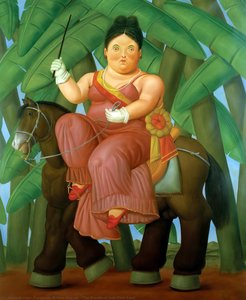 The President and First Lady
 la collectionneuse
 la famille
 scene de famille
Essays around oranges
 25 Masterpieces by Francisco de Zurbarán: The King of Spanish Baroque TenebrismImmerse yourself in the dramatic world of Francisco de Zurbarán. Explore 25 iconic Spanish Baroque masterpieces defined by intense tenebris…
 Citrus on Canvas: The Evolution of Orange Tones from Dutch Stilleven to ImpressionismExplore the evolution of citrus tones from Dutch masters to Impressionism. Trace this chromatic history through expert art analysis.
 Fernando Botero: Celebrating Volume, Form & Colombian IdentityExplore the captivating world of Fernando Botero! Discover his iconic 'Boterismo' style, Colombian influences, investment potential & lasti…