Portrait of Dirck van Delen

Dirck van Delen Paintings: The 57 Most Famous, Through a Gallery's Eye

Updated November 2026 · ranked by our popularity score (searches, visits and orders for each work) · 57 works by Dirck van Delen in our catalogue

In short

To the gallery's eye, Dirck van Delen's most famous painting is A musical company in a Renaissance hall (1636), whose original hangs in the Museum Boijmans Van Beuningen, Rotterdam. Iconoclasm in a Church (1630) and A colonnade. Part of a seven-part deorative sequence (1630) complete the trio every eye recognises. Of the 57 works by Dirck van Delen in our catalog, the gallery presents the 57 most famous below, each original with its year, its museum and what makes it unique.

1605 – 1671, Heusden Baroque Most works: Rijksmuseum

The gallery's top 10 Dirck van Delen paintings

1
A musical company in a Renaissance hall (1636) by Dirck van Delen

A musical company in a Renaissance hall

1636 · Oil On Canvas · Museum Boijmans Van Beuningen, Rotterdam

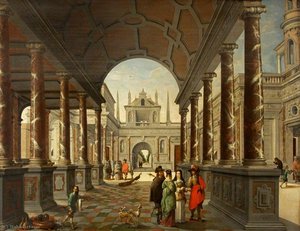
A checkered floor of stone and shadow stretches toward a distant, imagined horizon. In this Renaissance hall, the geometry of the room dictates the movement of the soul. Light spills from unseen windows on the left, catching the sharp edge of a lace collar and the heavy sheen of satin. The air feels still, held in place by massive columns and the weight of dark, polished wood. Figures gather in…

2
Iconoclasm in a Church (1630) by Dirck van Delen

Iconoclasm in a Church

1630 · Oil On Panel · Rijksmuseum, Amsterdam

Dirck van Delen painted Iconoclasm in a Church in 1630. The work presents an imagined scene of iconoclasm within a church interior. It captures a moment of religious upheaval, focusing on the destruction of sacred objects and the disruption of ecclesiastical order.

3
A colonnade. Part of a seven-part deorative sequence (1630) by Dirck van Delen

A colonnade. Part of a seven-part deorative sequence

1630 · Oil On Canvas · Rijksmuseum, Amsterdam

A colonnade. Part of a seven-part deorative sequence is an oil on canvas by Dirck van Delen. The work is dated 1630. It is also known by the title Gallery of a Palace with Ornamental Architecture and Columns. This painting was designed to function as part of a larger whole, serving as one piece of a seven-part wall decoration intended for a room in a palace.

4
The tomb of a Lord from the Van Tuyll van Serooskerken-family (1634) by Dirck van Delen

The tomb of a Lord from the Van Tuyll van Serooskerken-family

1634 · Oil On Panel · Staatliche Kunsthalle Karlsruhe, Carlsruhe

In this 1634 work, we find ourselves standing within a space that feels both profoundly real and entirely imagined. Dirck van Delen, a painter who specialized in the construction of architectural fantasies, has crafted a monumental funerary monument for a member of the Van Tuyll van Serooskerken family. The scene is defined by a rigorous linear perspective that draws the eye deep into a grand, silent interior. A sense of…

5
An Architectural Fantasy (1634) by Dirck van Delen

An Architectural Fantasy

1634 · Oil · National Gallery, London

The scene unfolds within An Architectural Fantasy, a work painted by Dirck van Delen in 1634. This composition presents an idealised city square, where the mathematical precision of perspective and proportion meets the shifting play of light and shade. The space feels vast and structured, inviting the eye to wander through a world of imagined grandeur and architectural order.

6
The Real Tennis Players (1626) by Dirck van Delen

The Real Tennis Players

1626 · Oil On Panel

The Real Tennis Players is a work by Dirck van Delen, an artist who emerged from Heusden, Netherlands. This particular piece dates to about 1626, a period during which the artist was establishing his presence within the Dutch Golden Age. Van Delen, who lived from 1605 to 1671, focused his attention on the intricate details of architectural spaces and the social life contained within them.

7
Architectural Fantasy with Figures (1633) by Dirck van Delen

Architectural Fantasy with Figures

1633 · Oil · Noordbrabants Museum, 's-Hertogenbosch

Architectural Fantasy with Figures emerges from the mind of Dirck van Delen, a painter who crafts grand, imagined spaces that challenge the boundaries of reality. This work invites the viewer into a structured world of palatial scale and mathematical precision. The artist, born in Heusden, Netherlands, in 1605, spent his life building these illusions of stone and light. He remains a significant figure of the Dutch Golden Age, having lived…

8
Gallant Scene in a Palace (1633) by Dirck van Delen

Gallant Scene in a Palace

1633 · Oil On Panel · Petit Palais, Paris

Gallant Scene in a Palace is a work by Dirck van Delen, executed in 1633. The artist, born in Heusden, Netherlands, in 1605, spent his life crafting the geometry of imagined spaces. He died in 1671, leaving behind a legacy of structured illusions and precise perspectives.

9
An Interior with Ladies and Cavaliers (1629) by Dirck van Delen

An Interior with Ladies and Cavaliers

1629 · Oil On Canvas · National Gallery of Ireland, Dublin City

In the quiet, structured world of 1629, An Interior with Ladies and Cavaliers emerges from the brush of Dirck van Delen. This work invites the viewer into an intimate interior where genre scenes unfold amidst the grandeur of a private space. The scene captures a moment of social grace, pulling us into a setting where the architecture itself feels like a silent participant in the gathering.

10
Architectural Interior at Night with the Priests of Bel (1628) by Dirck van Delen

Architectural Interior at Night with the Priests of Bel

1628 · Oil On Canvas · Rhode Island School of Design Museum of Art, Providence

Architectural Interior at Night with the Priests of Bel by Dirck van Delen depicts a gathering of priests or religious figures within a large interior at night. The composition is structured around a deep linear perspective that directs the viewer's gaze through a series of receding classical arches and colonnades. These architectural elements lead toward a distant, dimly lit interior. The use of lines is rigorous throughout the scene, with…

Dirck van Delen paintings, ranked 11 to 57

11Architectural Scene: A Palace Court (1627) by Dirck van DelenArchitectural Scene: A Palace Court1627 · Rhode Island School of Design Museum of Art 12Allegory on the suppression of religious freedom in the Netherlands under the Duke of Alva; the 17 Dutch provincial virgins kneeling for Alva, Granvelle and the pope, in the background the decapitation of Egmond and Hoorne on the market in Brussels (1629) by Dirck van DelenAllegory on the suppression of religious freedom in the Netherlands under the Duke of Alva; the 17 Dutch provincial virgins kneeling for Alva, Granvelle and the pope, in the background the decapitation of Egmond and Hoorne on the market in Brussels1629 · Museum Catharijneconvent 13Architectural fantasy with figures (1633) by Dirck van DelenArchitectural fantasy with figures1633 14Fantasy architecture with an elegant couple (1627) by Dirck van DelenFantasy architecture with an elegant couple1627 · Noordbrabants Museum 15Fantasy architecture with two elegant couples (1633) by Dirck van DelenFantasy architecture with two elegant couples1633 · Noordbrabants Museum 16Interior of Church (1635) by Dirck van DelenInterior of Church1635 · Royal Museum of Fine Arts Antwerp 17Distinguished Dinner Company in an Interior (1631) by Dirck van DelenDistinguished Dinner Company in an Interior1631 · Nationalmuseum 18A palatial interior with ladies and gentleman feasting, entertained by Carnival mummers (1632) by Dirck van DelenA palatial interior with ladies and gentleman feasting, entertained by Carnival mummers1632 19Fantasy architecture with four elegantly dressed women on the steps of a ramp (1627) by Dirck van DelenFantasy architecture with four elegantly dressed women on the steps of a ramp1627 · New York Historical Society 20A Seven-Part Decorative Sequence: An Interior, Dirck van Delen, 1630 - 1632 (1632) by Dirck van DelenA Seven-Part Decorative Sequence: An Interior, Dirck van Delen, 1630 - 16321632 · Rijksmuseum 21Colonnade with people and playing children (1637) by Dirck van DelenColonnade with people and playing children1637 22Conversation outside a Palace (1636) by Dirck van DelenConversation outside a Palace1636 · Statens Museum For Kunst 23Company at a Palace (1645) by Dirck van DelenCompany at a Palace1645 · Statens Museum For Kunst 24Christ Healing at the Pool of Bethesda (1637) by Dirck van DelenChrist Healing at the Pool of Bethesda1637 · Statens Museum For Kunst 25Elegant Company in Front of a Palace (1644) by Dirck van DelenElegant Company in Front of a Palace1644 · Statens Museum For Kunst 26Susanna and the two elders (1640) by Dirck van DelenSusanna and the two elders1640 · Museum Boijmans Van Beuningen 27A Family beside the Tomb of Prince William I in the Nieuwe Kerk, Delft (1645) by Dirck van DelenA Family beside the Tomb of Prince William I in the Nieuwe Kerk, Delft1645 · Rijksmuseum 28Baroque church interior with a friar and peasants (1645) by Dirck van DelenBaroque church interior with a friar and peasants1645 29Courtyard of a palace (1636) by Dirck van DelenCourtyard of a palace1636 · Staatliche Kunsthalle Karlsruhe 30Church Interior with the Parable of the Pharisee and the Publican (Luke 18:9-14) (1653) by Dirck van DelenChurch Interior with the Parable of the Pharisee and the Publican (Luke 18:9-14)1653 31Interior of a Gothic Church, Dirck van Delen, 1641 (1641) by Dirck van DelenInterior of a Gothic Church, Dirck van Delen, 16411641 · Rijksmuseum 32The Great Hall of the Binnenhof in The Hague (1651) by Dirck van DelenThe Great Hall of the Binnenhof in The Hague1651 · Rijksmuseum 33Great Garden Palace (1640) by Dirck van DelenGreat Garden Palace1640 · Kunsthistorisches Museum 34A Seven-Part Decorative Sequence: An Outdoor Stairway, Dirck van Delen, 1630 - 1632 (1632) by Dirck van DelenA Seven-Part Decorative Sequence: An Outdoor Stairway, Dirck van Delen, 1630 - 16321632 · Rijksmuseum 35A Seven-Part Decorative Sequence: An Outdoor Stairway, Dirck van Delen, 1630 - 1632 (1632) by Dirck van DelenA Seven-Part Decorative Sequence: An Outdoor Stairway, Dirck van Delen, 1630 - 16321632 · Rijksmuseum 36A Seven-Part Decorative Sequence: An Outdoor Stairway, Dirck van Delen, 1630 - 1632 (1632) by Dirck van DelenA Seven-Part Decorative Sequence: An Outdoor Stairway, Dirck van Delen, 1630 - 16321632 · Rijksmuseum 37A Seven-Part Decorative Sequence: An Outdoor Stairway, Dirck van Delen, 1630 - 1632 (1632) by Dirck van DelenA Seven-Part Decorative Sequence: An Outdoor Stairway, Dirck van Delen, 1630 - 16321632 · Rijksmuseum 38A Seven-Part Decorative Sequence: A Gallery, Dirck van Delen, 1630 - 1632 (1632) by Dirck van DelenA Seven-Part Decorative Sequence: A Gallery, Dirck van Delen, 1630 - 16321632 · Rijksmuseum 39Architectural Capriccio with Jephthah and His Daughter (1633) by Dirck van DelenArchitectural Capriccio with Jephthah and His Daughter1633 40Palace Courtyard with Figures (1635) by Dirck van DelenPalace Courtyard with Figures1635 · Philip Hahn Collection 41Elegant Figures in a Loggia (1635) by Dirck van DelenElegant Figures in a Loggia1635 42An Interior with Ladies and Gentlemen Dining (1629) by Dirck van DelenAn Interior with Ladies and Gentlemen Dining1629 43Tulip in a Wanli Kendi (1637) by Dirck van DelenTulip in a Wanli Kendi1637 44A church interior (1642) by Dirck van DelenA church interior1642 · Finnish National Gallery 45Fantasy architecture with steps and columns (1655) by Dirck van DelenFantasy architecture with steps and columns1655 · Kunsthistorisches Museum 46Conversation outside a Castle (1636) by Dirck van DelenConversation outside a Castle1636 · Statens Museum For Kunst 47Perspective Fantasy of a Palace, with Elegant Figures by Dirck van DelenPerspective Fantasy of a Palace, with Elegant Figures 48An architectural fantasy by Dirck van DelenAn architectural fantasy 49An Imaginary Church Interior, with a Large Pipe Organ by Dirck van DelenAn Imaginary Church Interior, with a Large Pipe Organ 50A dutch garden scene by Dirck van DelenA dutch garden scene 51Jupiter and Alkmene in an Architectural Setting by Dirck van DelenJupiter and Alkmene in an Architectural Setting 52Interior of a Church by Dirck van DelenInterior of a ChurchFitzwilliam Museum 53Interior of a Renaissance Church by Dirck van DelenInterior of a Renaissance Church 54Pool of Bethesda by Dirck van DelenPool of Bethesda 55Christ and the Woman Taken in Adultery by Dirck van DelenChrist and the Woman Taken in Adultery 56A Conversation in a Palace Courtyard by Dirck van DelenA Conversation in a Palace CourtyardScottish National Gallery 57The Entrance to a Palace by Dirck van DelenThe Entrance to a PalaceDulwich Picture Gallery

Dirck van Delen's famous paintings, period by period

The subjects that held Dirck van Delen's eye

The four subjects that come back most often in these originals, each with its finest example.

The museums that keep Dirck van Delen's originals

The 8 museums that hold the most of the paintings on this page.

Museum City Works by Dirck van Delen Paintings from this list
Rijksmuseum, AmsterdamRijksmuseum Amsterdam 11 Iconoclasm in a Church, A colonnade. Part of a seven-part deorative sequence, A Seven-Part Decorative Sequence: An Interior, Dirck van Delen, 1630 - 1632
Statens Museum For Kunst, CopenhagenStatens Museum For Kunst Copenhagen 5 Conversation outside a Palace, Company at a Palace, Christ Healing at the Pool of Bethesda
Noordbrabants Museum, 's-HertogenboschNoordbrabants Museum 's-Hertogenbosch 3 Architectural Fantasy with Figures, Fantasy architecture with an elegant couple, Fantasy architecture with two elegant couples
Museum Boijmans Van Beuningen, RotterdamMuseum Boijmans Van Beuningen Rotterdam 2 A musical company in a Renaissance hall, Susanna and the two elders
Staatliche Kunsthalle Karlsruhe, CarlsruheStaatliche Kunsthalle Karlsruhe Carlsruhe 2 The tomb of a Lord from the Van Tuyll van Serooskerken-family, Courtyard of a palace
Rhode Island School of Design Museum of Art, ProvidenceRhode Island School of Design Museum of Art Providence 2 Architectural Interior at Night with the Priests of Bel, Architectural Scene: A Palace Court
Kunsthistorisches Museum, ViennaKunsthistorisches Museum Vienna 2 Great Garden Palace, Fantasy architecture with steps and columns
National Gallery, LondonNational Gallery London 1 An Architectural Fantasy

Dirck van Delen, one signature painting per decade

Works per decade

Pick a decade to see the original that defines it.

Dirck van Delen's paintings: the gallery answers

Which Dirck van Delen painting is the most famous of all?Reveal the answer

A musical company in a Renaissance hall (1636), Museum Boijmans Van Beuningen, Rotterdam. Iconoclasm in a Church (1630) and A colonnade. Part of a seven-part deorative sequence (1630) come next.

How old was Dirck van Delen on completing A musical company in a Renaissance hall?Reveal the answer

31 years old: A musical company in a Renaissance hall dates from 1636, and Dirck van Delen was born in 1605.

Which are Dirck van Delen's top 10 paintings?Reveal the answer

A musical company in a Renaissance hall, Iconoclasm in a Church, A colonnade. Part of a seven-part deorative sequence, The tomb of a Lord from the Van Tuyll van Serooskerken-family, An Architectural Fantasy, The Real Tennis Players, Architectural Fantasy with Figures, Gallant Scene in a Palace, An Interior with Ladies and Cavaliers and Architectural Interior at Night with the Priests of Bel. The ranking above gives each one's year and museum.

How many works did Dirck van Delen create?Reveal the answer

Our catalog holds 57 works by Dirck van Delen, dated from 1626 to 1655.

Where do Dirck van Delen's most famous originals hang?Reveal the answer

Mostly in Rijksmuseum (Amsterdam), Statens Museum For Kunst (Copenhagen) and Noordbrabants Museum ('s-Hertogenbosch). The museum table above lists them all.

When did Dirck van Delen create the most famous paintings?Reveal the answer

In 1630s: 27 of the 57 works on this page were made then, A musical company in a Renaissance hall among them.

Which are Dirck van Delen's earliest and latest famous works?Reveal the answer

On this page, the earliest is The Real Tennis Players (1626) and the latest Fantasy architecture with steps and columns (1655).

Which subjects did Dirck van Delen return to most?Reveal the answer

Architecture (38), Columns (33) and People (21), across the 57 works on this page.

Which medium did Dirck van Delen work in most?Reveal the answer

Oil On Panel, for 17 of the 57 works on this page.

Which movement is Dirck van Delen associated with?Reveal the answer

Baroque, judging by the originals on this page.

Which Dirck van Delen originals does the Rijksmuseum hold?Reveal the answer

Iconoclasm in a Church, A colonnade. Part of a seven-part deorative sequence and A Seven-Part Decorative Sequence: An Interior, Dirck van Delen, 1630 - 1632: the Rijksmuseum, Amsterdam holds 11 of the works on this page.

Dirck van Delen: the artist

Dirck van Delen: Architect of Illusion

The Dutch Golden Age produced a dazzling array of artists, but few captured the imagination quite like Dirck van Delen (1605-1671). More than simply a painter, Van Delen was an architect of illusion, meticulously crafting impossible palaces and breathtaking church interiors that defied reality. His work, largely confined to architectural fantasies, offers a unique window into the aspirations and artistic sensibilities of 17th-century Europe – a period obsessed with grandeur, perspective, and the sublime.

Born in Heusden, Netherlands, Van Delen’s early life remains somewhat shrouded in mystery. The precise details of his apprenticeship are debated by art historians, with speculation centering on potential tutelage under both Frans Hals and Hendrick Aerts, though a more plausible influence stemmed from studies under Pieter van Bronckhorst and Bartholomeus van Bassen in Delft. This connection to Delft is significant, as it suggests an early exposure to the burgeoning artistic trends of the Low Countries – particularly the meticulous draftsmanship and architectural precision championed by figures like Jan van Londerseel whose prints profoundly shaped the visual language of his work.

Van Delen’s career unfolded primarily in Arnemuiden, where he served as toll house master and later held a prominent position on the town council. This civic engagement provided him with stability while allowing him to dedicate himself to his art. He married three times and, despite having no known children who survived beyond infancy, established a legacy through his pupils – Daniël de Blieck and Hans Jurriaensz. van Baden – who carried forward elements of his distinctive style.

The Architect’s Palette: Style and Technique

Van Delen's artistic identity is firmly rooted in the Baroque period, yet he developed a highly individual approach. His paintings are characterized by an almost obsessive attention to detail, meticulously rendering every column, cornice, and decorative element within his imagined architectural spaces. Unlike many of his contemporaries who focused on narrative scenes or portraiture, Van Delen’s subjects were entirely self-contained – grand palaces and imposing churches designed solely for the pleasure of the viewer.

His palette was remarkably consistent throughout his career, favoring a restrained yet sophisticated range of colors: cool blues and greens contrasted with warm ochres and reds, often punctuated by shimmering gold leaf. He expertly manipulated light and shadow to create an illusion of depth and volume, employing techniques borrowed from the Flemish masters but infused with his own unique sensibility. The influence of Hendrick Aerts is particularly evident in Van Delen’s early works, characterized by a meticulous rendering of architectural details and a subtle use of perspective.

Notably, Van Delen's work frequently involved collaborations with other artists, most notably Gonzales Coques and Pieter Codde. While the exact nature of these partnerships remains debated, it is believed that Van Delen primarily focused on painting the figures within his compositions, relying on the skills of others to execute the architectural elements. This division of labor reflects a pragmatic approach to artistic production – one that allowed him to concentrate on his core strength: creating compelling and believable illusions.

Imaginary Realms: Themes and Symbolism

Van Delen’s architectural fantasies are not merely decorative exercises; they are imbued with symbolic meaning. His palaces, often adorned with elaborate sculptures and opulent furnishings, represent the ideals of wealth, power, and divine authority – qualities highly valued during the Dutch Golden Age. The inclusion of figures within these spaces—often engaged in courtly activities or religious ceremonies—suggests a desire to explore the relationship between human ambition and spiritual aspiration.

His church interiors, equally impressive in their scale and detail, evoke a sense of awe and reverence. These meticulously rendered spaces, filled with soaring arches, stained glass windows, and intricate ornamentation, represent the glory of God and the enduring power of faith. The use of perspective is particularly striking, creating an illusion of vastness that draws the viewer into the heart of the architectural space.

A fascinating aspect of Van Delen’s work is his occasional inclusion of still lifes – notably a single flower arrangement—which stand in stark contrast to his predominantly architectural subjects. These intimate scenes offer a glimpse into a more personal side of the artist, suggesting an appreciation for beauty and natural forms.

Legacy and Influence

Despite his relative obscurity during his lifetime, Dirck van Delen’s work has gained increasing recognition in recent decades. His meticulously rendered architectural fantasies continue to captivate viewers with their illusionistic qualities and their evocative portrayal of the Dutch Golden Age. He is considered a key figure in the development of Dutch Baroque painting, particularly for his pioneering use of perspective and his ability to create convincing illusions of space.

Van Delen’s influence can be seen in the work of subsequent generations of Dutch artists, including Pieter van Bronckhorst and Bartholomeus van Bassen. His legacy endures as a testament to the power of artistic imagination – a reminder that even the most impossible dreams can be rendered with breathtaking detail and skill.