


1


Updated November 2026 · ranked by our popularity score (searches, visits and orders for each work) · 105 works by Copley Fielding in our catalogue
In short
To the gallery's eye, Copley Fielding's most famous painting is Richmond hill, (1830). Ambelside, (1829) and Lake Nemi with Pontine Marshes in the Background (1837) complete the trio every eye recognises. Of the 105 works by Copley Fielding in our catalog, the gallery presents the 89 most famous below, each original with its year, its museum and what makes it unique.


 Rotha Quillinan
12
 Figures Conversing In A Highland Landscape
13
 Thomas Lombe Taylor
14
 Coniston Beck, Lake District
15
 William Cubitt, Lord Mayor Of London
16
 View From Pont Aberglaslyn Looking West Towards Moel Hebog And The Aberglaslyn Woods
17
 Loch Katrine
18
 Dunster Castle, sunsetArt Gallery of New South Wales
19
 Loch Lomond at Dawn
20
 Sea Piece
21
 On The Wye
22
 A shipwreck on the yorkshire coast.
23
 A fishing vessel heading out to sea in a squall
24
 Nanette Rocks
25
 North View Of Tintern Abbey
26
 The Vale Of Neath
27
 Shipping In Rough Seas
28
 Henry Graves
29
 A Sea Piece
30
 John Gibson
31
 Hauling In The Fishing Boat Onto The Shore
32
 Evening, Cattle Grazing By A Lake
33
 Shipping off Portsmouth
34
 St. john's vale
35
 View Of Langdale Pikes And Ullswater
36
 Near Cadar Idris, North Wales
37
 Figures On A Bridge, With Ruins Beyond
38
 Skiddaw from derwentwater
39
 Near Ullswater
40
 Crowded Waters At Dusk
41
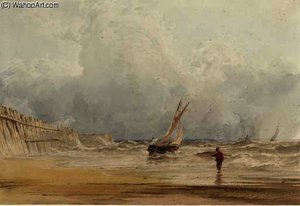 Off to the fishing grounds
42
 Scarborough Castle
43
 An Extensive Landscape With Cattle And A Drover
44
 On the glaslyn, north wales
45
 Droving cattle
46
 Mountainous Landscape With Lake And Stream
47
 Bolton Abbey From The River Wharfe, South View
48
 Loch Achray Ruskin
49
 Distant View Of The Cumberland Hills From Eskdale
50
 Scene Near Capel Curig Looking Towards Snowdon
51
 Off Fingle's Cave, Staffa, Argyllshire
52
 Fishing Smacks And Other Vessels Off The Coast In A Squall
53
 Mrs John Forster
54
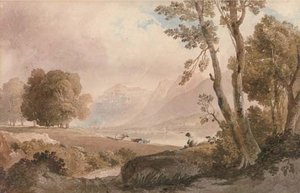 Cattle Watering In The Lake District
55
 River view
56
 Dolbadern castle
57
 Windsor Castle From The Park
58
 View Of Loch Katrine, Perthshire, With Ben Venue Beyond
59
 Harlech Castle
60
 An Extensive Landscape With A Hay-cart And Figures In The Foreground
61
 A View On The Brathay Near Ambleside
62
 Cayton Cliff Mill, near Scarborough
63
 Traeth Mawr, Port Maddock, North Wales
64
 Arundel Castle
65
 An Extensive Landscape With Cattle And Figures In The Foreground
66
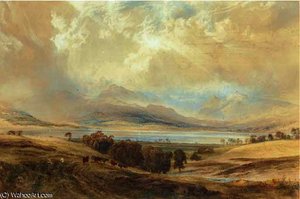 View of langdale pikes and bow fell, over windermere, westmoreland
67
 Scarborough, with a boat being vitalled in the harbour
68
 Fishing vessels before st michael's mount
69
 Figures Conversing In A Mountainous Lake Landscape
70
 Off ramsgate at sunset
71
 Fishing boats in a stiff breeze, off shore
72
 A Storm Passing Off on the Coast of Merionethshire
73
 Distant View Of Rievaulx Abbey, Near Helmsley, Yorkshire
74
 A Herder With Cattle At The Edge Of A Lake In A Mountainous Landscape
75
 A View Of Penrhyn Castle, Wales, With Figures In The Foreground
76
 Figures by a lake at dusk
77
 Lazing on the downs, watching over the flock
78
 Cows In A River Landscape
79
 Adam Sedgwick, Fellow, Geologist And Woodwardian Professor
80
 Byland Abbey, Yorkshire
81
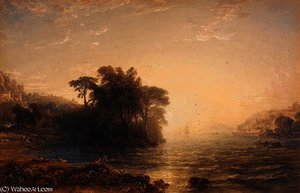 The ferry boat, possibly dartmouth cove
82
 A figure standing on a beach with shipping beyond
83
 A Scene On The Coast, MerionethshireYale Center for British Art
84
 Richard Lynch Cotton
85
 A rest by the wayside, sunset
86
 William GibbsTyntesfield
87
 Ennerdale, from high point farm
88
 John Frederick Lewis
89
 Mrs Susannah Milner-gibson, Nee Cullum
The four subjects that come back most often in these originals, each with its finest example.
The 4 museums that hold the most of the paintings on this page.
| Museum | City | Works by Copley Fielding | Paintings from this list |
|---|---|---|---|
 Birmingham Museum and Art Gallery |
Birmingham | 2 | Lake Nemi with Pontine Marshes in the Background, Scottish Loch With Mountains |
 Art Gallery of New South Wales |
Sydney | 1 | Dunster Castle, sunset |
 Yale Center for British Art |
New Haven | 1 | A Scene On The Coast, Merionethshire |
 Tyntesfield |
1 | William Gibbs |
Pick a decade to see the original that defines it.
Richmond hill, (1830). Ambelside, (1829) and Lake Nemi with Pontine Marshes in the Background (1837) come next.
43 years old: Richmond hill, dates from 1830, and Copley Fielding was born in 1787.
Richmond hill,, Ambelside,, Lake Nemi with Pontine Marshes in the Background, Scottish Loch With Mountains, Ubaldo and Carlo in the Enchanted Boat,, Byland Abbey,, A Herdsman With Cattle Above Rydal Water In The Lake District, Sunset, Sussex, Beached Fishing Vessels At Low Tide and Unloading the catch, whitby. The ranking above gives each one's year and museum.
Our catalog holds 105 works by Copley Fielding, dated from 1829 to 1851.
Mostly in Birmingham Museum and Art Gallery (Birmingham), Art Gallery of New South Wales (Sydney) and Yale Center for British Art (New Haven). The museum table above lists them all.
In 1830s: 4 of the 89 works on this page were made then, Richmond hill, among them.
On this page, the earliest is Ambelside, (1829) and the latest Byland Abbey, (1851).
Beach (11), Landscape (9) and Animals (8), across the 89 works on this page.
Romanticism, judging by the originals on this page.
Lake Nemi with Pontine Marshes in the Background and Scottish Loch With Mountains: the Birmingham Museum and Art Gallery, Birmingham holds 2 of the works on this page.
In the golden age of British watercolor, few names resonate with as much elegance and technical prowess as Anthony Vandyke Copley Fielding. Born in 1787 in the industrious landscape of Sowerby, near Halifax, Fielding emerged from the rugged textures of Yorkshire to become a defining voice of the Victorian era. His life was a masterful composition of scientific precision and romantic sensibility, a duality that allowed him to capture not just the surface of the natural world, but its very soul. As a pupil of the esteemed John Varley, Fielding inherited a profound respect for the nuances of light and atmosphere, a foundation upon which he built a career that would eventually lead him to the presidency of the Royal Society of Watercolours.
Fielding’s artistic development was deeply intertwined with his intellectual pursuits. His time as a Fellow of Trinity College, Cambridge, provided him with a unique vantage point; here, the rigors of scientific inquiry met the fluidity of artistic expression. This intersection is perhaps most visible in his meticulous approach to anatomy and nature. Having engaged in the study of dissections, he brought an unparalleled understanding of structure to his work, whether rendering the powerful musculature of a subject in portraiture or the intricate skeletal details of flora and fauna. This scientific eye did not stifle his creativity but rather anchored it, allowing him to depict the elements—the crashing waves of a coastal storm or the gentle light of a sunset—with a realism that felt both grounded and transcendent.
The breadth of Fielding’s oeuvre is nothing short of extraordinary, spanning from the tranquil valleys of the English Lake District to the dramatic, wind-swept coasts of Wales. He was a painter who understood the language of the weather. His landscapes often eschewed mere rustic charm in favor of an idealized, classical beauty inspired by the great Richard Wilson. In his hands, the British countryside became a stage for the sublime. One might find himself lost in the turbulent energy of A Scene on the Coast, Merionethshire - Storm Passing Off, where the tension between sea and sky is palpable, or find peace in the soft, luminous washes of his more pastoral views.
His fascination with marine subjects further solidified his reputation as a premier watercolorist. Fielding possessed a rare ability to capture the weight and movement of water, utilizing a sophisticated palette of inks, graphite, and watercolors to create depth and motion. His works often evoke a sense of profound openness, inviting the viewer to breathe in the salt spray or feel the sudden chill of an approaching gale. This mastery was not limited to the canvas; his influence extended into the realm of printmaking and teaching, where he shared his sophisticated techniques with a new generation of artists, ensuring that his legacy of atmospheric precision would endure.
The accolades bestowed upon Fielding during his lifetime serve as a testament to his standing among the giants of 19th-century art. His triumph at the Paris Salon of 1824, where he stood alongside luminaries such as John Constable and Richard Parkes Bonington, marked his arrival on the international stage. Furthermore, the high regard in which he was held by the influential critic John Ruskin underscores the lasting impact of his aesthetic vision. Fielding was more than a mere chronicler of scenery; he was an architect of atmosphere.
Today, the works of Anthony Vandyke Copley Fielding reside in some of the world's most prestigious institutions, including the Victoria & Albert Museum and the Yale Center for British Art. His contribution to the canon of British art remains significant because he bridged the gap between the meticulous observation of the Enlightenment and the emotive power of Romanticism. To look upon a Fielding painting is to witness a moment caught in the delicate balance between the tangible world and the infinite imagination, a legacy that continues to inspire collectors and art historians alike.

