The Specular Lens: Understanding the Metaphysical Role of Mirrors in Art History
To gaze into a mirror is to engage in a silent dialogue with the self, yet within the hallowed halls of art history, the mirror has always functioned as much more than a mere tool of vanity. It serves as a specular lens, a threshold where the tangible world meets the intangible realm of thought and spirit. Since the Renaissance, artists have utilized the reflective surface to challenge the very boundaries of perception, inviting viewers to question the stability of what they see. The mirror does not merely duplicate reality; it complicates it, introducing themes of duality, deception, and the infinite.
In the hands of a master, a reflected image can act as a window into a parallel dimension. When we observe a painted reflection, we are participating in a sophisticated visual game where the artist manip deconstructs the viewer's sense of space. This metaphysical engagement transforms the canvas from a flat plane into a profound exploration of existence. The mirror becomes a symbol of truth—revealing what is hidden behind the mask of the physical—while simultaneously acting as a site of illusion, where light and shadow conspire to create a reality that is both hauntingly familiar and deeply mysterious.
Fractured Realities: Salvador Dalí and the Surrealist Mirror
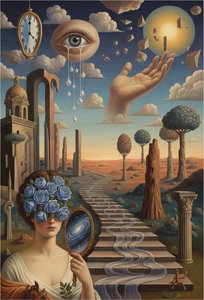
Nowhere is the subversive power of the mirror more potently realized than in the fever dreams of Salvador Dalí. For the Surrealists, the mirror was a primary instrument for shattering the logic of the waking world. Dalí, a virtuoso of the subconscious, utilized reflections to manifest his "paranoiac-critical" method, creating works where the boundaries between object and shadow dissolve into a fluid, dreamlike state. His fascination with the fragmented self is perhaps most exquisitely captured in his complex, unfinished explorations of the late 1970s.
Consider the mesmerizing complexity of works such as "DalH from the Back Painting Gala from the Back Eternalized by Six Virtual Corneas Provisionally Reflected in Six Real Mirrors." In this profound undertaking, Dalí does not simply paint a subject; he orchestrates a multi-dimensional experience. By incorporating the concept of virtual corneas and real mirrors, he forces the eye to navigate a labyrinth of reflections that defy linear perspective. Here, the mirror is no longer a passive observer but an active participant in the creation of a fractured reality, where the beloved Gala Dalí is both present and perpetually receding into a kaleidoscopic void of memory and desire.
Beyond the Surface: Symbolism, Identity, and the Reflected Self
Beyond the technical spectacle, mirror art delves into the deepest recesses of human identity. The reflected image serves as a powerful metaphor for the fragmented psyche—the tension between our public persona and our private, often shadowed, inner truth. In many iconic works, the mirror acts as a site of introspection, where characters confront their own mortality or the fleeting nature of beauty. This is particularly evident in the way artists use reflections to suggest the presence of an unseen observer, turning the act of viewing into an act of self-confrontation.
This symbolic depth extends to the concept of the doppelgänger, where a reflection might appear slightly altered, hinting at a hidden, perhaps more sinister, version of the subject. Through these subtle distortions, artists explore the fluidity of the self. The mirror becomes a stage for the performance of identity, where every glint of light and every obscured angle tells a story of what we choose to reveal and what we desperately seek to conceal. It is this psychological weight that elevates mirror art from mere decoration to a profound meditation on the human condition.
The Illusion of Depth: Technical Mastery in Reflective Compositions
Achieving a convincing reflection on a two-dimensional surface requires an extraordinary level of technical virtuosity. The artist must master the physics of light, understanding how luminosity, refraction, and shadow interact to create the illusion of depth. This involves a meticulous application of paint, often utilizing impasto techniques to build texture that catches actual light, mimicking the sheen of glass. The challenge lies in maintaining the transparency of the reflected image while ensuring it feels anchored within the physical composition.
< Glazing and Layering: To capture the ethereal quality of a reflection, masters often employ multiple thin layers of translucent oil, allowing light to penetrate the surface and bounce back, creating a luminous, inner glow.Perspective Manipulation: The artist must mathematically calculate vanishing points that exist not just within the painting, but within the reflected space itself, creating a complex, nested perspective.
Tonal Range: A successful mirror painting requires an expansive tonal range, from the deepest blacks of a shadowed corner to the brilliant, blinding whites of a specular highlight, all to simulate the high contrast found in real glass.
When these elements align, the result is a breathtaking illusion that pulls the viewer into the frame. The mastery of such technique is what separates a mere depiction from a true masterpiece, turning a flat canvas into an immersive, three-dimensional experience that continues to captivate the senses long after the initial encounter.
Curating the Infinite: Integrating Mirror-Inspired Art into Modern Interiors
In the contemporary collector's home, art inspired by reflections offers a unique opportunity to expand the perceived boundaries of a space. Incorporating works that feature deep, reflective compositions can introduce a sense of architectural movement and light into even the most static environments. Much like a physical mirror, these paintings act as focal points that draw the eye inward, creating an illusion of expanded volume and heightened sophistication.
When curating such pieces, one should consider the interplay between the artwork and the surrounding room. A large-scale, multi-panel painting featuring fractured reflections can serve as a dramatic centerpiece for a grand hallway or a wide lounge, echoing the complexity of modern design. For those seeking to create a cohesive aesthetic, we recommend pairing these visually complex works with minimalist surroundings to allow the intricate details of the brushwork and the depth of the composition to remain the undisputed protagonists of the space. By embracing the themes of reflection and light, one does not merely decorate a room; one invites the infinite into the heart of the home.
At OriginalUniqueArt.com, we celebrate this enduring fascination with the beauty of the reflected world. Our mission is to bring the profound depth of art history into your personal collection through exquisite, hand-painted reproductions and bespoke commissions. Whether you seek to recreate a Surrealist masterpiece or transform a modern memory into an oil painting of classical grandeur, our master artists are dedicated to preserving the soul of every brushstroke for generations to come.