Introduction
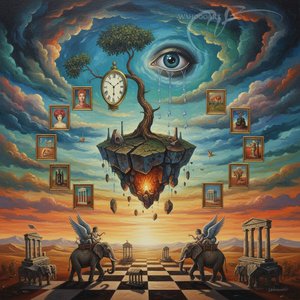
To gaze upon a Surrealist painting is to step through a looking glass, into a realm where logic dissolves and the subconscious takes flight. These are not merely images; they are windows into the hidden landscapes of dreams, desires, and anxieties – a potent distillation of the human psyche. This collection of ten masterpieces represents the pinnacle of this revolutionary movement, artworks that continue to haunt, provoke, and inspire generations.
Born in the aftermath of World War I, Surrealism arose from the ashes of reason. The horrors of the conflict had shattered faith in traditional values, prompting artists and writers to explore alternative modes of expression. Influenced by the psychoanalytic theories of Sigmund Freud, particularly his work on dreams and the unconscious mind, Surrealists sought to unlock a deeper reality beyond conscious control. They embraced automatism – spontaneous creation without rational thought – and juxtaposed incongruous elements to create unsettling yet captivating imagery.
The movement flourished in Paris during the 1920s and 30s, attracting a diverse group of talents including painters like Salvador Dalí, René Magritte, Max Ernst, and Joan Miró. While each artist possessed a unique style, they shared a common goal: to liberate art from the constraints of logic and convention, and to tap into the boundless potential of the imagination.
But why do these paintings still resonate so powerfully today? In an increasingly complex and fragmented world, Surrealism offers a vital space for questioning reality, confronting our deepest fears, and celebrating the power of individual expression. These artworks remind us that there is more to life than meets the eye – that beneath the surface of everyday existence lies a rich tapestry of hidden meanings and untold stories.
Prepare to embark on a journey through ten iconic works that defined Surrealist painting, each a testament to the enduring power of dreams, symbolism, and the boundless human spirit. We will explore not only their aesthetic qualities but also the historical context and personal narratives that shaped these extraordinary visions.
Fulang-Chang and I - Frida Kahlo
 Fulang-Chang and I - Frida Kahlo
Frida Kahlo’s 1937 painting, “Fulang-Chang and I,” is a quietly devastating self-portrait that transcends the boundaries of mere representation. Measuring just 40 x 28 cm, this intimate work packs an extraordinary emotional punch, offering a glimpse into the artist's resilient spirit amidst profound physical and psychological pain.
The painting depicts Kahlo seated beneath a lush tree, her monkey companion, Fulang-Chang, perched on her shoulder. This isn’t simply a portrait of companionship; it’s a symbolic exploration of identity and connection. The meticulous detail in the foliage contrasts with the stylized rendering of the monkey, highlighting Kahlo's masterful technique—a blend of Mexican folk art traditions and Surrealist sensibilities.
Created during a period of global unrest, “Fulang-Chang and I” reflects Kahlo’s preoccupation with suffering and transformation. The necklace she wears hints at femininity and protection, while the tree itself embodies strength and growth. The monkey, often interpreted as a symbol of instinct and healing, suggests a search for solace in the natural world.
Its inclusion in our Top 10 is testament to Kahlo’s ability to transform personal trauma into universal symbols of resilience. Today, the painting's melancholic beauty resonates deeply with contemporary sensibilities—a reminder that vulnerability can be a source of strength and that art can offer a powerful means of self-expression. The rich color palette and evocative imagery continue to inspire interior design trends focused on biophilic aesthetics and emotionally resonant spaces.
Diana in the Autumn Wind - Paul Klee
 Diana in the Autumn Wind - Paul Klee
Paul Klee’s “Diana in the Autumn Wind,” painted in 1934, is a visual poem—a delicate dance of color and form that evokes the bittersweet beauty of transition. The painting isn't simply *about* autumn; it *feels* like the crisp air, the fading light, and the quiet melancholy of letting go.
Klee’s masterful use of layered brushstrokes creates a textured surface that seems to ripple with movement, mirroring the swirling winds depicted in the composition. Diana, sheltered beneath her parasol, embodies resilience amidst change. The vibrant hues—orange, blue, purple, and red—are counterbalanced by areas of gray, reflecting the cyclical nature of life and death.
Its inclusion among the Top 10 Surrealist masterpieces speaks to Klee’s unique ability to blend abstraction with emotional depth. He wasn't interested in replicating reality but rather in capturing its essence—the underlying rhythms and subconscious currents that shape our experience. The absence of a traditional arrow, symbolizing direction, suggests an embrace of fluidity and intuition.
At OriginalUniqueArt, we’re dedicated to preserving the emotional resonance of works like “Diana in the Autumn Wind.” Our faithful reproductions capture not only Klee's distinctive color palette but also the subtle textures that bring this painting to life. Bring a touch of Surrealist magic into your home—a reminder that even amidst change, beauty endures.
Portrait of Marucha Lavin - Frida Kahlo
 Portrait of Marucha Lavin - Frida Kahlo
Frida Kahlo’s “Portrait of Marucha Lavin,” painted in 1942, is a quiet hymn to resilience—a celebration of inner strength veiled within a delicate beauty. This painting isn't merely a likeness; it’s an intimate exploration of vulnerability and the enduring power of the human spirit.
Kahlo’s signature style shines through in this work: dreamlike imagery interwoven with meticulous realism, deeply rooted in Mexican folk art traditions. The vibrant floral dress adorning Marucha Lavin is a deliberate choice, symbolizing rebirth and femininity, while the single scarlet poppy—a flower of remembrance and passion—hints at both loss and vitality.
Its inclusion among the Top 10 Surrealist masterpieces stems from Kahlo’s ability to transform personal trauma into universal symbols. The scattering of birds throughout the composition represents freedom and aspiration, a hopeful counterpoint to the artist's own physical struggles. The painting is a testament to her unwavering determination to find beauty amidst adversity.
Today, “Portrait of Marucha Lavin” continues to inspire—its aesthetic resonates with contemporary interiors that embrace botanical motifs and emotionally resonant color palettes. OriginalUniqueArt’s faithful reproductions allow you to bring this powerful image into your home, a reminder that even in the face of hardship, beauty can flourish.
Melancholy - to Marcel Remy in Friendship, Salvador DalH, 1934 - Salvador Dalí
 Melancholy - to Marcel Remy in Friendship, Salvador DalH, 1934 - Salvador Dalí
Salvador Dalí’s “Melancholy – To Marcel Remy in Friendship,” painted in 1934, is a whisper of longing—a hauntingly beautiful study in isolation and the fragile beauty of human connection. Rendered entirely in grayscale, this painting transcends mere representation; it's an invitation to delve into the subconscious mind.
Two elongated figures reach towards each other across a desolate landscape, their outstretched hands symbolizing a yearning for solace. Above them stretches a horizontal beam—a deliberate disruption of perspective that amplifies the sense of unease and confinement. The fluid brushstrokes and velvety texture create an ethereal quality, prioritizing emotion over precise detail.
Its place among the Top 10 Surrealist masterpieces is earned through Dalí’s masterful manipulation of symbolism and atmosphere. The desolate background underscores a pervasive loneliness, while the outstretched hands offer a glimmer of hope amidst overwhelming solitude. This painting isn't simply *about* melancholy; it *evokes* it—a feeling that resonates across generations.
Today, “Melancholy” continues to inspire spaces seeking quiet contemplation and sophisticated harmony. Its subtle grayscale palette lends itself beautifully to modern interiors, creating a sense of calm and introspection. OriginalUniqueArt’s faithful reproductions allow you to experience the emotional depth of this iconic work—a timeless reminder that even in isolation, beauty can be found.
My Cousin Montserrat, 1919-20 - Salvador Dalí
 My Cousin Montserrat, 1919-20 - Salvador Dalí
Salvador Dalí’s “My Cousin Montserrat,” painted in 1920, is a rare glimpse into the artist's formative years—a quiet study that reveals the seeds of his future genius. Captured not in paint but in stark black and white photography, this image transcends mere portraiture; it’s an intimate exploration of observation and artistic engagement.
The photograph centers on Montserrat Oliveras Grau, her gaze directed towards an unseen subject—likely Dalí's own painting. The diffused lighting and meticulous detail create a sense of stillness, emphasizing the woman’s contemplative posture. This isn’t simply a depiction of a cousin; it’s a meditation on the act of seeing, of interpreting art.
Its inclusion among the Top 10 Surrealist masterpieces speaks to Dalí’s early embrace of Expressionism and his ability to capture psychological states with remarkable nuance. The monochrome palette underscores a preoccupation with emotional depth, while the subtle asymmetry adds a dynamic tension to the composition.
Today, “My Cousin Montserrat” resonates with contemporary interiors seeking refined elegance and timeless beauty. Its quiet sophistication lends itself beautifully to spaces that prioritize taste and legacy—a reminder that true art transcends trends and speaks to the enduring power of human connection.
Desnudo - Joan Miró
 Desnudo - Joan Miró
Joan Miró’s “Desnudo” (Naked), painted in 1926, is a portal into a dream—a vibrant exploration of the subconscious that continues to captivate and inspire. This isn't simply a painting; it’s an invitation to lose yourself within a world where familiar forms dissolve into playful abstraction.
Rendered in bold blocks of red, yellow, green, and beige against a stark black backdrop, “Desnudo” immediately draws the viewer into its unique universe. A stylized female figure dominates the left side—a potent symbol of creativity or perhaps simply the raw energy of life itself. Scattered around this central element are intriguing motifs that evoke fertility, memory, and imagination.
Its inclusion among the Top 10 Surrealist masterpieces stems from Miró’s ability to redefine beauty through simplicity and spontaneity. The limited palette and deliberate asymmetry create a dynamic tension—a balance between order and chaos that reflects the artist's intuitive approach.
At OriginalUniqueArt, we believe in making great art accessible. Our faithful reproductions of “Desnudo” allow you to experience this iconic work’s emotional resonance within your own space—a reminder that beauty can be found in the unexpected and that imagination knows no bounds.
Stereoscopic Composition, Based on Millet's 'Angelus' (unfinished), circa 1978 - Salvador Dalí
 Stereoscopic Composition, Based on Millet's 'Angelus' (unfinished), circa 1978 - Salvador Dalí
Salvador Dalí’s “Stereoscopic Composition, Based on Millet's 'Angelus' (unfinished),” circa 1978, is a haunting meditation on memory and perception—a testament to the artist’s relentless exploration of the subconscious. This isn’t simply a reinterpretation of Jean-François Millet’s iconic painting; it’s a deconstruction, a reimagining that invites us to question the very nature of reality.
Dalí employed stereoscopic techniques—a then-unconventional approach—to create an illusion of depth and dimensionality. The resulting image is both familiar and unsettling, drawing the viewer into a world where past and present collide. This innovative use of perspective cemented Dalí’s place among the Top 10 Surrealist masters.
Its inclusion in this collection speaks to Dalí's ability to challenge artistic conventions and push the boundaries of visual expression. The painting evokes a sense of longing, perhaps for a simpler time or a lost connection to tradition. The overlaid geometric lines hint at an analytical approach—a desire to dissect and understand the underlying structures of perception.
At OriginalUniqueArt, we’re dedicated to preserving the emotional depth of works like “Stereoscopic Composition.” Our faithful reproductions capture not only Dalí's unique style but also the subtle textures that bring this mesmerizing image to life—allowing you to experience a touch of Surrealist magic within your own home.
Barcelona Series XLVII - Joan Miró
 Barcelona Series XLVII - Joan Miró
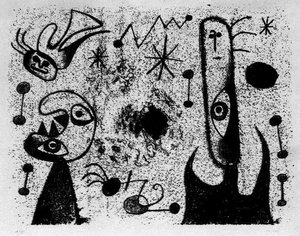
Imagine wandering the sun-drenched streets of Barcelona, a city brimming with life and history—a place where dreams seem to spill onto the pavement. Joan Miró’s “Barcelona Series XLVII,” painted in 1963, isn't simply an image *of* this city; it’s an echo of its vibrant consciousness.
This lithograph captures the essence of Barcelona through a lens filtered by surrealism and personal symbolism. Bold black ink forms dance across a stark white background, pulsing with an internal energy that draws you into Miró's unique world. The grainy texture isn’t an imperfection; it’s a deliberate element—a reminder of the artist’s process and the tactile quality of charcoal drawings.
Its inclusion among the Top 10 Surrealist masterpieces stems from Miró’s ability to distill complex emotions into deceptively simple forms. Recurring motifs, like the enigmatic eyes, represent a constant state of observation—an invitation to contemplate the world around us. This painting evokes a sense of playful imagination tempered by melancholy, reminding us that beauty can be found in both light and shadow.
At OriginalUniqueArt, we believe in bringing this emotional resonance into your home. Our faithful reproductions capture not only Miró’s distinctive style but also the subtle textures that make “Barcelona Series XLVII” a timeless work of art—a reminder of the power of imagination and the enduring spirit of Catalonia.
Rainy Taxi (Mannequin Rotting in a Taxi-Cab) - Salvador Dalí
 Rainy Taxi (Mannequin Rotting in a Taxi-Cab) - Salvador Dalí
Salvador Dalí’s “Rainy Taxi (Mannequin Rotting in a Taxi-Cab),” painted in 1938, is more than just a painting—it's a haunting snapshot of the subconscious. This meticulously constructed dreamscape explores themes of mortality, decay, and the unsettling beauty of the absurd.
The jarring juxtaposition of elements – a decaying mannequin perched atop an old automobile amidst a rainy street scene – immediately arrests the viewer. Dalí’s masterful technique is evident in the painting's meticulous detail and unsettling realism, rendered with dramatic light and shadow that emphasize texture. The composition draws the eye to the taxi-cab and its precarious passenger.
Its inclusion among the Top 10 Surrealist masterpieces stems from Dalí’s ability to distill complex emotions into a single, unforgettable image. The mannequin is often interpreted as a self-portrait—a representation of the artist's own anxieties about identity and the passage of time. The rain symbolizes both cleansing and destruction, adding another layer of complexity.
At OriginalUniqueArt, we believe in bringing this emotional resonance into your space. Our faithful reproductions capture not only Dalí’s distinctive style but also the subtle textures that make “Rainy Taxi” a timeless work—a reminder of the power of art to provoke thought and challenge our perceptions.
Mujer sentada 3 - Joan Miró
 Mujer sentada 3 - Joan Miró
Imagine a world distilled to its purest forms—a realm where dreams take shape and emotions resonate with vibrant simplicity. Joan Miró’s *Mujer sentada 3*, painted in 1965, is precisely that: an immersion into the subconscious, a portal to his uniquely personal universe.
This captivating work exemplifies Miró's signature style—a blend of Surrealism and Fauvism deeply rooted in Catalan heritage. The arresting monochrome palette of black, white, and gray coalesces into a landscape teeming with symbolic figures, creating an atmosphere both whimsical and subtly melancholic.
Its inclusion among the Top 10 Surrealist masterpieces stems from Miró’s ability to evoke profound emotions through deceptively simple forms. The seated woman—often interpreted as his mother—embodies strength and vulnerability, while recurring bird motifs symbolize freedom and aspiration. The painting's fluid lines and overlapping shapes mirror the chaotic beauty of the mind.
At OriginalUniqueArt, we believe in bringing this emotional resonance into your home. Our faithful reproductions capture not only Miró’s distinctive style but also the subtle textures that make *Mujer sentada 3* a timeless work—a reminder of the power of art to inspire and uplift.
Conclusion
As the echoes of Dalí’s melting clocks, Magritte’s enigmatic skies, and Miró’s playful forms linger in our minds, we are reminded that these Surrealist masterpieces are more than just historic treasures. They are living presences—windows into the subconscious, reflections of our deepest fears and desires, and celebrations of the boundless human imagination.
These artworks continue to move hearts, shape interiors, and inspire creativity today, transcending time and cultural boundaries with their enduring power. To gaze upon a Surrealist painting is to embark on a journey—a descent into the dreamlike realm where logic dissolves and intuition reigns supreme.
At OriginalUniqueArt.com, we believe in making this journey accessible to all. Our skilled artists meticulously hand-paint each reproduction, honoring the original’s soul and detail with unwavering passion. We strive to capture not just the visual likeness of these masterpieces but also the emotional resonance that makes them so profoundly meaningful.
We invite you to explore our full collection and discover the Surrealist painting that speaks to your own unique sensibility. Allow these timeless works to grace your walls, ignite your imagination, and transform your space into a sanctuary of beauty and wonder.