Introduction: The Enduring Appeal of Rural Scenes
From the earliest cave paintings depicting hunts to the idyllic pastorals of classical antiquity, humanity has long held a complex and often idealized relationship with the rural world. This fascination isn’t merely aesthetic; it speaks to fundamental questions about our origins, labor, community, and identity. The scenes of farms, fields, and village life aren't simply representations of places, but reflections of societal values, anxieties, and aspirations. They offer a glimpse into ways of living often contrasted with the burgeoning complexities of urban existence, a contrast that only intensified with the Industrial Revolution and continues to resonate today. The enduring power of these images lies in their ability to evoke a sense of longing for simplicity, authenticity, and connection to the land – even as they acknowledge the hardships inherent in such lives.
The Realist Movement & Depicting Everyday Life
Realism, Realistic, or Realists may refer to: == In the arts == Realism (arts), the general attempt to depict subjects truthfully in different forms of the arts Arts movements related to realism include: == In philosophy == Philosophical realism ...
The 19th century witnessed a seismic shift in artistic priorities with the rise of Realism. Rejecting the romanticized narratives and historical grandeur favored by earlier generations, artists began to turn their attention to the tangible realities of contemporary life – and nowhere was this more evident than in depictions of rural existence. Figures like Gustave Courbet championed an honest portrayal of the working class, challenging conventional notions of beauty and subject matter. This wasn’t about painting pretty landscapes; it was about confronting social issues, documenting the lives of ordinary people, and acknowledging the dignity of labor. Realism sought to depict life “as it is,” without embellishment or idealization, a radical departure that often met with criticism but ultimately paved the way for greater artistic freedom and social commentary.
Van Gogh, Millet, and the Dignity of Labor
 Peasant and Peasant Woman Planting Potatoes
Discover Vincent van Gogh's 'Peasant and Peasant Woman Planting Potatoes' (1885), a powerful realist scene capturing rural labor with expressive brushwork and earthy tones. Perfect for art collectors and enthusiasts.
Jean-François Millet stands as a pivotal figure in this movement. His paintings, such as Landscape with a Peasant Woman, aren’t merely depictions of rural figures; they are imbued with a profound sense of empathy and respect for the working class. Millet elevated the peasant to a symbol of virtue and resilience, portraying their toil not as something degrading but as an essential part of the human experience. Vincent van Gogh, deeply influenced by Millet, carried this torch forward. His Peasant and Peasant Woman Planting Potatoes (1885) is a powerful testament to the physicality and hardship of agricultural labor. The expressive brushwork and earthy tones convey not just the scene itself but also the emotional weight of their existence. Van Gogh’s focus wasn't on romanticizing poverty, but on capturing the raw humanity and quiet dignity of these individuals – figures often overlooked by mainstream society.
Beyond France: Representing Rural Identity in Russia and America
 Nikolai Dubovskoi
Explore the evocative realist landscapes of Nikolai Dubovskoi (1859-1918), a key figure in Russian Impressionism & the Peredvizhniki movement. Discover his serene scenes of rural Russia, capturing mood and social commentary.
The impulse to represent rural life extended far beyond the French countryside. In Russia, artists like Nikolai Dubovskoi captured the serene beauty and melancholic mood of the Russian landscape and its people. Dubovskoi’s work, deeply rooted in the traditions of the Peredvizhniki movement (also known as The Wanderers), often depicted scenes of rural poverty and social injustice with a quiet intensity. Simultaneously, American artists like Elizabeth Nourse found acclaim in France while focusing on genre scenes depicting everyday life, including portraits of working-class women and children. Nourse’s paintings offer a nuanced perspective on the lives of those living outside the rapidly industrializing cities, highlighting their strength, resilience, and often-unseen contributions to society. These artists, though geographically distant, shared a common desire to portray the realities of rural life with honesty and empathy.
Nostalgia and Idealization: A Complex Relationship with the Past
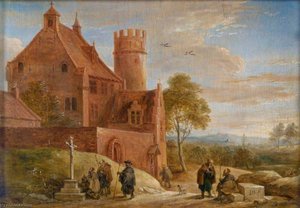 Les pèlerins
Explore 'Les Pèlerins' by David Teniers II! A serene Baroque landscape painting featuring a castle & figures in earthy tones. Discover Flemish artistry & detailed realism.
While Realism aimed for objectivity, it’s impossible to divorce these depictions from a certain degree of nostalgia. As societies modernized, the rural world increasingly became associated with a lost past – a simpler time before the complexities of industrial life. This longing often manifested in idealized representations of peasant life, glossing over the hardships and focusing instead on romanticized notions of community and connection to nature. David Teniers the Younger’s Les Pèlerins, for example, presents a serene Baroque landscape with figures engaged in peaceful travel, offering an idyllic vision that may not have fully reflected the realities of 17th-century life. Jules Bastien-Lepage, another key figure in the Realist movement, similarly imbued his rural scenes with a sense of poetic melancholy, hinting at a disappearing way of life. This tension between realism and idealization is crucial to understanding the enduring appeal – and occasional problematic aspects – of these artworks.
Conclusion: The Continuing Relevance of Rural Art
The paintings born from this era continue to resonate with audiences today because they tap into universal themes of labor, identity, and our relationship with the natural world. They remind us of the importance of acknowledging the dignity of all work, regardless of its perceived status, and offer a poignant glimpse into ways of life that are rapidly disappearing. These artworks aren’t simply historical documents; they are powerful statements about human resilience, social justice, and the enduring search for meaning in a changing world. At OriginalUniqueArt.com, we believe in making these masterpieces accessible to all, allowing you to bring the beauty and emotional depth of rural art into your own home. Explore our collection today and discover the stories waiting to be told – or perhaps, retold – through the timeless power of paint and canvas.