Nikolai Dubovskoy: Weaver of Twilight and Mood
The Russian landscape painter Nikolai Nikanorovich Dubovskoy (1859-1918) remains a quietly significant figure within the broader tapestry of 19th-century art, particularly as a key contributor to the Peredvizhniki movement. Often overshadowed by his more flamboyant contemporaries, Dubovskoy possessed a unique ability to capture not just the visual beauty of the Russian countryside but also its elusive emotional atmosphere – what he and Isaac Levitan termed “landscape of mood.” His work, characterized by a subtle palette, atmospheric perspective, and an intimate understanding of light, offers a serene counterpoint to the more overtly dramatic styles prevalent at the time.
Born in Novocherkassk, a town steeped in Cossack history, Dubovskoy’s artistic journey began with humble beginnings. His father, a Troop Sergeant, recognized his son's innate talent for drawing and encouraged him to pursue it, defying societal expectations that favored military careers. Early influences included his uncle, a local artist who provided foundational instruction, and the illustrations of popular magazines like Niva, which ignited a passion for depicting the natural world. This early exposure shaped his approach – a deep connection to the land and a desire to translate its essence onto canvas.
The Peredvizhniki and Artistic Evolution
Dubovskoy’s formal artistic training commenced at the Imperial Academy of Arts in St. Petersburg, where he studied under Mikhail Klodt. However, disillusioned with the rigid academic constraints, he deliberately chose not to participate in the prestigious final competition, opting instead to exhibit his work independently through the Society for Traveling Art Exhibitions – the Peredvizhniki. This decision marked a pivotal moment, aligning him with a group of artists committed to social realism and portraying life outside the confines of the established Salon system.
The Peredvizhniki’s influence profoundly shaped Dubovskoy's artistic development. He embraced their ethos of direct observation, rejecting idealized representations in favor of capturing the authentic beauty of Russia’s diverse landscapes. His early works, such as “Winter” (1884), already demonstrated a mastery of atmospheric perspective and a sensitivity to light – qualities that would become hallmarks of his style. The patronage of Pavel Tretyakov further solidified his position within the movement, providing him with crucial exposure and recognition.
A Palette of Twilight and Light
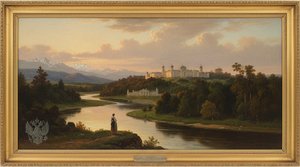
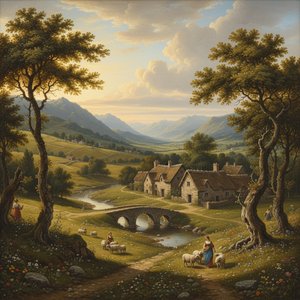
Dubovskoy’s artistic signature lies in his evocative depictions of twilight landscapes—scenes bathed in the soft, melancholic hues of dawn and dusk. These paintings are not merely representations of scenery; they are imbued with a profound sense of stillness and introspection. He skillfully employed muted colors – predominantly blues, grays, and browns – to create an atmosphere of quiet contemplation, often punctuated by subtle shifts in light and shadow. His compositions frequently feature solitary figures—peasants, travelers, or simply observers—who seem lost in the vastness of the Russian wilderness.
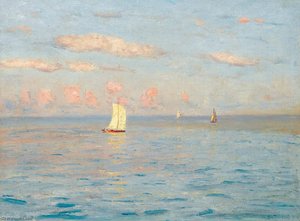
Influenced by Impressionism, particularly the work of Claude Monet and Pierre-Auguste Renoir, Dubovskoy experimented with broken brushstrokes and a focus on capturing fleeting moments of light. However, he retained a distinctly Russian sensibility, avoiding the overtly decorative tendencies sometimes associated with Impressionism. His landscapes are rooted in a deep understanding of the Russian countryside—its vastness, its beauty, and its inherent solitude.
Key Works and Legacy
Among Dubovskoy’s most celebrated works are “Evening in November” (1907), a hauntingly beautiful depiction of a winter landscape shrouded in mist; "Naples" (1896), an Impressionistic study of the vibrant Mediterranean city, showcasing his ability to capture the energy and atmosphere of urban life; and “Twilight” (1909), a quintessential example of his mastery of atmospheric perspective. These paintings, along with numerous other landscapes depicting Russian villages, forests, and rivers, are held in prominent collections throughout Russia and beyond.
Despite facing relative obscurity during the Soviet era, Nikolai Dubovskoy’s work has experienced a resurgence of interest in recent decades. His evocative landscapes continue to resonate with viewers seeking solace and beauty in the natural world. He remains a vital figure in Russian landscape painting, a testament to the power of observation, sensitivity, and a profound connection to the land.