Expressionism · 1964
Composition (Yi Eungro, 1964)
Yi Eungro (1904–1989) made Composition. It dates from 1964. It belongs to the Expressionism movement. It is made in oil. It is kept at Lee Ungno Museum in Daegu, South Korea. It measures 146 × 116 cm (57.5 × 45.7 in).
- 1964
- Oil
- 146 × 116 cm (57.5 × 45.7 in)
- Lee Ungno Museum, Daegu

 Preview

 Hand Made Oil Painting
 Send
 Share
 Fact sheet


 Download
 Similars
 X-Ray
 Diaporama
 Q&A

 Stats
Composition, in brief
- Title
- Composition
- Artist
- Yi Eungro (1904–1989)
- Artist born in
- Seoul, South Korea
- Date
- 1964
- Medium
- Oil
- Dimensions
- 146 × 116 cm (57.5 × 45.7 in)
- Where to see it
- Lee Ungno Museum, Daegu, South Korea
- Movement
- Expressionism
- Period
- Modern
- Subject
- abstract landscape, forest scene, warm tones, impasto texture, vertical brushstrokes, earthy palette
What does Composition depict?
A Symphony of Earth and Light
In the evocative realm of mid-century abstraction, few works capture the primal essence of nature as tangibly as Yi Eungro’s Composition. Created in 1964, this masterpiece serves as a breathtaking window into a textured, primordial landscape where the boundaries between the physical world and emotional expression dissolve. At first glance, the viewer is enveloped by a dense, rhythmic grove of vertical forms that suggest a forest caught in a moment of eternal transition. The painting does not merely represent a scene; it breathes with a life force derived from its deep, warm earth tones and a masterful use of atmospheric perspective. As the eye travels from the shadowy, grounded depths of the base toward the lighter, more ethereal heights, one experiences a profound sense of ascent, as if witnessing the first light of dawn breaking through a thick canopy.
The technical brilliance of this work lies in its extraordinary impasto technique. The oil paint is applied with such sculptural generosity that the canvas becomes a three-dimensional topography. Each vertical brushstroke acts as a structural element, building up layers of pigment that catch the light and cast soft, subtle shadows across the surface. This tactile quality invites the viewer to reach out and touch the movement within the piece, feeling the energy of the artist's hand. The interplay of light and shadow is not merely a visual trick but a fundamental component of the composition, creating a diffuse, glowing atmosphere that softens the edges of the organic shapes and lends the entire work an air of mystery and quiet awe.
The Intersection of Tradition and Modernity
To understand the profound impact of Composition, one must consider the artistic journey of Yi Eungro. A pivotal figure in Korean modern art, Yi was a master who bridged the gap between the delicate traditions of Eastern ink wash painting and the bold, expressive vigor of Western abstraction. While his early training focused on the disciplined "four gentlemen" style of calligraphy, his later works, like this 1964 composition, demonstrate a radical evolution. He moved away from literal representation toward an expressionistic language that prioritizes emotional resonance over anatomical accuracy. In this piece, the influence of his Korean heritage is felt in the rhythmic, calligraphic energy of the vertical strokes, while the heavy, textured oil application speaks to a global, modernist dialogue.
For the discerning collector or interior designer, this artwork offers more than just aesthetic beauty; it provides a focal point of immense psychological depth. The warm, saturated palette of ochre, sienna, and deep umber creates an atmosphere of warmth and stability, making it an ideal centerpiece for spaces designed for contemplation or sophisticated gathering. Because the work lacks a singular, distracting focal point, it possesses a unique ability to integrate seamlessly into diverse environments—from contemporary minimalist galleries to richly textured, classical studies. It is a piece that does not demand attention through noise, but rather commands it through a silent, powerful presence, offering an enduring sense of energy, mystery, and the timeless beauty of the natural world.
Which museum holds Composition?
Lee Ungno Museum
Daegu, South Korea
A Symphony of Ink and Modernity: The Legacy of Lee Ungno In the heart of Daejeon’s cultural landscape, the Lee Ungno Museum stands as a profound testament to the transformative power of artistic vision. This institution serves as a bridge between eras, offering a rare glimpse into the soul of a man who successfully synthesized the meditative weight of Eastern ink wash painting with the bold, experimental frontiers of Western modernism. To step into this museum is to enter a space where the ancient traditions of Korean calligraphy meet the electric energy of European abstract expressionism, creating a dialogue that resonates across generations.
High-resolution images of Composition

Protected by copyright: these files are for personal reference, not a licence to republish.
Yi Eungro, Composition (1964).
Yi Eungro (1904–1989), Composition, 1964, oil, Lee Ungno Museum, Daegu, South Korea. Image: OriginalUniqueArt.com.
Questions on Composition, answered
Where can I see the original "Composition" by Yi Eungro?
The original "Composition" by Yi Eungro is held at the Lee Ungno Museum, Daegu, South Korea. A reproduction allows the work to be displayed at home.
When was "Composition" made?
"Composition" by Yi Eungro was created in 1964.
What medium is "Composition" by Yi Eungro executed in?
The medium of "Composition" by Yi Eungro is oil. Reproductions aim to render the appearance of this technique.
What size is "Composition" by Yi Eungro in real life?
The original "Composition" by Yi Eungro measures 146 x 116 cm (57.5 × 45.7 in).
What subjects appear in "Composition" by Yi Eungro?
The themes present in "Composition" by Yi Eungro include abstract landscape, forest scene, warm tones, impasto texture, vertical brushstrokes, earthy palette, korean art. Together they summarize the artwork's subject matter.
Can the image of "Composition" by Yi Eungro be freely reproduced?
The copyright answer for "Composition" by Yi Eungro: the work is still protected by copyright. This determines whether reproductions of the image may be freely made.
Who created "Composition"?
"Composition" was created by Yi Eungro. The information on this page describes Yi Eungro's original work.
What style does "Composition" belong to?
The movement associated with "Composition" by Yi Eungro is Expressionism. This classification situates the work among related artists and artworks.
What stage of Yi Eungro's development does "Composition" represent?
"Composition" represents the Mature Period of Yi Eungro.
About the artist, Yi Eungro

1904–1989, South Korea
Yi Eungro
**early life and training** lee ungno, also known as yi eungro, was a korean-born french painter and printmaker born in séoul, south korea in 1904. his early life was marked by a brief stint at the hongseong botong hakyo (홍성보통학교, 홍城초등학교, 洪城普通學校), after which he dedicated himself to studying painting under yeomjae song tae-hoe from 1920. **artistic career in korea and japan** lee ungno's artistic career began in earnest when he moved to seoul in 1922, becoming an apprentice to celebrated calligrapher-painter-photographer haegang kim gyu-jin. he primarily learned to paint the four gentlemen in the 'haegang style.' notably, his inkwash painting of a bamboo, mukjuk (묵죽, 墨竹, ink bamboo), won a prize in the 3rd annual joseon art exhibition.
Also by Yi Eungro
 Untitled1969
 I Ching 64 Hexagrams Sequence(山風蠱)1974
 People1979
 The travels of Marco Polo Series1980
Essays around Composition
 20th century Korean paintersYoo Youngkuk graduated from Tokyo's Bunka Gakuin University in 1938, helping to forge a new visual language for a nation in transition.
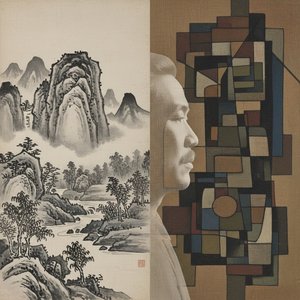 Yi Eungro: Bridging East & West in the Landscape of Korean ModernismExplore the captivating world of Yi Eungro (Lee Ungno), a pivotal figure in Korean modernism. Discover his unique fusion of Eastern and Wes…
 Spontaneity and Matter: Distinguishing CoBrA from Art InformelJean Dubuffet mixed sand, tar, and gravel into his 1947 works to create sculptural surfaces. Why did post-war artists reject traditional or…