Text size

() ·

A painting made for you, by hand

Isaac Newton

Hand Made Oil Reproduction

Hand-painted oil on canvas in your size and frame, made to order by our artists. ( Switch to Print Switch to Digital Image)

Collectible Description

William Blake

Artist Biography

A visionary of English Romanticism known for The Tyger. Discover his mystical illuminated prints and poetry today.

from ·

Chapter 1

How large should it be?

Slide to change the size; the picture on the left shows the frame at its real width. The proportions of the original are kept.

Standard
custom
CM
INCH

Pick from our preset sizes that match the artwork's original proportions.

width
height

Type the width and the height you need, to fit your frame or your wall. This is hand-painted, so for a size with a different shape the artist can paint a bit more around the picture, or cut a bit — you choose. We send you a digital mockup to approve before the painting starts. The picture shown on this page does not show the real result — only the mockup does.

Chapter 2

How should it arrive?

Choose the edges of the stretched canvas

Choose your frame

Corner sample of the WhiteWrap canvas edge finish, stretched on solid wood bars
White $1
Corner sample of the BlurSideWrap canvas edge finish, stretched on solid wood bars
Blurside $1
Corner sample of the ExtendedWrap canvas edge finish, stretched on solid wood bars
Extended $1
Corner sample of the P118B picture frame: moulded polystyrene, 5 cm wide and 3 cm thick
P118B $10
Corner sample of the P118H picture frame: moulded polystyrene, 5 cm wide and 3 cm thick
P118H $10
Corner sample of the P118W picture frame: moulded polystyrene, 5 cm wide and 3 cm thick
P118W $10
Corner sample of the P438Z picture frame: moulded polystyrene, 5.5 cm wide and 3.5 cm thick
P438Z $10
Corner sample of the P508JH picture frame: moulded polystyrene, 7 cm wide and 3.5 cm thick
P508JH $12
Corner sample of the P508YH picture frame: moulded polystyrene, 7 cm wide and 3.5 cm thick
P508YH $12
Corner sample of the P805H picture frame: moulded polystyrene, 5 cm wide and 3.5 cm thick
P805H $10
Corner sample of the P805Z picture frame: moulded polystyrene, 5 cm wide and 3.5 cm thick
P805Z $10
Corner sample of the P919BZ picture frame: moulded polystyrene, 7 cm wide and 3.5 cm thick
P919BZ $10
Corner sample of the P919G picture frame: moulded polystyrene, 7 cm wide and 3.5 cm thick
P919G $10
Corner sample of the P919XJ picture frame: moulded polystyrene, 7 cm wide and 3.5 cm thick
P919XJ $10
Corner sample of the P959ZH picture frame: moulded polystyrene, 5 cm wide and 3 cm thick
P959ZH $10
Corner sample of the P968JZ picture frame: moulded polystyrene, 6 cm wide and 4 cm thick
P968JZ $12
Corner sample of the W106C picture frame: solid wood, 5 cm wide and 3 cm thick
W106C $8
Corner sample of the W218G picture frame: solid wood, 5 cm wide and 3 cm thick
W218G $10
Corner sample of the W218JH picture frame: solid wood, 5 cm wide and 3 cm thick
W218JH $8
Corner sample of the W218Y picture frame: solid wood, 5 cm wide and 3 cm thick
W218Y $10
Corner sample of the W307PJ picture frame: solid wood, 6 cm wide and 3 cm thick
W307PJ $10
Corner sample of the W316G picture frame: solid wood, 6 cm wide and 3 cm thick
W316G $10
Corner sample of the W316PJ picture frame: solid wood, 6 cm wide and 3 cm thick
W316PJ $8
Corner sample of the W316Y picture frame: solid wood, 6 cm wide and 3 cm thick
W316Y $10
Corner sample of the W398PJ picture frame: solid wood, 5 cm wide and 3 cm thick
W398PJ $8
Corner sample of the W4111J picture frame: solid wood, 6.5 cm wide and 3.5 cm thick
W4111J $10
Corner sample of the W500HY picture frame: solid wood, 7 cm wide and 5 cm thick
W500HY $15
Corner sample of the W500JH picture frame: solid wood, 7 cm wide and 5 cm thick
W500JH $15
Corner sample of the W692G picture frame: solid wood, 8 cm wide and 4 cm thick
W692G $12
Corner sample of the W849H picture frame: solid wood, 5 cm wide and 3 cm thick
W849H $8
Corner sample of the W940BG picture frame: solid wood, 7.5 cm wide and 4.5 cm thick
W940BG $15
Corner sample of the W953PJ picture frame: solid wood, 6 cm wide and 3.5 cm thick
W953PJ $8
Corner sample of the H24-GOLD picture frame: carved wood with gesso, 10 cm wide and 6 cm thick
H24-GOLD $30
Corner sample of the H24-SILVER picture frame: carved wood with gesso, 10 cm wide and 6 cm thick
H24-SILVER $30
Corner sample of the H36-GOLD picture frame: carved wood with gesso, 15 cm wide and 6.5 cm thick
H36-GOLD $45
Corner sample of the H36-SILVER picture frame: carved wood with gesso, 15 cm wide and 6.5 cm thick
H36-SILVER $45
Frame preview
Framed

Moulding: . Overall size with the frame: .

Chapter 3

Who paints it, and should anything change?

Examples of what can be changed: Replace face with customer photo; Add pet (e.g., replace cat with dog); Include hidden message in background; Change background landscape or elements.
After order, OriginalUniqueArt.com team will email client for instructions and provide a mockup preview

Worldwide Delivery () in 3/4 weeks instead of standard 5 weeks. (9 November). No compromise on quality.

Chapter 4

The finishing touches

A nameplate, as in a museum?

Engraved Bronze Plaque Details

This elegant plaque features the artist's name and the title of the artwork, finely engraved for a timeless presentation.

It is made from bronze with a refined, elegant finish. The text is precisely laser-engraved for a sharp and permanent result. Measuring 9x2 cm, the plaque is compact yet easy to read. It's built to be durable and scratch-resistant, offering a professional, museum-quality look. Mounting is simple thanks to the included adhesive backing.

Transparent Acrylic Plaque Details

The plaque includes essential engraved details such as the artist's name, the title of the artwork, the date it was created, the type of media used-like oil on canvas or watercolor-a brief description of the piece, and a QR code that links to the complete artwork information.

It is crafted from clear acrylic, offering a sleek, modern appearance. The text is UV-engraved in black to ensure strong visual contrast. With a size of 10x15 cm, it ensures optimal readability. It comes equipped with two metal hooks for secure wall mounting. The plaque is designed to be weather-resistant, making it suitable for various environments, and it includes interactive features that work seamlessly with smartphone scanning.

Black Acrylic Plaque Details

This elegant plaque includes engraved information such as the artist's name, the title of the artwork, the date it was created, the type of media used (like oil on canvas or watercolor), a short description of the artwork, and a QR code for quick access to more information.

The plaque itself is made from refined black acrylic with a premium finish. The text is laser-engraved in white for high contrast and readability. Its size is 10x15 cm, designed to be easy to read. It comes with two metal hooks for professional mounting. The design is sleek and fits any interior style. It is also weather-resistant and durable, with built-in digital integration for mobile compatibility.

A protective varnish?

When do you need it?

Chapter 5

Your painting, as you ordered it

Isaac Newton

Reproduction Medium

Reproduction Size

-

Elite Senior Artist

More detail, finesse, and extra production time

-

Reproduction Frame

-

-

For artworks or reproductions larger than 105 cm (approximately 41 inches) on any side, the frame will be shipped as a kit, disassembled. This method ensures safe delivery and prevents damage during transport.

Professional assembly required - this is not a DIY product.
The kit must be assembled and the canvas stretched by an experienced professional framer, using wood glue (not supplied), a canvas stretching plier and clamps to hold the bars square while the glue dries. Incorrect assembly or uneven canvas tension can permanently damage the artwork and is not covered by our warranty.

  • All solid wood bars are included, precisely cut to size.

  • Assembled with the screws provided, plus wood glue for the corner joints, which is not supplied and must be sourced by your framer.

  • Professional tools are required and not included: a canvas stretching plier (tensioner) and clamps to hold the bars square while the glue dries.

Important:
The corner joints require wood glue, the bars must be held with clamps until the glue is fully dry, and tightening the canvas on the assembled frame requires a canvas stretching plier. None of these are included in the kit. Please arrange an experienced professional framer before ordering this size.

Nameplate

-

-

Protective Varnish

Glossy Varnish (enhances colors, protects against light/moisture)

-

Customize My Artwork

Examples of what can be changed: Replace face with customer photo; Add pet (e.g., replace cat with dog); Include hidden message in background; Change background landscape or elements.

-

Urgent

Worldwide Delivery () in 3/4 weeks instead of standard 5 weeks. (9 November). No compromise on quality.

-

Express Shipping

Worldwide Delivery () in 5 weeks. (16 November).

Included

Total Price

$ 300

Total Price $ 300

Glass option is only available in size under 110 CM

Included with every order

  • Free Worldwide Express Shipping
  • High-Quality Linen Canvas
  • Full Shipping Insurance
  • Customs Tax Refund Guarantee
  • True Color Matching Guarantee
  • 100-Day Return Policy (Defects Only)
  • 100% Money-Back Guarantee
  • Bulk Discount Offer

Isaac Newton

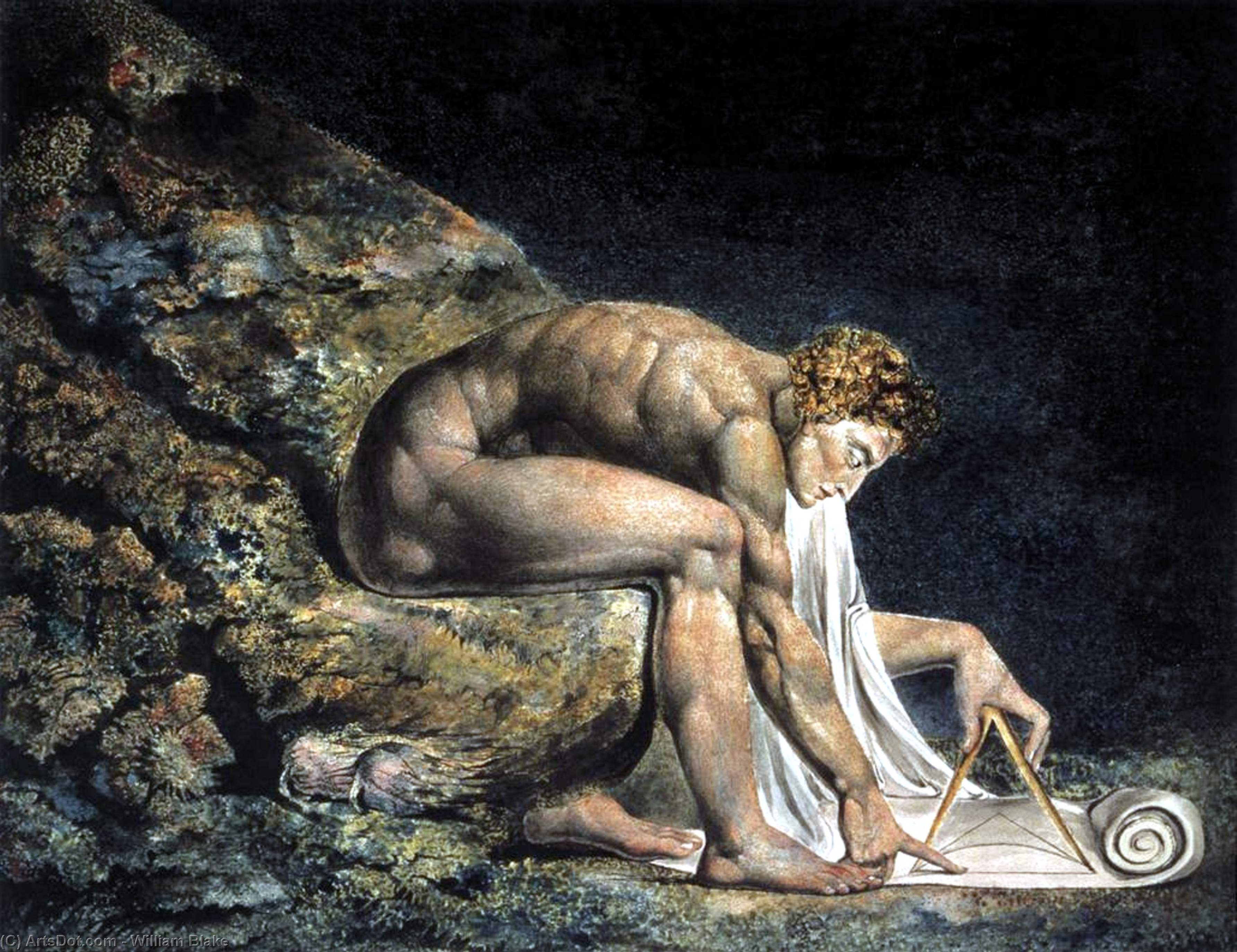
William Blake's Isaac Newton, created in 1795, is a captivating and thought-provoking engraving that showcases the artist's unique blend of mysticism and critique of scientific rationalism. This piece is part of the esteemed collection at the Tate Gallery in London, United Kingdom.

Blake’s depiction of Newton is not a traditional portrait but rather an allegorical representation. The figure of Newton is shown sitting on a rock, his back turned to the viewer, engrossed in his work. He is surrounded by elements that symbolize his scientific endeavors, such as a compass and a piece of cloth. The bird perched atop the rock adds a touch of mysticism, suggesting a connection between the natural world and human knowledge.

Blake's use of symbolism in Isaac Newton is multifaceted. The rock upon which he sits can be seen as a symbol of solidity and permanence, contrasting with the fluid, ever-changing nature of human understanding. Blake's work often explores the tension between reason and imagination, and Isaac Newton is no exception. By depicting Newton in this manner, Blake questions the dominance of scientific thought over other forms of knowledge and experience.

The engraving technique used by Blake adds a layer of depth and texture to the piece. The intricate details and the play of light and shadow create a sense of dimensionality, drawing the viewer into the world of the painting. This style is characteristic of Romanticism, emphasizing emotion, imagination, and individualism.

Blake's work was influenced by various artistic movements, including Romanticism and Neoclassicism. His unique blend of mysticism and critique of scientific rationalism places him at the forefront of innovative artists who challenged conventional norms. For those interested in exploring more of Blake’s works, William Blake:Isaac Newton and William Blake:Newton are available on OriginalUniqueArt. Additionally, the museum where this piece is housed, Tate Gallery, is discussed in detail at Discovering the Masterpieces of Tate Britain, United Kingdom.

This engraving captures a profound dichotomy—Newton’s unwavering focus on scientific observation juxtaposed against the ethereal presence of the bird and the rock. Blake deliberately avoids portraying Newton as merely a man of intellect; instead, he presents him as an embodiment of humanity's struggle to reconcile reason with intuition. The artist’s masterful use of chiaroscuro enhances this dramatic effect, highlighting Newton’s solitary posture and emphasizing the symbolic significance of his surroundings.

Considered alongside Blake’s broader philosophical concerns regarding the role of imagination in shaping human understanding, Isaac Newton stands as a powerful emblem of Romantic artistic vision. Its enduring appeal lies in its ability to provoke contemplation on the fundamental questions concerning human consciousness and our relationship with the natural world.

OriginalUniqueArt offers exceptional reproductions of William Blake’s Isaac Newton, meticulously crafted to preserve the artist's original aesthetic and technical brilliance. Explore high-quality prints that bring this iconic artwork into your home or office.

Questions & Answers

What art movement does "Isaac Newton" by William Blake belong to?

The movement associated with "Isaac Newton" by William Blake is Romanticism. This classification situates the work among related artists and artworks.

What is the recommended print size for "Isaac Newton" by William Blake?

The recommended print size for "Isaac Newton" by William Blake is large.

When was "Isaac Newton" created, and to which movement does it belong?

"Isaac Newton" was made in 1795, within the Romanticism movement.

More about this painting

Preview AR preview Switch to Print Switch to Digital Image Send
Details Guide Add to favorites Download Similars X-Ray Diaporama Q&A Stats

In numbers

  • 1795the year it was painted
  • 29frames to choose from
  • standard sizes, in its own proportions
  • 5weeks to paint and deliver it
William Blake

William Blake

1757 - 1827, United Kingdom

Quick facts about William Blake

  • Artistic Movement Or Style: Romanticism
  • Artists Or Movements Influenced By This Artist:
    • Pre-Raphaelite Brotherhood
    • Symbolism
    • Modernism
  • Artists Who Influenced This Artist:
    • Raphael
    • Michelangelo
  • Full Name: William Blake
  • Nationality: British
  • Notable Artworks:
    • The Ancient of Days
    • Isaac Newton
    • The Tyger
    • The Lamb
    • London
  • Place Of Birth: London, United Kingdom
  • Date Of Birth: 1757
  • Date Of Death: 1827

Artist Biography

Early Life, Family and Training

William Blake was born on November 28, 1757, in London, England. He was raised in a household above his father’s hosier shop at 28 Broad Street. His parents, James Blake and Catherine Wright Armitage Blake, provided a stable environment during a period of significant social change in the city. While his upbringing was marked by the modest means of a tradesman's family, his early years were defined by a singular, intense imagination that often manifested in visions, such as seeing angels in the branches of a tree during childhood walks.

Formal training began at the age of ten when he was enrolled at Henry Pars' drawing school. This early instruction provided the technical foundation for a career that would eventually move beyond simple sketching. By the age of 14, the necessity of practical work led him into a seven-year apprenticeship under the engraver James Basire. This period was essential to his development, as it introduced him to the rigorous mechanics of printmaking and the physical properties of metal and acid.

During his apprenticeship, Blake spent significant time sketching the tombs at Westminster Abbey. The Gothic architecture and the weathered stone of these monuments left a lasting impression on his aesthetic sensibilities. These studies allowed him to internalize the forms of the past, which he would later reinterpret through his own unique lens. His training was not merely a pursuit of craft, but a deep immersion into the visual language of history and structure.

Technique and Artistic Innovation

Blake’s creative process was defined by a restless desire to merge the written word with the visual image. He moved beyond the standard commercial engravings of his era to develop a unique method of relief etching for his illuminated books. This technique involved applying an acid-resistant varnish to copper plates, allowing him to etch both text and illustration into a single, integrated form. This method was not merely a technical choice but a spiritual one; he claimed the process was revealed to him through a visionary experience following the death of his brother, Robert. Working alongside his wife, Catherine, who assisted in the printing and coloring, he managed the entire production from the initial etching to the final stitching of the books.

His aesthetic was a deliberate departure from the rigid rules of his contemporaries. He rejected the traditional use of linear perspective, which sought to mimic the physical world, in favor of a more emotive and symbolic representation of space. This flattening of the visual field allowed him to prioritize the internal logic of his visions over the constraints of naturalism. To bring these visions to life, he frequently employed watercolors and tempera paints, applying color by hand to the printed sheets to achieve a specific, personal texture. His work was a labor of both hand and spirit, often produced in the quiet of his London home.

Key Works and Major Publications

The early output of his career began with the publication of Poetical Sketches in 1783. This initial collection of verse was followed by his most widely recognized lyrical achievements: Songs of Innocence in 1789 and Songs of Experience in 1794. These works established a recurring tension in his writing, exploring the contrast between a state of untainted childhood and the corruption of adult reality. Between 1790 and 1793, he produced The Marriage of Heaven and Hell, a provocative work that challenged established moral and religious doctrines through prose and verse.

His engagement with the political turbulence of his era found expression in his prophetic books. He produced America, a Prophecy in 1793 and Europe, a Prophecy in 1794, works that reflected the revolutionary spirit of the time. These publications were not merely texts but integrated visions where the etched image and the written word functioned as a single entity. His later years were marked by expansive, complex projects that required years of sustained effort.

The later stages of his life saw the development of massive, intricate cycles. He worked on the Milton series between 1804 and 1808, and his final major undertaking, Jerusalem, occupied him from 1804 until 1820. These works represent the culmination of his lifelong attempt to construct a private mythology, one that sought to reconcile the human spirit with the divine through a highly personal symbolic language.

Patrons, Workshop and Commissions

The financial reality of Blake’s life was often a struggle for stability. For much of his career, he earned a living as a journeyman engraver, taking on commercial work to sustain himself. In about 1784, he attempted to establish a more permanent professional footing by setting up a print shop alongside James Parker, a friend and former fellow apprentice. This venture, however, did not provide the lasting security he required. Instead, his livelihood frequently depended on the steady support of a few dedicated patrons, most notably Thomas Butts, whose patronage offered a vital lifeline to the artist's more personal pursuits.

His professional geography shifted as his circumstances changed. Between 1800 and 1803, Blake moved to the coastal town of Felpham. During this period, he lived and worked under the patronage of William Hayley. This time in Felpham provided a temporary reprieve from the urban pressures of London, allowing him to focus on his complex series of works. Even as he navigated the demands of commissions, his work remained deeply tied to the specific needs of those who supported his vision, often balancing the practical requirements of engraving for others with the private labor of his own illuminated printing.

Legacy and Enduring Influence

During his lifetime, Blake’s vision was often met with misunderstanding, his work frequently dismissed as the product of an eccentric or unstable mind. He lived a life of relative obscurity, often struggling for financial stability while working as an engraver. Yet, the very qualities that marginalized him in the early nineteenth century eventually secured his place as a pivotal figure in the Romantic movement. His insistence on the primacy of the imagination over the constraints of reason provided a blueprint for those who would later seek to break from traditional academic structures.

The impact of his singular style eventually reached beyond his immediate circle. The Pre-Raphaelite Brotherhood embraced him as a kindred spirit, finding common ground in his rejection of Neoclassical conventions. As the decades passed, his influence moved through the Symbolist and Modernist movements, finding resonance in their shared interest in subjective experience and spiritual depth. He did not merely illustrate poems; he constructed a private mythology that continues to provide a source of inspiration for poets, painters, and thinkers across various disciplines.

  • The Tyger
  • The Lamb
  • London
  • Jerusalem

Where to See the Works Today

The physical remnants of Blake’s vision are scattered across several major institutions, reflecting the global reach of his influence. In London, the Tate Gallery holds six of his works, including the significant 1795 depiction of Isaac Newton. This collection offers a substantial look at the technical precision he applied to his engravings and the way he translated complex spiritual concepts into visual form.

Across the Atlantic, his presence is felt in several prominent American collections. The Yale Center for British Art in New Haven maintains four works, such as the 1804 print of Los Entering the Grave. Meanwhile, the Museum of Fine Arts in Boston also holds four pieces, including his 1808 study of Adam and Eve Sleeping. These holdings allow for a comparative study of his development from a commercial engraver to a creator of independent, illuminated volumes.

His reach extends even further to the Southern Hemisphere. The National Gallery of Victoria in Melbourne contains one work, an 1827 piece titled Antaeus setting down Dante and Virgil in the last circle of hell. This single presence in Australia highlights the enduring international interest in his peculiar, highly personal mythology.
Quick Facts

  • Subject or theme: Science critique; Mysticism
  • Dimensions: 460 x 600 cm
  • Artistic style: Detailed engraving; Light and shadow play
  • Notable elements or techniques: Allegorical depiction; Compass; Bird
  • Influences: Neoclassicism
  • Location: Tate Gallery, London

Art Quiz

There is only one correct answer for each question.

Question 1:
What artistic movement is William Blake’s Isaac Newton primarily associated with?
Question 2:
Where was Isaac Newton depicted in Blake's engraving?
Question 3:
What symbol represents Newton’s scientific endeavors within the artwork?
Question 4:
Blake's engraving utilizes what artistic technique to create a sense of dimensionality?
Question 5:
What is the primary critique conveyed by Blake’s depiction of Newton regarding intellectual pursuits?