Origins & Early Masters: From Goldsmiths' Tools to Artistic Expression
The story of engraving isn’t one that begins with artists, but with artisans – the meticulous goldsmiths and metalworkers of antiquity. Long before it was celebrated as a fine art, engraving served a practical purpose: adorning precious objects, marking ownership, and creating intricate designs on armor and weaponry. These early practitioners developed the fundamental skills—the precise control of the burin, the understanding of how to manipulate metal surfaces—that would eventually lay the groundwork for artistic engraving. The earliest surviving examples, dating back to Germany in the late 1430s, were humble beginnings: playing cards decorated with drypoint technique, a precursor to more refined methods. However, it was during the Renaissance that engraving truly blossomed, transitioning from craft to an esteemed art form. Martin Schongauer stands as a pivotal figure, his precise lines and dramatic compositions establishing a new standard for printmaking. But it was Albrecht Dürer who arguably elevated engraving to its highest status. His mastery of both technique and symbolism—evident in works like “The Great Triumphal Car”—demonstrated the medium’s capacity for profound artistic expression.
The Technical Process of Engraving: Burins, Plates, and Ink
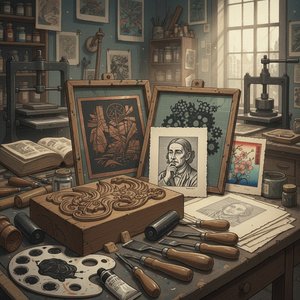
At the heart of engraving lies a deceptively simple process. A hardened steel tool, known as a burin or graver, is used to cut lines into a hard surface—typically a copper plate, though zinc has also been employed. Unlike relief printing where areas are raised, in engraving, the image exists within the incised grooves. This fundamental difference defines the aesthetic qualities of intaglio prints: their delicate detail, subtle tonal variations, and unique textural depth. The engraver doesn’t simply ‘draw’ on the plate; they *remove* material, creating a network of channels that will hold ink. The angle and pressure applied to the burin dictate the width and depth of these lines, influencing the final print's appearance. Once the design is complete, the plate is inked—a careful process involving applying ink to the surface, then meticulously wiping away excess from the flat areas, leaving it only within the engraved grooves. Dampened paper is then pressed firmly against the plate, often using a rolling press, transferring the ink and revealing the image. The resulting print is not merely a copy, but a unique artwork in its own right.
Engraving vs. Etching: Dissecting the Differences in Technique and Aesthetic
Often used interchangeably, engraving and etching are distinct printmaking techniques with markedly different characteristics. While both fall under the umbrella of intaglio printing—meaning the image is incised into a surface—the method of incision sets them apart. Engraving relies on direct cutting with a burin, demanding immense skill and precision. Etching, conversely, employs acid to bite into the metal plate. The artist covers the plate with an acid-resistant ground, then draws through it using etching needles or burins, exposing the copper beneath. The plate is then immersed in acid, which corrodes the exposed areas, creating the incised lines. This difference in process translates to a distinct aesthetic. Engraving typically features clean, sharp lines with a controlled quality, reflecting the deliberate hand of the artist. Etching, on the other hand, often exhibits softer lines and more varied textures due to the unpredictable nature of the acid bite. Rembrandt van Rijn masterfully exploited etching’s nuances, using it to create atmospheric depth and dramatic chiaroscuro effects in his renowned works.
Iconic Engravings & Their Historical Context: Dürer, Callot, and Beyond
The 15th and 16th centuries witnessed a flourishing of engraving, producing masterpieces that continue to captivate audiences today. Albrecht Dürer’s “Melancholia I” is perhaps the most iconic example, a complex allegorical work exploring themes of creativity, despair, and the human condition. His technical virtuosity—the intricate detail in the angel's wings, the precise rendering of geometric forms—remains unparalleled. Jacques Callot, a French engraver working in the 17th century, pushed the boundaries of the medium with his series “The Misères et les Malheurs de la Guerre” (Miseries and Calamities of War). These stark depictions of war’s brutality offered a powerful social commentary, influencing generations of artists. Beyond these giants, numerous other engravers contributed to the rich tapestry of this art form. The production of playing cards became a significant industry, while religious imagery and portraits remained popular subjects. The demand for engravings fueled their widespread dissemination, making art accessible to a broader audience than ever before.
The Enduring Legacy of Engraving: Influence on Printmaking & Modern Art
Though largely superseded by photographic processes in commercial applications, engraving’s influence continues to resonate within the world of printmaking and beyond. The techniques developed by early engravers—the precise control of line, the understanding of tonal variation—laid the foundation for subsequent methods like mezzotint and aquatint. Even today, artists continue to explore the possibilities of intaglio printing, pushing the boundaries of traditional approaches. The aesthetic qualities of engraving—its delicate detail, subtle textures, and unique atmosphere—have inspired countless painters, illustrators, and designers. The emphasis on craftsmanship and meticulous execution remains a hallmark of fine art printmaking. Furthermore, the historical importance of engravings as vehicles for social commentary and artistic expression continues to be recognized and celebrated. The legacy is not merely one of technique, but of storytelling, observation, and the enduring power of visual communication.
Collecting Engravings: Authenticity, Preservation, and Investment Potential
For those drawn to the beauty and historical significance of engravings, building a collection can be a deeply rewarding experience. However, navigating the art market requires careful consideration. Establishing authenticity is paramount—researching provenance (the history of ownership) and seeking expert appraisal are crucial steps. Condition plays a significant role in value; prints free from foxing (brown spots caused by oxidation), tears, or repairs command higher prices. Preservation is equally important. Framing engravings under UV-protective glass and maintaining stable environmental conditions (moderate temperature and humidity) will safeguard their longevity. While not all engravings represent substantial investments, works by renowned artists like Dürer and Callot consistently hold value—and often appreciate over time. OriginalUniqueArt
offers a curated selection of museum-quality reproductions, allowing you to experience the beauty of these masterpieces firsthand. We also provide free art consultation services to guide your collecting journey, ensuring informed decisions and lasting enjoyment. Explore our collection today and discover the timeless allure of engraving.