
 Preview
 Send
Send Share
Share
 Details
 Guide
Guide

 Download
 Similars
 X-Ray
X-Ray Diaporama
 Q&A
Q&A Stats
StatsBreakfast Piece

- 49.0 x 41.0 cm


 Read More
Giclée / Art Print
Museum-quality giclée or canvas print with fast production and flexible finish options. ( Buy Hand Made Painting Switch to Digital Image)




P118B $10

P118H $10

P118W $10

P438Z $10

P508JH $12

P508YH $12

P805H $10

P805Z $10

P919BZ $10

P919G $10

P919XJ $10

P959ZH $10

P968JZ $12

W106C $8

W218G $10

W218JH $8

W218Y $10

W307PJ $10

W316G $10

W316PJ $8

W316Y $10

W398PJ $8

W4111J $10

W500HY $15

W500JH $15

W692G $12

W849H $8

W940BG $15

W953PJ $8




Pick from our preset sizes that match the artwork's original proportions.

Type the width and the height you need, to fit your frame or your wall. A print can only be cut, never made bigger than the picture, so a size with a different shape loses a part of the image. We send you a digital mockup to approve before we print anything. The picture shown on this page does not show the real cut — only the mockup does.
Worldwide Delivery () in 2 weeks instead of standard 4/5 weeks. (9 November)

Free Worldwide Express Shipping

High-Quality Linen Canvas

Full Shipping Insurance

Customs Tax Refund Guarantee

True Color Matching Guarantee

100-Day Return Policy (Defects Only)

100% Money-Back Guarantee

Bulk Discount Offer
 Glass option is only available in size under 110 CM

Breakfast Piece
Giclée / Art Print
Reproduction Size
-


Total Price
$ 81
A Window into Dutch Domesticity: Willem van Aelst’s *Breakfast Piece*
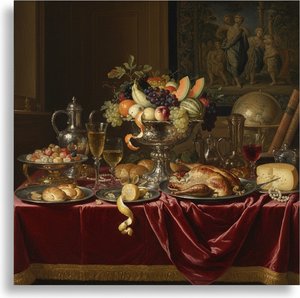
Willem van Aelst's *Breakfast Piece*, painted in 1671, is more than just a still life; it’s a meticulously crafted snapshot of 17th-century Dutch life, brimming with the quiet luxury and observant detail that defined the Golden Age. Measuring a modest 49 x 41 cm, this oil on canvas work, currently housed in the Academy of Fine Arts Vienna, offers a captivating glimpse into a world where even the most commonplace objects – a bowl of fruit, a loaf of bread, onions, and a glass vase – were elevated to subjects of profound artistic consideration. Van Aelst’s mastery lies not merely in his technical skill but in his ability to imbue these everyday items with a sense of palpable presence, inviting the viewer into an intimate moment of domestic tranquility.
Chiaroscuro and the Illusion of Depth
The painting's impact is immediately drawn from Van Aelst’s masterful use of chiaroscuro – the dramatic interplay of light and shadow. This technique isn’t simply decorative; it’s fundamental to creating a convincing illusion of three-dimensionality, allowing each object to appear almost tangible. The artist meticulously renders textures with astonishing accuracy: the rough skin of the onions contrasts sharply with the smooth surface of the glass vase, while the glistening fish reflects light in a way that suggests freshness and vitality. The dark tablecloth, acting as a stage backdrop, further emphasizes the luminous quality of the food items, drawing the eye towards their intricate details.
A Reflection of Dutch Society – Symbolism and Context
*Breakfast Piece* provides a valuable window into the social and cultural values of 17th-century Holland. The abundance of food—a symbol of prosperity and good fortune—reflects the economic strength of the Dutch Republic at the time. The composition, with its triangular arrangement, echoes classical principles of harmony and balance, reflecting the influence of Renaissance art on the Dutch Golden Age. While seemingly a simple still life, it subtly engages with the *vanitas* theme – a reminder of mortality and the fleeting nature of earthly pleasures – a common motif in Dutch Baroque painting. The artist’s meticulous attention to detail speaks to the importance placed on material possessions and the appreciation for beauty within the domestic sphere.
The Artistry of Willem van Aelst
Willem van Aelst was a true innovator in the field of still life painting. Born in Delft in 1626, he dedicated his career to capturing the nuances of everyday objects with unparalleled precision and artistry. His work exemplifies the meticulous realism that characterized the Dutch Golden Age, showcasing a deep understanding of light, texture, and composition. Van Aelst’s legacy rests on his ability to transform ordinary subjects into extraordinary works of art, solidifying his place as one of the most important still life painters of his era. This piece is a testament to his dedication to detail and his profound appreciation for the beauty found in the simplest of things.
Questions & Answers
What explains the copyright situation of "Breakfast Piece" by Willem Van Aelst?
"Breakfast Piece" by Willem Van Aelst is in the public domain - its copyright has expired. Copyright terms are measured from the artist's death, and Willem Van Aelst died in 1683.
How big is the original "Breakfast Piece"?
The original "Breakfast Piece" by Willem Van Aelst measures 49 x 41 cm.
In which movement and which era is "Breakfast Piece" by Willem Van Aelst placed?
"Breakfast Piece" belongs to the Baroque Still Life movement, and its creator worked in the Early-Modern era.
Artist Biography
A Master of the Dutch Golden Age
Willem van Aelst emerged from the storied streets of Delft as a preeminent figure of the Dutch Golden Age, a period defined by unparalleled prosperity and artistic refinement. Born into a family of prominent city magistrates, his path toward the canvas was paved by lineage and mentorship. He began his artistic journey under the watchful eye of his uncle, Evert van Aelst, a respected still-life painter who instilled in him the foundational techniques of the genre. By 1643, Van Aelst had officially entered the Guild of Saint Luke in Delft, marking his transition from pupil to master.
His early career was marked by an expansive, cosmopolitan spirit that took him far beyond the borders of the Netherlands. Between 1645 and 1649, he lived in France, and subsequently traveled to Italy, where his talents garnered international acclaim. In Florence, he served as a court painter to Ferdinando II de' Medici, the Grand Duke of Tuscany. During this illustrious period, he was known by the Italianized name Guillielmo d'Olanda, and his skill was so highly regarded that the Grand Duke publicly honored him with a gold chain and medal. This exposure to the Mediterranean light and the sophisticated tastes of the Medici court undoubtedly enriched his visual vocabulary.
The Art of Stillness and Symbolism
Van Aelst specialized in the exquisite realms of still-life painting, specifically focusing on floral arrangements and game. His work is celebrated for its ability to transform the mundane into the magnificent. Whether depicting a Breakfast Piece or a collection of hunting trophies, he possessed a singular ability to imbue inanimate objects with a palpable, breathing presence. His compositions often utilized chiaroscuro—the dramatic interplay of light and shadow—to create a profound illusion of depth and texture. In his hands, the rough skin of an onion, the delicate translucency of a glass vase, or the glistening feathers of a bird became subjects of intense psychological and sensory engagement.
Beyond mere technical virtuosity, Van Aelst’s paintings served as complex tapestries of meaning. His works often explored the tension between beauty and decay, reflecting the 17th-century fascination with vanitas—the fleeting nature of life. In pieces such as his Still-Life of Dead Birds and Hunting Weapons, he captured a haunting beauty that spoke to themes of honor, death, and the precarious balance of the natural world. His ability to weave together prosperity and mortality allowed his art to resonate deeply with the social and cultural values of the Dutch Republic.
Legacy and Artistic Influence
Upon returning to the Netherlands, Van Aelst settled in Amsterdam, where he became one of the most prominent still-life painters of his generation. His success allowed him to reside in the prestigious Prinsengracht district, a testament to his standing in the art world. His influence extended far beyond his own brushstrokes, as he became a teacher to several notable artists who would carry forward the traditions of Dutch still life, including:
- Rachel Ruysch
- Isaac Denies
- Maria van Oosterwijck
- Ernst Stuven
The historical significance of Willem van Aelst lies not only in his individual mastery but in his role as a bridge between the local traditions of Delft and the grander European courts. His works remain preserved in some of the world's most esteemed institutions, including the National Gallery of Art and the Staatliche Museen zu Berlin, ensuring that his meticulous observations of life, light, and shadow continue to captivate viewers centuries after his passing.

Willem Van Aelst
1626 - 1683 , Netherlands
Quick Facts
- Artistic Movement Or Style: Dutch Golden Age
- Artists Or Movements Influenced By This Artist:
- Rachel Ruysch
- Isaac Denies
- Maria van Oosterwijck
- Ernst Stuven
- Artists Who Influenced This Artist:
- Evert van Aelst
- Otto Marseus van Schrieck
- Full Name: Willem van Aelst
- Nationality: Dutch
- Notable Artworks:
- Breakfast Piece
- Still Life with Fowl
- Still-Life of Dead Birds and Hunting Weapons
- Place Of Birth: Delft, Netherlands
- Date Of Birth: 1626
- Date Of Death: 1683
Related Articles

Willem van de Velde the Elder: Master of Maritime Painting & Chronicler of the Dutch Golden Age
Discover the captivating maritime paintings of Willem van de Velde the Elder, a master chronicler of the Dutch Golden Age. Explore his unparalleled realism and lasting influence on naval art history.
Abraham Hendricksz van Beyeren: Pioneering Dutch Still Life & the Banquet Tradition
Explore the captivating world of Dutch Golden Age still life with Abraham van Beyeren. Discover his innovative techniques, symbolic banquet scenes & lasting influence on art history. Learn about collecting these masterpieces.

Golden Light & Dutch Skies: The Timeless Magic of Dutch Golden Age Landscapes
Discover the breathtaking beauty of Dutch Golden Age landscapes. Explore the mastery of light, chiaroscuro, and 17th-century realism through an expert art history lens, celebrating the enduring legacy of the Dutch Masters for discerning collectors and art lovers.

Masterpieces of Light: The Top 25 Artworks by Rembrandt van Rijn
Explore 25 iconic Rembrandt masterpieces from the Dutch Golden Age. Discover the genius of light and shadow. Explore the full collection online.

Dutch Masters: 10 Golden Age Paintings That Still Inspire |
Journey into the Dutch Golden Age! Explore 10 iconic paintings by Rembrandt, Vermeer & Hals. Discover the stories behind these Baroque masterpieces and find museum-quality art reproductions to elevate your home decor on .


