Preview
 Send
Send Share
Share
 Details
 Guide
Guide

 Download
 Similars
 X-Ray
X-Ray Diaporama
 Stats
StatsStill Rose


 Read More
The artwork displayed on this page is protected by copyright law, which means we cannot legally create or sell an identical reproduction. This protection is enforced under international agreements such as the Berne Convention and by national laws, including those outlined by the U.S. Copyright Law - Title 17.
This method fully complies with copyright regulations because it does not involve copying or duplicating the protected artwork. Instead, it is a creative reinterpretation - a new painting that is influenced by the original but not identical to it.
Giclée / Art Print
Museum-quality giclée or canvas print with fast production and flexible finish options. ( Buy Hand Made Painting Switch to Digital Image)

White $1

Blurside $1

Extended $1

































Pick from our preset sizes that match the artwork's original proportions.

Type the width and the height you need, to fit your frame or your wall. A print can only be cut, never made bigger than the picture, so a size with a different shape loses a part of the image. We send you a digital mockup to approve before we print anything. The picture shown on this page does not show the real cut — only the mockup does.
Worldwide Delivery () in 2 weeks instead of standard 4/5 weeks. (24 October)

Free Worldwide Express Shipping

High-Quality Linen Canvas

Full Shipping Insurance

Customs Tax Refund Guarantee

True Color Matching Guarantee

100-Day Return Policy (Defects Only)

100% Money-Back Guarantee

Bulk Discount Offer
 Glass option is only available in size under 110 CM

Still Rose
Giclée / Art Print
Reproduction Size
-


Total Price
$ 81
A Symphony of Crimson: The Immersive Power of Still Rose
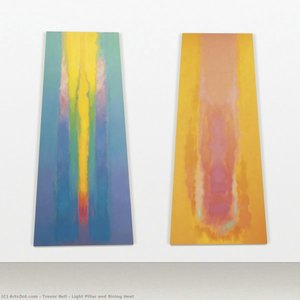
In the realm of abstract expressionism, few works command the immediate attention of a room quite like Still Rose. This large-scale masterpiece by the esteemed British artist Trevor Bell is not merely a painting, but an atmospheric experience that envelops the viewer in a warm, pulsating glow. At first glance, the eye is met with a breathtaking gradient of fire and earth; a vibrant, sun-drenched orange at the upper reaches of the canvas gradually descends into a deep, saturated crimson at its base. There is no subject to distract the mind, no figure to anchor the gaze—only the pure, unadulter than raw emotion of color itself. The composition operates on a flat plane, yet through the masterful manipulation of hue, it creates an illusion of receding space, pulling the observer into a meditative, infinite horizon.
The technical brilliance of Still Rose lies in its seamless transitions and the subtle, tactile quality of its surface. Utilizing what appears to be a sophisticated wet-on-wet blending technique, Bell achieved a smoothness that feels almost liquid. Upon closer inspection, one can discern the delicate traces of layering and brushwork that prevent the piece from feeling static. These minute textural variations catch the light, lending a sense of movement to the color field as if the painting were breathing. This mastery of medium ensures that the work remains dynamic, shifting its character depending on the ambient lighting of the room, making it an extraordinary centerpiece for any sophisticated interior.
Beyond its aesthetic splendor, the painting carries a profound symbolic weight. The choice of red and orange—colors intrinsically linked to passion, energy, and the primal warmth of a setting sun—evokes a dual sense of intensity and comfort. While the deep reds can suggest the heat of danger or the depth of human emotion, the soft transitions provide a sanctuary for contemplation. For the collector or interior designer, this piece offers a unique opportunity to introduce a focal point that is both bold and tranquil. It serves as an anchor in modern decor, providing a sophisticated backdrop that complements minimalist aesthetics while injecting a much-needed pulse of vitality into a living space or gallery.
As a significant figure associated with the influential St Ives School, Trevor Bell’s legacy is one of boundary-pushing abstraction. In Still Rose, we see the culmination of his lifelong devotion to color and form. Owning a high-quality reproduction of this work allows one to bring a piece of British art history into the home—a fragment of a movement that redefined how we perceive light and space. It is an invitation to pause, to breathe, and to lose oneself in the eternal glow of a single, perfect moment captured in pigment.
Questions & Answers
Does the copyright of "Still Rose" by Trevor Bell allow reproductions?
"Still Rose" by Trevor Bell, held at the Museum of Fine Arts, is still protected by copyright. This status determines whether reproductions of the image may be made.
What subject and atmosphere does "Still Rose" by Trevor Bell combine?
"Still Rose" by Trevor Bell combines abstract expressionism, color field painting, red orange palette, meditative art, emotional color, modern abstraction, bold color artwork with a bold atmosphere.
What color palette is used in "Still Rose" by Trevor Bell?
The palette of "Still Rose" by Trevor Bell is described as dark. It is a compact description of the work's colors.
Artist Biography
A Visionary of Form: The Life and Legacy of Trevor Bell
In the vibrant tapestry of twentieth-century British abstraction, few threads are as strikingly colored or structurally daring as those woven by Trevor Bell. Born in Leeds in 1930, Bell emerged from the industrial heart of England to become a transformative force within the prestigious St Ives School. His journey was one of profound metamorphosis, moving from the structured academic training of his youth toward a radical reimagining of what a painting could be. To encounter a Bell original is to step into a world where the boundaries of the frame dissolve, replaced by a rhythmic dance of geometry and light that continues to captivate the modern eye.
The trajectory of Bell’s career was irrevocably altered in 1955 when, drawn by the magnetic pull of the Cornish coast and encouraged by his contemporary Terry Frost, he relocated to Cornwall. This move was far more than a change in geography; it was an immersion into a crucible of creative innovation. Surrounded by the rugged landscapes and the pioneering spirits of artists like Peter Lanyon and Barbara Hepworth, Bell began to move away from representational echoes toward a pure exploration of Abstract Expressionism. The salt-sprayed light and undulating topography of St Ives provided the essential catalyst for his fascination with how color and shape could evoke the essence of nature without mimicking its literal form.
The Revolution of the Shaped Canvas
As Bell’s artistic consciousness deepened, he began to challenge the very architecture of the medium. He grew dissatisfied with the traditional rectangular window of the canvas, viewing it as a restrictive container that imposed an artificial limit on the energy of his compositions. This dissatisfaction birthed one of his most significant contributions to modern art: the shaped canvas. By manipulating the physical edges of his work, Bell allowed the painted forms to bleed into the surrounding space, creating an organic continuity between the artwork and its environment.
These experimental formats were not merely aesthetic whims but profound structural statements. Through these non-traditional boundaries, he achieved several artistic breakthroughs:
- Dynamic Interconnectivity: The edges of the canvas became active participants in the composition, guiding the viewer's eye through interlocking geometric segments.
- Spatial Expansion: His work broke the "fourth wall" of traditional painting, suggesting that the energy of the colors extended far beyond the physical fabric.
- Structural Harmony: The interplay between bold, saturated hues and meticulously calculated shapes created a sense of balanced tension, mirroring the natural rhythms of the Cornish landscape.
A Lasting Impression on British Abstraction
The historical significance of Trevor Bell lies in his ability to marry the visceral emotion of abstraction with a rigorous, almost architectural precision. While many of his contemporaries focused on the gestural spontaneity of action painting, Bell sought a more structured equilibrium. His work stands as a testament to a period when British art was bravely redefining itself on the global stage, moving away from pastoral traditions toward a sophisticated, international language of form.
Throughout his decades of experimentation, Bell remained a steadfast explorer of the relationship between color and perception. His legacy is preserved not just in museum collections, but in the very way we perceive the limits of the frame. He taught us that art need not be contained by borders, but can instead exist as an expansive, breathing entity. Today, his influence persists in the works of contemporary abstract artists who continue to push the boundaries of shape and space, forever indebted to the bold, geometric courage of this Leeds-born pioneer.

Trevor Bell
1930 - 2017 , United Kingdom
Quick Facts
- Full Name: Trevor Bell
- Nationality: British
- Date Of Birth: 1930
- Date Of Death: 2017
- Place Of Birth: Leeds, United Kingdom
- Notable Artworks:
- Studio with florida queen on the rear wall
- Still Rose
- Untitled
- Artistic Movement Or Style: Abstract Expressionism
- Artists Who Influenced This Artist: ['Terry Frost']
- Artists Or Movements Influenced By This Artist: ['Abstract Expressionism']
Related Articles
Mark Rothko's Masterpieces: 25 Paintings That Define Abstract Expressionism | OriginalUniqueArt
Explore 25 iconic Mark Rothko paintings that define Abstract Expressionism. Discover the stories, colors & emotions behind these masterpieces. Find museum-quality art reproductions and curated decor ideas at OriginalUniqueArt.com.

Geometric Abstraction's 10 Defining Masterpieces | Art for Your Home - OriginalUniqueArt
Explore 10 defining masterpieces of Geometric Abstraction! Discover Kandinsky, Mondrian & Malevich’s iconic works. Find museum-quality art reproductions and curated decor ideas to elevate your home at OriginalUniqueArt.com.
Jacob Kainen: A Pioneer of American Color Field Painting & Abstract Expressionism
Explore the life & work of Jacob Kainen, a pivotal figure in American Abstract Expressionism and Color Field painting. Discover his journey from Social Realism to vibrant abstraction and lasting influence on 20th-century art.

Kandinsky's Masterpieces: 25 Paintings That Define Abstract Art | OriginalUniqueArt
Journey through Wassily Kandinsky's 25 most iconic abstract paintings. Explore his revolutionary use of color, form & spiritual expressionism. Find museum-quality Kandinsky reproductions and elevate your home decor with OriginalUniqueArt.com. Discover all masterpieces on OriginalUniqueArt.com!

Abstract Expressionism's 10 Defining Masterpieces |
Explore 10 defining Abstract Expressionism masterpieces by Pollock, Rothko & de Kooning. Discover the stories behind these iconic paintings and find museum-quality art reproductions to elevate your home decor on .