Modernism
Study for ''Eye Level'' (Stuart Davis)
Stuart Davis (1892–1964) made Study for ''Eye Level''. It belongs to the Modernism movement.

 Preview

 Hand Made Oil Painting
 Send
 Share
 Fact sheet


 Download
 Similars
 X-Ray
 Diaporama
 Q&A

 Stats
Study for ''Eye Level'', in brief
- Title
- Study for ''Eye Level''
- Artist
- Stuart Davis (1892–1964)
- Artist born in
- Philadelphia, United States
- Movement
- Modernism
- Subject
- study
High-resolution images of Study for ''Eye Level''
Protected by copyright: the image is shown for reference only.
Other sizes, crops and citation →Stuart Davis, Study for ''Eye Level''.
Questions on Study for ''Eye Level'', answered
What is "Study for ''Eye Level''" about?
The themes present in "Study for ''Eye Level''" by Stuart Davis include study. Together they summarize the artwork's subject matter.
Is "Study for ''Eye Level''" free of copyright?
"Study for ''Eye Level''" by Stuart Davis is still protected by copyright. This status governs how the image of the work may be reproduced.
Who is the artist behind "Study for ''Eye Level''"?
"Study for ''Eye Level''" is attributed to Stuart Davis.
What art movement does "Study for ''Eye Level''" by Stuart Davis belong to?
The movement associated with "Study for ''Eye Level''" by Stuart Davis is Modernism. This classification situates the work among related artists and artworks.
Is "Study for ''Eye Level''" by Stuart Davis in the public domain, and why?
"Study for ''Eye Level''" by Stuart Davis is still protected by copyright. Copyright terms are measured from the artist's death, and Stuart Davis died in 1964.
About the artist, Stuart Davis
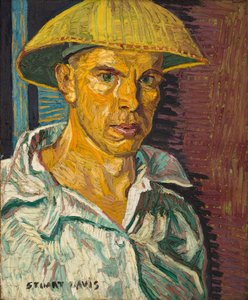
1892–1964, United States
Stuart Davis
Stuart Davis: A Pioneer of American Modernism Early Life and Training Born on December 7, 1892, in Philadelphia, Stuart Davis was immersed in an artistic environment from a young age. His father, Edward Wyatt Davis, served as the art editor for the Philadelphia Press, while his mother, Helen Stuart Davis, was a sculptor. This familial background undoubtedly fostered his early interest in visual arts. Davis received formal training at the Robert Henri School of Art in New York City from 1909 to 1912 under the guidance of Robert Henri.
Also by Stuart Davis
 Odol
 Lucky Strike1924
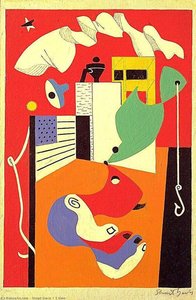 T View1951
 Blue Café1928
Essays around Study for ''Eye Level''
 Top 25 Masterpieces by David Moreau: A Journey Through Texture and LightExplore 25 iconic David Moreau textured masterpieces. Discover museum-quality reproductions on OriginalUniqueArt.com.
 Masterpieces of Fernand Léger: The Top 25 Essential WorksExplore the top 25 masterpieces by Fernand Léger. Discover the essence of Cubism and modernism. Explore the full collection online at Origi…
 Stuart Davis: Modernist Abstraction & the Vibrant Spirit of the Jazz AgeExplore the vibrant world of Stuart Davis, a pioneer of American Modernism. Discover his jazz-inspired paintings, signature style & investm…