Switch to Print
 Read More







































 For artworks or reproductions larger than 105 cm (approximately 41 inches) on any side, the frame will be shipped as a kit, disassembled. This method ensures safe delivery and prevents damage during transport.


A Window Into Renaissance Dignity
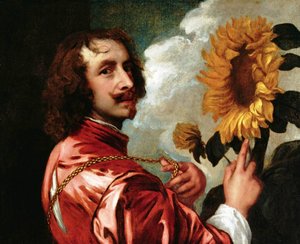
In his 1621 self-portrait, Sir Anthony van Dyck presents far more than a mere reflection of his own features; he offers a profound meditation on identity and the burgeoning ambitions of a rising star. The artist captures himself in a formal, commanding pose, seated against a dark, atmospheric backdrop that serves to push his presence toward the viewer. This deliberate use of chiaroscuro—the masterful manipulation of light and shadow—creates a dramatic luminosity across his face and robe, ensuring that his gaze becomes the focal point of the composition. There is an undeniable aura of confidence in this work, as if Van Dyck is not simply documenting his likeness but actively constructing the persona of a sophisticated gentleman.
The technique employed here is a testament to the artist's extraordinary skill with oil on canvas. His meticulous brushwork achieves an astonishing level of detail, capturing the subtle textures of skin and the heavy, luxurious drape of his clothing. The way light dances upon the gold trim of his black robe suggests a tactile richness that invites the eye to linger. Through this precise execution, Van Dyck demonstrates a profound understanding of anatomy and the interplay of light, lending the portrait a sense of depth and dynamism that is characteristic of the Baroque style.
Symbolism and the Soul of the Artist
Beyond the physical mastery of the piece lies a rich tapestry of symbolism designed to convey status and introspection. The dark sky or backdrop functions as more than an atmospheric element; it symbolizes a space of deep contemplation, mirroring the artist’s own inward gaze. Within this shadowy realm, the gold trim on his attire serves as a subtle yet powerful signifier of prestige and social standing, reflecting Van Dyck’s connection to the aristocratic circles he would later come to define. Even the warm tones found in his hair and beard are intentional, conveying a sense of maturity and wisdom that bolsters the portrait's message of dignified self-representation.
For the collector or interior designer, this reproduction offers an evocative emotional impact. To view this work is to enter a moment of quiet contemplation, connecting with an artist grappling with the complexities of his own purpose and place in the world. It is a piece that brings a sense of historical weight and intellectual depth to any space, acting as a conversation starter that celebrates the enduring power of portraiture to convey human emotion and the indomitable spirit of the individual.
Questions & Answers
What color harmony does "Self Portrait" by Sir Anthony van Dyck display?
The color harmony of "Self Portrait" is recorded as strong color unity.
What print size of "Self Portrait" by Sir Anthony van Dyck fits the recommended room?
In a living room, "Self Portrait" is suggested at a medium print size.
What are the reproduction rights of "Self Portrait" at the Alte Pinakothek?
"Self Portrait" by Sir Anthony van Dyck, held at the Alte Pinakothek, is in the public domain - its copyright has expired. This status determines whether reproductions of the image may be made.
More about this painting
 Preview
 Send
Send Share
Share
 Details
 Guide
Guide

 Download
 Similars
 X-Ray
X-Ray Diaporama
 Q&A
Q&A Stats
Stats