Read More


 For artworks or reproductions larger than 105 cm (approximately 41 inches) on any side, the frame will be shipped as a kit, disassembled. This method ensures safe delivery and prevents damage during transport.


More about this painting
Text size

() ·
A painting made for you, by hand
Hand Made Oil Reproduction
Hand-painted oil on canvas in your size and frame, made to order by our artists. ( Switch to Print Switch to Digital Image)
Artist Biography
A Venetian Baroque master known for Bacchus and Ariadne. Discover his luminous and vigorous paintings today.
from ·
Chapter 1
How large should it be?
Slide to change the size; the picture on the left shows the frame at its real width. The proportions of the original are kept.
Standard
custom
CM
INCH
Pick from our preset sizes that match the artwork's original proportions.
Loading sizes...

width
height
Type the width and the height you need, to fit your frame or your wall. This is hand-painted, so for a size with a different shape the artist can paint a bit more around the picture, or cut a bit — you choose. We send you a digital mockup to approve before the painting starts. The picture shown on this page does not show the real result — only the mockup does.
Chapter 2
How should it arrive?
Choose the edges of the stretched canvas
Choose your frame

White $1

Blurside $1

Extended $1

P118B $10

P118H $10

P118W $10

P438Z $10

P508JH $12

P508YH $12

P805H $10

P805Z $10

P919BZ $10

P919G $10

P919XJ $10

P959ZH $10

P968JZ $12

W106C $8

W218G $10

W218JH $8

W218Y $10

W307PJ $10

W316G $10

W316PJ $8

W316Y $10

W398PJ $8

W4111J $10

W500HY $15

W500JH $15

W692G $12

W849H $8

W940BG $15

W953PJ $8

H24-GOLD $30

H24-SILVER $30

H36-GOLD $45

H36-SILVER $45
Framed
Moulding: . Overall size with the frame: .
Chapter 3
Who paints it, and should anything change?
Examples of what can be changed: Replace face with customer photo; Add pet (e.g., replace cat with dog); Include hidden message in background; Change background landscape or elements.
After order, OriginalUniqueArt.com team will email client for instructions and provide a mockup preview
After order, OriginalUniqueArt.com team will email client for instructions and provide a mockup preview
Worldwide Delivery () in 3/4 weeks instead of standard 5 weeks. (9 November). No compromise on quality.
Chapter 4
The finishing touches
A nameplate, as in a museum?
Engraved Bronze Plaque Details
This elegant plaque features the artist's name and the title of the artwork, finely engraved for a timeless presentation.
It is made from bronze with a refined, elegant finish. The text is precisely laser-engraved for a sharp and permanent result. Measuring 9x2 cm, the plaque is compact yet easy to read. It's built to be durable and scratch-resistant, offering a professional, museum-quality look. Mounting is simple thanks to the included adhesive backing.
Transparent Acrylic Plaque Details
The plaque includes essential engraved details such as the artist's name, the title of the artwork, the date it was created, the type of media used-like oil on canvas or watercolor-a brief description of the piece, and a QR code that links to the complete artwork information.
It is crafted from clear acrylic, offering a sleek, modern appearance. The text is UV-engraved in black to ensure strong visual contrast. With a size of 10x15 cm, it ensures optimal readability. It comes equipped with two metal hooks for secure wall mounting. The plaque is designed to be weather-resistant, making it suitable for various environments, and it includes interactive features that work seamlessly with smartphone scanning.
Black Acrylic Plaque Details
This elegant plaque includes engraved information such as the artist's name, the title of the artwork, the date it was created, the type of media used (like oil on canvas or watercolor), a short description of the artwork, and a QR code for quick access to more information.
The plaque itself is made from refined black acrylic with a premium finish. The text is laser-engraved in white for high contrast and readability. Its size is 10x15 cm, designed to be easy to read. It comes with two metal hooks for professional mounting. The design is sleek and fits any interior style. It is also weather-resistant and durable, with built-in digital integration for mobile compatibility.
A protective varnish?
When do you need it?
Chapter 5
Your painting, as you ordered it
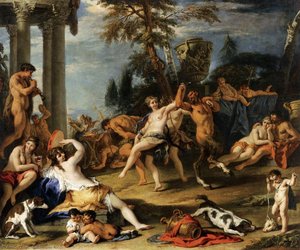
Cupid before Jupiter (Central Section)
Reproduction Medium
Reproduction Size
-
Elite Senior Artist
More detail, finesse, and extra production time
-
Reproduction Frame
-
-
For artworks or reproductions larger than 105 cm (approximately 41 inches) on any side, the frame will be shipped as a kit, disassembled. This method ensures safe delivery and prevents damage during transport.
Professional assembly required - this is not a DIY product.
The kit must be assembled and the canvas stretched by an experienced professional framer, using wood glue (not supplied), a canvas stretching plier and clamps to hold the bars square while the glue dries. Incorrect assembly or uneven canvas tension can permanently damage the artwork and is not covered by our warranty.
All solid wood bars are included, precisely cut to size.
Assembled with the screws provided, plus wood glue for the corner joints, which is not supplied and must be sourced by your framer.
Professional tools are required and not included: a canvas stretching plier (tensioner) and clamps to hold the bars square while the glue dries.
Important:
The corner joints require wood glue, the bars must be held with clamps until the glue is fully dry, and tightening the canvas on the assembled frame requires a canvas stretching plier. None of these are included in the kit. Please arrange an experienced professional framer before ordering this size.
Nameplate
-
-
Protective Varnish
Glossy Varnish (enhances colors, protects against light/moisture)
-
Customize My Artwork
Examples of what can be changed: Replace face with customer photo; Add pet (e.g., replace cat with dog); Include hidden message in background; Change background landscape or elements.
-
Urgent
Worldwide Delivery () in 3/4 weeks instead of standard 5 weeks. (9 November). No compromise on quality.
-
Express Shipping
Worldwide Delivery () in 5 weeks. (16 November).
Included
Total Price
$ 300
Glass option is only available in size under 110 CM
Included with every order
- Free Worldwide Express Shipping
- High-Quality Linen Canvas
- Full Shipping Insurance
- Customs Tax Refund Guarantee
- True Color Matching Guarantee
- 100-Day Return Policy (Defects Only)
- 100% Money-Back Guarantee
- Bulk Discount Offer
 Preview
 Send
Send Share
Share
 Details
 Guide
Guide

 Download
 Similars
 X-Ray
X-Ray Diaporama
 Q&A
Q&A Stats
StatsIn numbers
- 1715the year it was painted
- 29frames to choose from
- standard sizes, in its own proportions
- 5weeks to paint and deliver it
About the original

- 269.0 x 345.0 cm


Sebastiano Ricci
1659 - 1734, Italy
Quick facts about Sebastiano Ricci
- Artistic Movement Or Style: Late Baroque school of Venice
- Artists Or Movements Influenced By This Artist: ['Giovanni Domenico Ferretti']
- Artists Who Influenced This Artist: ['Giovanni Gioseffo Dal Sole']
- Full Name: Sebastiano Ricci
- Nationality: Italian
- Notable Artworks:
- Bacchus and Ariadne
- Memorial to Admiral Sir Clowdisley Shovell
- Venus takes leave from Adonis
- Place Of Birth: Belluno, Italy
- Date Of Birth: 1659
- Date Of Death: 1734
Artist Biography
The Life of Sebastiano Ricci
Born in Belluno, Italy, on August 1, 1659, Sebastiano Ricci entered a world that would eventually see him become a central figure in the late Baroque period of Venetian painting. The son of Andreana and Livio Ricci, his early years were shaped by the traditions of the Veneto, though his path was marked by significant personal turbulence. He was a man of restless energy, a trait that saw him navigate both the heights of international patronage and the depths of legal scandal. In 1678, a youthful indiscretion led to his imprisonment, an event that would shadow his reputation even as his talent drew him toward the great centers of Italian art.
His life was a series of movements between cities, driven by both professional necessity and personal flight. He moved through Bologna and Rome, often finding himself at the center of controversy. In 1688, he fled Bologna for Turin, traveling with Magdalen, the daughter of the painter Giovanni Peruzzini. This period of instability was punctuated by further legal troubles, including an incident that nearly cost him his life before the intervention of the Duke of Parma secured his freedom. These trials did not halt his ascent; instead, they became part of the complex narrative of a man who lived as intensely as he painted.
By the time of his death on May 15, 1734, Ricci had established himself as a painter of significant reach, moving between the courts of Italy and the salons of France and England. He left behind a body of work that bridged the gap between the heavy drama of the Baroque and the lighter grace of the coming Rococo. His life was a study in contrast, much like the light and shadow he employed on canvas.
Early Life, Family and Training
Born in the picturesque town of Belluno, Italy, Sebastiano Ricci was the son of Andreana and Livio Ricci. His path toward the canvas began in earnest in 1671 when he was apprenticed to Federico Cervelli in Venice. While the details of his earliest instruction remain subject to historical debate, some sources suggest that his first master was actually Sebastiano Mazzoni. These formative years in Venice provided the foundation for a career that would eventually bridge the gap between the late Baroque and the emerging Rococo style.
The trajectory of his youth was marked by both artistic promise and personal volatility. In 1678, a youthful indiscretion led to his imprisonment, a period of turmoil that would recur throughout his life. Despite such interruptions, his talent remained a constant. He was part of a significant artistic lineage, notably serving as the uncle to the painter Marco Ricci, who would later become an innovator in landscape painting.
Artistic Activity in Bologna and Rome
After leaving the formative years of his training, Ricci’s path led him to Bologna, where his developing hand began to absorb the local atmosphere. During this period, his painting style was shaped by the influence of Giovanni Gioseffo dal Sole. This exposure helped refine his approach to composition before his career took him toward the more demanding centers of Italian art.
The year 1682 brought a significant contract from the Fraternity of Saint John of Florence, requesting a depiction of the Decapitation of John the Baptist. This period of professional growth was marked by both artistic advancement and personal instability. Following a period of exile and legal difficulty, he found refuge in the service of the Duke of Parma. The Duke provided him with a monthly salary of 25 crowns and lodging within the Farnese palace in Rome, offering a stability that his earlier years had lacked.
His presence in Rome eventually led to high-level diplomatic commissions. In 1692, he was tasked with a significant undertaking for the French crown: copying Raphael's Coronation of Charlemagne in Vatican City for Louis XIV. This assignment required a disciplined adherence to the established masters, a task he completed by 1694. Such responsibilities placed him in direct contact with the highest levels of European patronage, bridging the gap between his early struggles and his eventual status as an international figure.
Patrons, Workshop and Commissions
Ricci’s career was defined by a restless movement between the great courts of Europe, driven by both high-level patronage and the necessity of escape. His reputation for grand decorative schemes led to significant appointments, such as his work for the Grand Duke Ferdinando de' Medici. In Florence, Ricci collaborated with Giuseppe Tonelli to decorate rooms within the Pitti Palace, a commission that solidified his standing among the Italian nobility. His reach extended far beyond the Italian peninsula, as his talent was sought by the French crown. On behalf of Louis XIV, he was tasked with the delicate duty of copying Raphael's Coronation of Charlemagne in Vatican City, a project that required both technical precision and an understanding of royal prestige.
His professional standing was formally recognized in France when he was admitted to the Royal French Academy of Painting and Sculpture on 18 May 1718. This membership signaled his integration into the highest circles of European art. Later, his influence crossed the English Channel. He accepted foreign patronage in London, where he undertook a commission for Lord Burlington. This period of international work demonstrated his ability to adapt his Venetian sensibilities to the specific tastes of the British aristocracy.
- Coronation of Charlemagne (copy)
- Venus takes leave from Adonis
Technique and Style
Ricci’s brushwork was defined by a vigorous and luminous quality, a characteristic that positioned him as a late practitioner of the Cortonesque grand manner fresco style. His approach to composition was inherently dynamic, often utilizing a sense of movement to drive the narrative of his scenes. This energy was frequently paired with a dramatic use of light and shadow, a technique that sculpted his figures and provided a sense of depth within his large-scale works. His ability to manipulate chiaroscuro allowed him to direct the viewer's eye through complex, crowded arrangements.
The artist’s visual language drew a clear lineage from the grand manner fresco painting favored by Giovanni Battista Gaulli. This influence is evident in the way he handled color and light to achieve a sense of theatricality. His palettes were often rich, utilizing deep tones to contrast with sudden bursts of light. This interplay between shadow and brilliance helped him navigate the transition between the late Baroque and the emerging Rococo sensibilities. He favored themes that were grand and vigorous, often leaning into mythological or religious subjects that demanded a certain scale and intensity.
In his more intimate works, such as his depictions of Bathsheba, he demonstrated a sophisticated command of texture and atmosphere. He utilized light to emphasize the tactile qualities of skin and fabric, creating a sense of presence that felt both substantial and airy. This technical versatility allowed him to move from the monumental requirements of ceiling frescoes to the nuanced demands of oil on canvas without losing his distinctive touch.
Key Works and Masterpieces
Ricci’s output reflects a career of constant movement and shifting allegiances. His early collaborative efforts include the decoration of the oratory of the Madonna of the Seraglio between 1685 and 1687, a project undertaken alongside Ferdinando Galli-Bibiena. This period of his life was marked by a developing ability to handle large-scale religious and decorative spaces. By 1715, his hand was applied to the oil on canvas known as the Resurrection, a work that captures the dramatic energy characteristic of his mature period.
The artist’s command of the Baroque style is particularly evident in Bacchus and Ariadne. This composition demonstrates his capacity for complex narrative and the vigorous movement required by the Venetian tradition. He also possessed a specific talent for the celestial, seen in Venus takes leave from Adonis, where he focused on capturing heavenly depictions with a particular lightness of touch. His ability to balance these grand, mythological themes with a sense of atmospheric depth allowed him to navigate the demands of both private collectors and public institutions.
- St Anthony of Padua Healing a Youth (1690)
- Neptune and Amphitrite (1691)
- Aeneas Rescuing Anchises (1700)
- The Rape of the Sabine Women (1700)
- Self Portrait (1704)
- Venus and Adonis (1705)
Legacy and Influence
Ricci occupied a central position in the Venetian artistic landscape, acting as a bridge between the heavy traditions of the late Baroque and the lighter sensibilities that would define the coming era. As an elder contemporary of Giovanni Battista Tiepolo, his presence in Venice helped shape the visual language that the younger generation would eventually inherit. His ability to balance grand, luminous compositions with a sense of movement provided a necessary evolution for the school of Venice, moving away from rigid structures toward a more fluid, airy aesthetic.
The reach of his influence extended beyond the lagoons of Venice. In Florence, his approach to fresco painting left a mark on the work of Giovanni Domenico Ferretti, a painter of the Rococo style. By adapting Venetian techniques to different regional demands, Ricci ensured that his specific brand of luminous, vigorous painting informed the development of decorative arts across Italy. His career was a study in adaptation, proving that a painter could maintain a distinct personal style while meeting the diverse needs of international patrons.
- The Assumption (1734)
- Bathsheba in her Bath (about 1720)
- Bacchus and Ariadne (1713)
Explore artworks organized by themes, styles, and characteristics.