Read More


 For artworks or reproductions larger than 105 cm (approximately 41 inches) on any side, the frame will be shipped as a kit, disassembled. This method ensures safe delivery and prevents damage during transport.


More about this painting
Text size

() ·
A painting made for you, by hand
Hand Made Oil Reproduction
Hand-painted oil on canvas in your size and frame, made to order by our artists. ( Switch to Print Switch to Digital Image)
Artist Biography
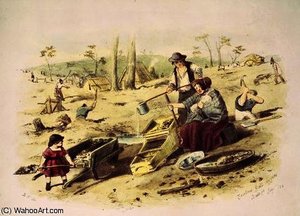
Discover Samuel Thomas Gill (1818-1880), the 'Artist of the Goldfields'! Explore his vibrant watercolours & lithographs capturing colonial life, gold rush scenes, and Indigenous culture in 19th century Australia.
from ·
Chapter 1
How large should it be?
Slide to change the size; the picture on the left shows the frame at its real width. The proportions of the original are kept.
Standard
custom
CM
INCH
Pick from our preset sizes that match the artwork's original proportions.
Loading sizes...

width
height
Type the width and the height you need, to fit your frame or your wall. This is hand-painted, so for a size with a different shape the artist can paint a bit more around the picture, or cut a bit — you choose. We send you a digital mockup to approve before the painting starts. The picture shown on this page does not show the real result — only the mockup does.
Chapter 2
How should it arrive?
Choose the edges of the stretched canvas
Choose your frame

White $1

Blurside $1

Extended $1

P118B $10

P118H $10

P118W $10

P438Z $10

P508JH $12

P508YH $12

P805H $10

P805Z $10

P919BZ $10

P919G $10

P919XJ $10

P959ZH $10

P968JZ $12

W106C $8

W218G $10

W218JH $8

W218Y $10

W307PJ $10

W316G $10

W316PJ $8

W316Y $10

W398PJ $8

W4111J $10

W500HY $15

W500JH $15

W692G $12

W849H $8

W940BG $15

W953PJ $8

H24-GOLD $30

H24-SILVER $30

H36-GOLD $45

H36-SILVER $45
Framed
Moulding: . Overall size with the frame: .
Chapter 3
Who paints it, and should anything change?
Examples of what can be changed: Replace face with customer photo; Add pet (e.g., replace cat with dog); Include hidden message in background; Change background landscape or elements.
After order, OriginalUniqueArt.com team will email client for instructions and provide a mockup preview
After order, OriginalUniqueArt.com team will email client for instructions and provide a mockup preview
Worldwide Delivery () in 3/4 weeks instead of standard 5 weeks. (1 November). No compromise on quality.
Chapter 4
The finishing touches
A nameplate, as in a museum?
Engraved Bronze Plaque Details
This elegant plaque features the artist's name and the title of the artwork, finely engraved for a timeless presentation.
It is made from bronze with a refined, elegant finish. The text is precisely laser-engraved for a sharp and permanent result. Measuring 9x2 cm, the plaque is compact yet easy to read. It's built to be durable and scratch-resistant, offering a professional, museum-quality look. Mounting is simple thanks to the included adhesive backing.
Transparent Acrylic Plaque Details
The plaque includes essential engraved details such as the artist's name, the title of the artwork, the date it was created, the type of media used-like oil on canvas or watercolor-a brief description of the piece, and a QR code that links to the complete artwork information.
It is crafted from clear acrylic, offering a sleek, modern appearance. The text is UV-engraved in black to ensure strong visual contrast. With a size of 10x15 cm, it ensures optimal readability. It comes equipped with two metal hooks for secure wall mounting. The plaque is designed to be weather-resistant, making it suitable for various environments, and it includes interactive features that work seamlessly with smartphone scanning.
Black Acrylic Plaque Details
This elegant plaque includes engraved information such as the artist's name, the title of the artwork, the date it was created, the type of media used (like oil on canvas or watercolor), a short description of the artwork, and a QR code for quick access to more information.
The plaque itself is made from refined black acrylic with a premium finish. The text is laser-engraved in white for high contrast and readability. Its size is 10x15 cm, designed to be easy to read. It comes with two metal hooks for professional mounting. The design is sleek and fits any interior style. It is also weather-resistant and durable, with built-in digital integration for mobile compatibility.
A protective varnish?
When do you need it?
Chapter 5
Your painting, as you ordered it
Native corroboree
Reproduction Medium
Reproduction Size
-
Elite Senior Artist
More detail, finesse, and extra production time
-
Reproduction Frame
-
-
For artworks or reproductions larger than 105 cm (approximately 41 inches) on any side, the frame will be shipped as a kit, disassembled. This method ensures safe delivery and prevents damage during transport.
Professional assembly required - this is not a DIY product.
The kit must be assembled and the canvas stretched by an experienced professional framer, using wood glue (not supplied), a canvas stretching plier and clamps to hold the bars square while the glue dries. Incorrect assembly or uneven canvas tension can permanently damage the artwork and is not covered by our warranty.
All solid wood bars are included, precisely cut to size.
Assembled with the screws provided, plus wood glue for the corner joints, which is not supplied and must be sourced by your framer.
Professional tools are required and not included: a canvas stretching plier (tensioner) and clamps to hold the bars square while the glue dries.
Important:
The corner joints require wood glue, the bars must be held with clamps until the glue is fully dry, and tightening the canvas on the assembled frame requires a canvas stretching plier. None of these are included in the kit. Please arrange an experienced professional framer before ordering this size.
Nameplate
-
-
Protective Varnish
Glossy Varnish (enhances colors, protects against light/moisture)
-
Customize My Artwork
Examples of what can be changed: Replace face with customer photo; Add pet (e.g., replace cat with dog); Include hidden message in background; Change background landscape or elements.
-
Urgent
Worldwide Delivery () in 3/4 weeks instead of standard 5 weeks. (1 November). No compromise on quality.
-
Express Shipping
Worldwide Delivery () in 5 weeks. (8 November).
Included
Total Price
$ 300
Glass option is only available in size under 110 CM
Included with every order
- Free Worldwide Express Shipping
- High-Quality Linen Canvas
- Full Shipping Insurance
- Customs Tax Refund Guarantee
- True Color Matching Guarantee
- 100-Day Return Policy (Defects Only)
- 100% Money-Back Guarantee
- Bulk Discount Offer
 Preview
 Send
Send Share
Share
 Details
 Guide
Guide

 Download
 Similars
 X-Ray
X-Ray Diaporama
 Q&A
Q&A Stats
StatsIn numbers
- 29frames to choose from
- standard sizes, in its own proportions
- 5weeks to paint and deliver it
About the original

Samuel Thomas Gill
1818 - 1880, United Kingdom
Quick facts about Samuel Thomas Gill
- Full Name: Samuel Thomas Gill
- Nationality: British-Australian
- Date Of Birth: 1818
- Date Of Death: 1880
- Place Of Birth: Perriton, United Kingdom
- Notable Artworks:
- The Beehive
- Departure of Capt Sturt
- Invalid's tent
- Artistic Movement Or Style: Colonial art
Artist Biography
Early Life and Artistic Foundations
Samuel Thomas Gill, a name synonymous with the visual chronicle of 19th-century Australia, was born on May 21, 1818, in the quiet coastal village of Perriton, near Minehead in Somerset, England. The son of Reverend Samuel Gill, a Baptist minister, and Winifred Oke, young Samuel’s upbringing instilled in him both a strong moral compass and an early appreciation for observation – qualities that would profoundly shape his artistic journey. His initial education at Plymouth and Dr Seabrook's academy provided a solid foundation, but it was the informal instruction in drawing from his father that first ignited his passion for art. This nascent talent led him to London, where he honed his skills as a draftsman and watercolour painter with the Hubard Profile Gallery. Here, amidst the bustling artistic scene, Gill gained valuable experience in portraiture and the delicate art of silhouette creation, mastering techniques that would later serve him well in capturing the essence of colonial life. These early years were crucial in developing his eye for detail and establishing a technical proficiency that set the stage for his future endeavors.A New World: Australia and the Goldfields
In December 1839, Gill embarked on a transformative journey, emigrating to South Australia with his family aboard the *Caroline*. This move marked not only a geographical shift but also a pivotal moment in his artistic development. Establishing a studio in Adelaide, he quickly found demand for his portrait services and topographical sketches of houses and landscapes. However, it was his participation in J.A. Horrocks’s 1846 expedition into the Flinders Ranges that truly cemented his place as an artist of exploration and documentation. The tragic death of Horrocks during this journey deeply affected Gill, yet he channeled his grief and observations into poignant diary entries and sketches – invaluable records of early colonial life and the harsh realities of venturing into the Australian interior. This experience instilled in him a profound respect for the land and its challenges, themes that would recur throughout his oeuvre. The discovery of gold in Victoria in 1852 drew Gill eastward, to the bustling diggings where he became known as “The Artist of the Goldfields.” Here, he created a prolific body of work – watercolours and lithographs depicting the vibrant, chaotic, and often brutal reality of life on the goldfields. His series *Victoria Gold Diggings and Diggers As They Are* (1853) stands as a remarkable achievement, offering a nuanced and humanizing portrayal of miners from diverse backgrounds, capturing not only their hopes for fortune but also their daily struggles and interactions.Documenting a Nation: Style and Significance
Gill’s artistic style was characterized by its directness, realism, and keen observation. He possessed an exceptional ability to capture the energy of a scene, whether it be the bustling streets of Adelaide or the frenetic activity of the goldfields. His watercolours are particularly notable for their vibrant colours and meticulous detail, while his lithographs demonstrate a mastery of line and tone. Throughout the 1860s, Gill continued to produce artwork, including *Australian Sketchbook*, which showcased his views of Melbourne and its surroundings. While some later works exhibited a coarser handling of watercolour and occasionally revisited earlier subjects, his commitment to depicting Australian life remained unwavering. He was among the first artists to portray Indigenous Australians with respect and sensitivity, offering a relatively nuanced perspective compared to prevailing societal biases. His work provides invaluable visual records of 19th-century Australia, offering insights into its social, economic, and cultural development. Gill’s ability to capture both the grandeur and the everyday realities of colonial life has secured his place as a significant artist in Australian history. He is celebrated for his vibrant watercolours and lithographs that depict Indigenous culture, goldfields scenes, and Victorian-era townscapes – images that continue to resonate with audiences today.Legacy and Enduring Impact
Samuel Thomas Gill’s life came to a poignant end on October 27, 1880, when he collapsed and died on the steps of the Bourke Street Post Office in Melbourne. Though his later years were marked by hardship and struggle, his artistic legacy endured. Initially overlooked after his death, Gill's work experienced a resurgence in appreciation during the 20th century as scholars and art enthusiasts recognized its historical importance and artistic merit. Today, he is rightfully acknowledged as a pivotal figure in Australian art history – a chronicler of a nation’s formative years. His paintings and lithographs are held in major public collections across Australia, including the Art Gallery of South Australia, the National Gallery of Victoria, and the State Library of Victoria. Gill's work continues to inform our understanding of colonial life, offering a unique window into the past and reminding us of the challenges and triumphs of those who shaped modern Australia. His dedication to capturing the essence of his adopted homeland ensures that his artistic voice will continue to resonate for generations to come, solidifying his position as “The Artist of the Goldfields” and a true pioneer of Australian art.
Explore artworks organized by themes, styles, and characteristics.