Preview
 Send
Send Share
Share
 Details
 Guide
Guide

 Download
 Similars
 X-Ray
X-Ray Diaporama
 Q&A
Q&A Stats
StatsStudy of a Pilgrim

- 27.0 x 20.0 cm


 Read More
Giclée / Art Print
Museum-quality giclée or canvas print with fast production and flexible finish options. ( Buy Hand Made Painting Switch to Digital Image)




P118B $10

P118H $10

P118W $10

P438Z $10

P508JH $12

P508YH $12

P805H $10

P805Z $10

P919BZ $10

P919G $10

P919XJ $10

P959ZH $10

P968JZ $12

W106C $8

W218G $10

W218JH $8

W218Y $10

W307PJ $10

W316G $10

W316PJ $8

W316Y $10

W398PJ $8

W4111J $10

W500HY $15

W500JH $15

W692G $12

W849H $8

W940BG $15

W953PJ $8




Pick from our preset sizes that match the artwork's original proportions.

Type the width and the height you need, to fit your frame or your wall. A print can only be cut, never made bigger than the picture, so a size with a different shape loses a part of the image. We send you a digital mockup to approve before we print anything. The picture shown on this page does not show the real cut — only the mockup does.
Worldwide Delivery () in 2 weeks instead of standard 4/5 weeks. (6 November)

Free Worldwide Express Shipping

High-Quality Linen Canvas

Full Shipping Insurance

Customs Tax Refund Guarantee

True Color Matching Guarantee

100-Day Return Policy (Defects Only)

100% Money-Back Guarantee

Bulk Discount Offer
 Glass option is only available in size under 110 CM

Study of a Pilgrim
Giclée / Art Print
Reproduction Size
-


Total Price
$ 81
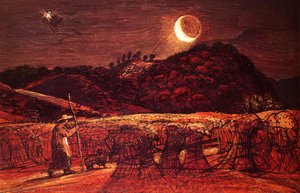
Study of a Pilgrim – Samuel Palmer’s Romantic Reverie
The watercolor painting “Study of a Pilgrim,” executed by Samuel Palmer in approximately 1850, stands as a quintessential emblem of the Romantic movement's preoccupation with spirituality and contemplation. More than just a depiction of an elderly man seated beneath a luminous moonlit cornfield, it embodies a profound yearning for transcendence—a desire to reconnect with nature’s sublime beauty and inner peace amidst the anxieties of Victorian England. Palmer, deeply influenced by William Blake’s visionary aesthetic, sought to capture not merely what he saw but what he felt; this ambition is palpable in every brushstroke.A Visionary Landscape: Technique and Composition
Palmer's masterful technique—characterized by delicate washes of muted browns and greens—creates an atmosphere of ethereal stillness. He employs a subtle gradated shading effect, skillfully blending colors to convey the soft glow of moonlight filtering through the corn stalks. The composition itself is deliberately simple yet powerfully evocative. The central figure, rendered in meticulous detail despite its understated presence, occupies a prominent position within the frame, drawing the viewer’s gaze upwards towards the expansive sky—a deliberate gesture mirroring Blake's fascination with celestial realms and spiritual illumination. The artist’s careful attention to texture contributes significantly to the painting’s tactile quality, inviting contemplation of the natural world.Symbolism Rooted in Blakean Influence
Palmer’s artistic sensibilities were undeniably shaped by his encounter with William Blake, whose poetic visions championed imagination and intuition as pathways to spiritual understanding. Like Blake's depictions of angels and prophetic figures, Palmer’s pilgrim embodies a quest for moral purity and enlightenment—a symbolic representation of humanity’s aspiration to commune with the divine. The cornfield itself serves as a potent emblem of fertility and regeneration, reflecting Blake’s belief in the transformative power of nature. Furthermore, the solitary posture of the man suggests introspection and detachment from worldly concerns, aligning perfectly with Romantic ideals of spiritual solitude.Historical Context: Victorian England's Quest for Transcendence
“Study of a Pilgrim” emerged during a period marked by significant social upheaval—the Industrial Revolution reshaping Britain’s landscape and challenging traditional beliefs. Amidst this rapid transformation, artists like Palmer sought refuge in the tranquility of rural landscapes, attempting to recapture a sense of spiritual harmony lost in the bustle of urban life. The painting reflects a broader cultural preoccupation with themes of mortality, faith, and the sublime—concepts central to Romantic thought and profoundly impacting artistic expression throughout Europe. It represents a deliberate reaction against Enlightenment rationalism, prioritizing emotion and intuition as sources of knowledge and inspiration.Emotional Resonance: A Momentary Pause for Reflection
Ultimately, “Study of a Pilgrim” transcends its formal elements to convey a powerful emotional resonance. The painting invites viewers to pause amidst the frenetic pace of modern existence—to contemplate the beauty of simplicity and the enduring relevance of spiritual contemplation. Palmer’s masterful rendering captures not just an image but also a feeling—a quiet reverence for the natural world and a yearning for inner peace that continues to captivate audiences today. It remains a testament to the Romantic spirit's unwavering belief in the transformative potential of art and its capacity to illuminate the human condition.Questions & Answers
What color leads the composition of "Study of a Pilgrim" by Samuel Palmer?
The dominant color of "Study of a Pilgrim" by Samuel Palmer is driftwood (#a38e72).
What is "Study of a Pilgrim" made with, and in which style?
"Study of a Pilgrim" by Samuel Palmer combines the acrylic on canvas technique with the Romanticism style. Technique and movement describe the making and the style of the work.
How can I get a digital file of "Study of a Pilgrim" by Samuel Palmer?
To get a digital file of "Study of a Pilgrim" by Samuel Palmer, order a high-resolution digital image download on its Digital Image page.
Artist Biography
Early Life and the Seeds of Vision
Samuel Palmer, born in London in 1805, emerged from a world steeped in both intellectual curiosity and spiritual seeking. His father, a bookseller and Baptist minister, instilled in him a love for literature and a contemplative nature, while his early artistic inclinations manifested remarkably early – by the age of twelve, he was already diligently painting churches, demonstrating an innate talent for observation and detail. This precocious ability quickly gained recognition; at just fourteen years old, Palmer exhibited works inspired by J.M.W. Turner at the Royal Academy, signaling a promising start to his artistic journey. Though receiving limited formal training – a brief stint at Merchant Taylors' School offered little in the way of structured art education – his path was irrevocably altered by a pivotal encounter with William Blake in 1824, facilitated through the landscape painter John Linnell. This meeting proved transformative, as Blake’s visionary style and profound spiritual depth resonated deeply within Palmer, becoming a cornerstone of his artistic identity.The Shoreham Period: A Realm of Mystical Pastoral
The years spent near Shoreham, Kent (1826-1835), represent the most intensely creative and distinctive phase of Samuel Palmer’s career. He purchased a humble cottage, affectionately nicknamed “Rat Abbey,” and it was here, amidst the rolling hills and ancient woodlands, that he forged his unique artistic voice. This period wasn't merely about depicting landscapes; it was about *transforming* them into realms of mystical beauty and spiritual resonance. Palmer’s Shoreham paintings are characterized by their evocative use of sepia tones, creating a sense of timelessness and melancholy, and often bathed in the ethereal glow of moonlight. These weren’t simply representations of nature but idealized visions, imbued with personal symbolism and a deep connection to the land. He wasn't alone in this pursuit; Palmer became associated with a group of like-minded artists known as “the Ancients,” including George Richmond and Edward Calvert, all drawn to Blake’s mystical leanings and seeking to revive a spiritual dimension within their art. This collective fostered an environment of shared ideas and mutual inspiration, solidifying Palmer's commitment to visionary pastoral painting.Shifting Tides: London, Italy, and the Pursuit of Stability
In 1835, Palmer returned to London, marking a turning point in his artistic trajectory. The intensely mystical style of his Shoreham paintings began to give way to more conventional landscapes and watercolors, a shift partly dictated by financial necessity and pragmatic advice from his father-in-law, John Linnell, who urged him to cater to prevailing public tastes. While he continued to paint prolifically, Palmer increasingly relied on watercolor as a means of income, a popular medium in England at the time but one that perhaps didn’t fully satisfy his artistic ambitions. A honeymoon trip to Italy with his wife, Hannah Linnell, in 1837-1839 broadened his palette and introduced brighter colors into his work, though these sometimes resulted in hues considered overly vivid by contemporaries. To supplement his income, Palmer worked as a private drawing master, a demanding occupation that limited the time he could dedicate to his own artistic pursuits. Financial difficulties plagued him throughout this period, exacerbated by the unfortunate actions of his brother, who pawned many of his early paintings – forcing Palmer to redeem them at considerable expense.Later Years and Enduring Legacy
A move to Furze Hill House in Redhill, Surrey, in 1862 brought a degree of financial stability to Palmer’s life, allowing him to revisit the visionary style of his earlier Shoreham paintings, albeit with a more mature and refined technique. His later works include exquisite illustrations for Milton’s poems *L'Allegro* and *Il Penseroso*, demonstrating his continued mastery of line and composition, as well as a series of evocative etchings illustrating Virgil. The Lonely Tower, completed in 1879, is widely considered one of his finest later achievements, showcasing his exceptional skill in etching and capturing a mood of poignant solitude. The death of his son, Thomas More Palmer, in 1861 cast a long shadow over these final years, adding a layer of melancholy to his work. Samuel Palmer passed away in 1881, leaving behind a body of work that, while initially overlooked, has since been recognized as profoundly significant within the context of British Romanticism. He stands as a key figure in visionary art, demonstrating the lasting impact of William Blake’s artistic and philosophical ideas and helping to foster a revival of interest in spiritual themes during the 19th century. His unique ability to blend meticulous observation with imaginative vision continues to captivate audiences today, solidifying his place as an enduringly important artist.
Samuel Palmer
1805 - 1881 , United Kingdom
Quick Facts
- Full Name: Samuel Palmer
- Nationality: British
- Date Of Birth: 1805
- Date Of Death: 1881
- Place Of Birth: London, United Kingdom
- Notable Artworks:
- Cornfield by Moonlight
- Self-Portrait
- Harvesting
- The Lonely Tower
- Artistic Movement Or Style: Romanticism
- Artists Who Influenced This Artist:
- William Blake
- J.M.W. Turner
- Artists Or Movements Influenced By This Artist: ['The Ancients']
Related Articles

The Enduring Appeal of Watercolor: History, Techniques & Contemporary Practice
Explore the captivating world of watercolor painting! Discover its rich history, essential techniques, influential artists, and collecting tips. A comprehensive guide for art enthusiasts.

Ephemeral Visions: Exploring the History & Emotional Resonance of Watercolor Painting
Explore the captivating history of watercolor painting, from ancient techniques to modern masters like Kandinsky & Blake. Discover essential artists, collecting tips & the emotional power of this luminous medium. Expert insights for art enthusiasts.

Watercolor Wonders: 10 Masterpieces That Redefined Art History | OriginalUniqueArt
Journey through 10 legendary watercolor masterpieces by Sargent, Turner & Homer! Explore iconic landscapes, portraits & floral art that redefined history. Find museum-quality reproductions and curated decor ideas at OriginalUniqueArt.com.

Ephemeral Visions: Exploring the Artistic Legacy & Contemporary Practice of Watercolor Painting
Explore the captivating world of watercolor painting! Discover its rich history, essential techniques, influential artists & collecting tips. A comprehensive guide for art enthusiasts from OriginalUniqueArt.

Ephemeral Visions: Exploring the Artistic Legacy & Nuances of Watercolor Painting
Explore the captivating world of watercolor painting! Discover its rich history, essential techniques, influential artists & collecting tips from art experts. A comprehensive guide for enthusiasts.