Untitled
Black and White Photography
Photo
Other
1865
19th Century
23.0 x 28.0 cm
Los Angeles County Museum of Art
Hand Made Oil Reproduction
Hand-painted oil on canvas in your size and frame, made to order by our artists.
Pick from our preset sizes that match the artwork's original proportions.
You may enter your own dimensions to fit a specific frame or space. If your selected size does not match the original image's proportions, we will either crop the artwork or extend the painting with additional hand-painted elements. A digital mockup will be sent for your approval before production begins.

Please note that the on-screen preview does not reflect the actual cropping or extension. Only the mockup will accurately show the final composition.
While custom sizes are available, we recommend selecting a dimension from the predefined list to preserve the original proportions.
After order, OriginalUniqueArt.com team will email client for instructions and provide a mockup preview
Worldwide Delivery () in 3/4 weeks instead of standard 5 weeks. (23 July). No compromise on quality.
Free Worldwide Express Shipping
High-Quality Linen Canvas
Full Shipping Insurance
Customs Tax Refund Guarantee
True Color Matching Guarantee
60-Day Return Policy (Defects Only)
100% Money-Back Guarantee
Bulk Discount Offer
Untitled
Reproduction Medium
Reproduction Size
-
Total Price
-
Artwork Description
A Moment Frozen in Monochrome
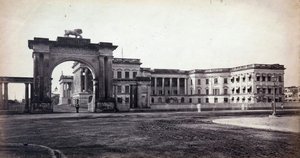
In this evocative black and white photograph from 1865, the viewer is transported into a realm of profound stillness and spiritual contemplation. The subject, an untitled sculpture of Jesus Christ, stands with arms outstretched toward the heavens, perched atop a rugged stone pedestal. Captured by the pioneering eye of Samuel Dixon Bourne, the image transcends mere documentation, becoming a poetic meditation on faith and permanence. The stark contrast of the monochrome palette emphasizes the textures of the marble or concrete, lending the figure a monumental weight that feels both ancient and eternal. There is a palpable sense of reaching—a silent, visual prayer captured in a single, breathless moment of light and shadow.
The composition masterfully balances the divine subject with its architectural surroundings. In the background, the rhythmic presence of windows suggests the solemnity of a church or a religious institution, providing a structured, human-made backdrop to the organic, soaring gesture of the statue. The inclusion of two solitary benches, flanking the scene, invites the observer to imagine themselves sitting in this very space, lost in thought. This careful arrangement creates an atmosphere of peace, where the boundaries between the physical world and the spiritual realm seem to blur, making it a piece that resonates deeply with anyone seeking tranquility within their surroundings.
The Visionary Eye of Samuel Dixon Bourne
To understand the depth of this work, one must consider the historical context provided by its creator. Samuel Dixon Bourne was not merely a photographer but a chronicler of grandeur. Emerging from a background of classical studies and banking, Bourne brought a disciplined yet deeply sensitive approach to the photographic medium during the Victorian era. His ability to capture the interplay of light on stone and the architectural dignity of his subjects reflects a mastery of early photographic techniques. This specific work, dating back to 1865, showcases his talent for finding the sublime within the structured environments of his time.
For the discerning collector or interior designer, this reproduction offers more than just a visual element; it provides a focal point of historical significance and emotional gravity. The piece possesses a timeless elegance that complements both classical and contemporary interiors. Whether placed in a quiet study, a minimalist gallery space, or a grand hallway, the photograph serves as a window into the nineteenth century—a sophisticated tribute to the enduring power of religious iconography and the artistry of early photography. It is an invitation to pause, to breathe, and to reconnect with the quiet majesty of the past.
Artist Biography
A Visionary Through the Lens: The Life of Samuel Dixon Bourne
Samuel Dixon Bourne (1834–1912) was far more than a mere chronicler of landscapes; he was a pioneer who redefined the visual vocabulary of an empire. Born in Neasden, United Kingdom, Bourne’s early life was shaped by the disciplined atmosphere of a classical education, yet his heart belonged to the burgeoning medium of photography. While his professional beginnings were rooted in the stable, predictable world of banking at Moore & Robinson’s Bank in Nottingham, the call of the visual arts proved irresistible. This transition from the ledger to the lens marked the beginning of a profound journey that would eventually lead him away from the comforts of England toward the sun-drenched, culturally rich expanses of the Indian subcontinent. As his technical mastery grew, so did his reputation as an educator and intellectual within the photographic community. Bourne was not simply a practitioner but a scholar of light and chemistry, contributing insightful discourse to the prominent journals of the Victorian era. His deep understanding of photographic techniques allowed him to move beyond simple documentation, seeking instead to capture the sublime essence of the natural world. This pursuit of the extraordinary eventually culminated in his transformative decision to abandon his banking career entirely, setting sail for India—a move that would forever alter the course of colonial photography.The Dawn of Bourne & Shepherd and the Indian Odyssey
Upon arriving in Calcutta in 1863, Bourne embarked on one of the most significant collaborative ventures in photographic history. Alongside Charles Shepherd, he established the legendary Bourne & Shepherd Studios, a partnership that would become synonymous with the visual identity of British India. Their operations were strategically brilliant, spanning from the misty, high-altitude retreats of Shimla to the bustling, humid streets of Calcutta. This dual presence allowed Bourne to explore two distinct yet equally captivating realms: the majestic, sweeping grandeur of the Himalayan landscapes and the intricate, human-centric architectural studies of the urban centers. His work during this period serves as a breathtaking window into a vanished era. Through his lens, the monumental scale of the Mughal Empire was rendered with both precision and poetic grace. One might gaze upon his formal architectural study, The Taj Mahal from the corner of the quadrangle, and witness the meticulous way he utilized light to highlight the intricate details of Mughal artistry. His ability to capture the interplay of shadow and stone transformed static monuments into living histories, making him a master of the photogravure process and a premier documentarian of the era's architectural splendor.Legacy of Light and the Documentation of a Civilization
Beyond the grand monuments, Bourne possessed a rare sensitivity for the pulse of everyday life. His photographic repertoire extended into the intimate corners of Indian urbanity, capturing the vibrant energy of streets such as Bombay, The Said-Memon Street. In these black and white compositions, the viewer is transported to the 1860s, witnessing the movement, commerce, and social fabric of colonial India. This ability to balance the epic with the intimate—to capture both the soaring peaks of the Himalayas and the quiet, spiritual stillness of a Christ statue in a peaceful setting—is what distinguishes his oeuvre from that of his contemporaries. The historical significance of Samuel Dixon Bourne cannot be overstated. He did not merely take photographs; he constructed a visual archive that remains an indispensable resource for historians, architects, and art lovers alike. His work stands as a testament to the power of the photographic medium to bridge distances and eras. Through his dedication to capturing the beauty, culture, and complexity of India, Bourne left behind a legacy of light that continues to illuminate our understanding of the nineteenth-century world, ensuring that the grandeur of the past remains eternally accessible to the present.samuel dixon bourne
1834 - 1912 , United Kingdom
Quick Facts
- Artistic Movement Or Style: Victorian Landscape Photography
- Artists Or Movements Influenced By This Artist: ['Photogravure']
- Artists Who Influenced This Artist: ['William Henry Fox Talbot']
- Date Of Birth: 1834
- Date Of Death: 1912
- Full Name: Samuel Dixon Bourne
- Nationality: British
- Notable Artworks:
- Paigah Tomb
- Group of bhooteas, Darjeeling
- Interiors of Moti Masjid, Agra Fort
- Marochetti
- Tomb of Itmad-ud Daulah
- Bombay, The Said-Memon Street
- The Taj Mahal from the corner of the quadrangle
- Place Of Birth: Neasden, United Kingdom

Glass option is only available in size under 110 CM