Introduction
To gaze upon these ten photographs is to witness history breathed into life, frozen moments that continue to resonate with raw power and profound empathy. They are not merely images; they are portals—windows into worlds often unseen, voices for those frequently unheard. This collection represents the very essence of documentary photography: a commitment to truth-telling, a dedication to social awareness, and an unwavering belief in the ability of a single frame to ignite change.
The seeds of this movement were sown in the late 19th century with the advent of portable cameras and advancements in printing technology. Early pioneers like Jacob Riis used photography as a tool for social reform, exposing the harsh realities of urban poverty in works such as "How the Other Half Lives." As the 20th century unfolded, documentary photography blossomed into a powerful force during times of immense upheaval—the Great Depression, world wars, and the Civil Rights Movement. The Farm Security Administration (FSA) project, for example, employed photographers like Dorothea Lange and Walker Evans to document the plight of rural Americans, creating images that became synonymous with an era.
But documentary photography is more than just a historical record. It’s about connection—the ability to forge a human link across time and circumstance. These photographs challenge us to confront uncomfortable truths, to question our assumptions, and to recognize the shared humanity that binds us all. They remind us that every face tells a story, every landscape holds a memory, and every moment deserves to be witnessed.
The ten masterpieces we present here are not exhaustive, but they represent pivotal moments in the evolution of this art form—works that have shaped our understanding of the world and continue to inspire photographers today. Prepare to embark on a journey through time, empathy, and the enduring power of visual storytelling. Each image is a testament to the courage of those who dared to look closely, and to the transformative potential of photography itself.
Indescribable horrors - Alan Moore
 Indescribable horrors - Alan Moore
Imagine a silence so heavy it presses against your chest, broken only by the rasping breaths of those clinging to life. A landscape stripped bare not by nature, but by inhumanity. This is the world Alan Moore captured in "Indescribable Horrors" (1945), a photograph taken at Bergen-Belsen shortly after its liberation. It isn’t an image one *views*; it’s one that overwhelms you—a visceral confrontation with the aftermath of unimaginable suffering.
Moore, an Australian war artist, didn't seek to create beauty, but to bear witness. The photograph depicts a chaotic scene: bodies piled onto trucks, soldiers handling them with chilling detachment, and onlookers frozen in a state of shock or morbid curiosity. It’s a stark portrayal of the dehumanization inherent in genocide, a testament to the horrors of the Holocaust that transcends mere documentation.
What elevates this image beyond reportage is its raw emotional power. The grainy black-and-white film amplifies the somber mood, while the composition—crowded and unsettling—forces us to confront the scale of the tragedy. "Indescribable Horrors" belongs in any canon of documentary photography for its unflinching honesty and enduring relevance. It serves as a potent reminder of our collective responsibility to remember, to learn, and to prevent such atrocities from ever happening again.
In our own lives, surrounded by comfort and ease, it’s easy to become detached from the weight of history. Yet, art like Moore's compels us to engage with difficult truths, fostering empathy and a deeper understanding of the human condition—qualities that enrich not only our minds but also the spaces we inhabit.
Bjorn Waldegard & Hans Thorszelius - Mohamed Amin
 Bjorn Waldegard & Hans Thorszelius - Mohamed Amin
Imagine the scent of damp earth and wild grasses, a stillness broken only by the distant hum of insects. A sense of isolation descends—a feeling of being utterly lost within an expansive landscape. This is the atmosphere Mohamed Amin masterfully evokes in "Bjorn Waldegard & Hans Thorszelius" (1978), a photograph capturing a dramatic moment from the East African Safari Rally.
More than just a record of motorsport, this image speaks to the relentless power of nature and the dedication required to push boundaries. The partially submerged Porsche 911SC CS19, isolated amidst dense Kenyan vegetation, is a poignant symbol of ambition tested—and perhaps momentarily defeated. Amin, known as “Six Camera Mo,” relentlessly pursued these fleeting moments, sleeping in the wild to capture the raw essence of the rally.
The grainy black-and-white film amplifies the scene’s authenticity, while the composition—organic and irregular lines contrasting with the car's geometric form—creates a visual tension. This photograph isn’t simply about speed or competition; it’s about resilience, solitude, and the humbling force of the natural world. It rightfully earns its place among the top masterpieces of documentary photography for its ability to capture not just an event, but a feeling.
In our own spaces, we often seek refuge from chaos. Yet, art like Amin’s reminds us of the beauty found within vulnerability and the power of embracing the untamed—qualities that can inspire reflection and a deeper connection to the world around us.
Tawaf at night - Mohamed Amin
 Tawaf at night - Mohamed Amin
Close your eyes and imagine a sea of humanity swirling around a sacred center, bathed in the cool glow of night. A collective devotion so powerful it seems to ripple through time itself. This is the world Mohamed Amin captured in "Tawaf at Night" (1978), a breathtaking long-exposure photograph taken during Hajj in Mecca.
The image isn’t merely a depiction of a religious pilgrimage; it's an exploration of faith, unity, and the sheer scale of human spirituality. Amin masterfully used time exposure to transform individual movements into luminous trails, creating a swirling vortex around the Kaaba—the holiest shrine in Islam. The cool tones and dramatic lighting amplify the sense of reverence and solemnity.
What sets this photograph apart is its ability to convey both the intimacy of personal devotion and the grandeur of collective worship. It’s a testament to Amin's skill as a photojournalist, capturing not just what was seen, but *felt*. "Tawaf at Night" rightfully belongs among the top masterpieces of documentary photography for its profound emotional impact and its ability to transcend cultural boundaries.
In our own lives, we often seek moments of connection and transcendence. Art like Amin’s reminds us of the power of shared experience and the enduring human quest for meaning—qualities that can transform any space into a sanctuary for reflection and contemplation.
Jumping for joy! - Mohamed Amin
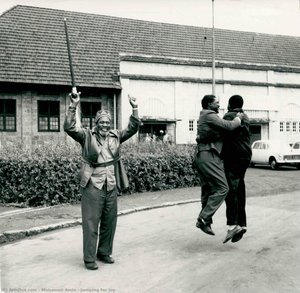 Jumping for joy! - Mohamed Amin
Imagine a burst of uncontained joy—a moment so pure it transcends time and place. This is precisely what Mohamed Amin captured in "Jumping for Joy!" (1963), a photograph documenting the jubilation following Kenya’s independence election victory. It's not simply an image of celebration; it’s a visceral embodiment of hope, unity, and the power of collective liberation.
The photograph depicts Tom Mboya and Mwai Kibaki leaping in the air alongside Kenyatta, their expressions radiating unbridled excitement. Amin masterfully froze this fleeting moment, capturing the raw energy and emotion of a nation reborn. The grainy black-and-white film lends an immediacy to the scene, while the dynamic composition—figures suspended mid-air—emphasizes movement and exhilaration.
What elevates this image beyond mere reportage is its universal appeal. It’s a testament to the human spirit's capacity for joy and resilience, a reminder that even in the face of adversity, hope can prevail. "Jumping for Joy!" rightfully earns its place among the top masterpieces of documentary photography for its ability to inspire and uplift.
In our own lives, we often seek moments of connection and celebration. Art like Amin’s reminds us of the power of shared joy and the enduring importance of fighting for a brighter future—qualities that can infuse any space with optimism and inspiration.
Queen Eliabeth with Mzee Kenyatta at the Nairobi airport - Mohamed Amin
 Queen Eliabeth with Mzee Kenyatta at the Nairobi airport - Mohamed Amin
Imagine a moment suspended between worlds—a formal greeting imbued with layers of history and unspoken complexities. This is what Mohamed Amin captured in "Queen Elizabeth with Mzee Kenyatta at the Nairobi Airport," a photograph that transcends mere documentation to become a powerful symbol of a changing era.
The image depicts Queen Elizabeth II and Jomo Kenyatta, Kenya’s first president, engaged in a ceremonial exchange. The composition—centered around a raised platform and dominated by the presence of both figures—emphasizes the weight of protocol and international relations. Amin masterfully captured this fleeting moment, conveying an atmosphere of respect, formality, and subtle tension.
What elevates this photograph beyond reportage is its ability to encapsulate a pivotal historical transition. It’s a testament to Amin's skill as a photojournalist, capturing not just what was seen, but the underlying currents of power and change. "Queen Elizabeth with Mzee Kenyatta at the Nairobi Airport" rightfully belongs among the top masterpieces of documentary photography for its profound symbolic weight and enduring relevance.
In our own spaces, we often seek objects that tell stories and evoke a sense of history. Art like Amin’s reminds us of the complexities of human interaction and the power of visual representation—qualities that can infuse any environment with depth and meaning.
Zito - Berenice Abbott
 Zito - Berenice Abbott
Imagine the aroma of freshly baked bread wafting through a bustling city street—a simple pleasure captured with remarkable clarity in Berenice Abbott’s "Zito" (1937). This photograph isn't merely a depiction of an Italian bakery in Greenwich Village; it’s a poignant slice of everyday life, a testament to the enduring spirit of community and commerce.
Sponsored by the Federal Art Project, Abbott meticulously documented New York City’s urban landscape, creating over three hundred images that would later be compiled into her seminal book, *Changing New York*. "Zito" exemplifies her ability to find beauty in the ordinary—the rough brickwork, the woven baskets, and the crusty loaves of bread all contribute to a sense of authenticity and warmth.
What elevates this photograph beyond mere documentation is its timeless appeal. It’s a reminder that even in the midst of change, certain pleasures remain constant. "Zito" rightfully belongs among the top masterpieces of documentary photography for its ability to evoke a sense of nostalgia and connection—qualities we at strive to bring into your home with our handcrafted reproductions.
Just as Abbott captured the essence of New York City, we believe art has the power to transform any space. Let "Zito" inspire a feeling of warmth and comfort in your own sanctuary—a reminder of simple pleasures and the enduring beauty of everyday life.
Roadside Stand, vicinity Birmingham, Alabama - Walker Evans
 Roadside Stand, vicinity Birmingham, Alabama - Walker Evans
Imagine a stillness—a quiet dignity radiating from a simple roadside stand in Alabama. This is the essence Walker Evans captured in "Roadside Stand, vicinity Birmingham, Alabama" (1971), an image that transcends mere documentation to become a poignant meditation on American life during the Great Depression.
Evans’s work for the Farm Security Administration documented the effects of economic hardship with unflinching honesty. But “Roadside Stand” is more than just a record of poverty; it's a study in resilience, community, and the enduring human spirit. The composition—centered around the storefront and its proprietors—emphasizes the dignity of labor and the simple pleasures of everyday life.
What elevates this photograph beyond reportage is its timeless appeal. It’s a reminder that even in the face of adversity, hope persists. “Roadside Stand” rightfully belongs among the top masterpieces of documentary photography for its ability to evoke empathy and connection—qualities we at strive to bring into your home with our handcrafted reproductions.
Just as Evans captured the essence of a bygone era, we believe art has the power to transform any space. Let “Roadside Stand” inspire a feeling of warmth and contemplation in your own sanctuary—a reminder of simple pleasures and the enduring beauty of the human spirit.
Swimmers #2 - David Dixon Porter
 Swimmers #2 - David Dixon Porter
Imagine a cool embrace—the weightlessness of water, the subtle tension between bodies, and a shared moment of vulnerability. This is the world David Dixon Porter captured in "Swimmers #2" (1971), an image that transcends mere documentation to become a powerful exploration of human interaction.
Taken at a benefit concert amidst torrential rain, this photograph depicts two nude figures submerged in water—one playfully pulling the other’s hair. The dramatic lighting and dynamic composition emphasize their connection, creating a scene both intimate and unsettling. Porter masterfully captured a fleeting moment of raw emotion, revealing a glimpse into the complexities of human relationships.
What elevates this photograph beyond reportage is its ability to evoke a sense of mystery and intrigue. It’s a reminder that even in moments of chaos, beauty can be found—a testament to Porter's skill as a photojournalist. “Swimmers #2” rightfully belongs among the top masterpieces of documentary photography for its profound emotional impact and enduring relevance.
In our own spaces, we often seek art that challenges us to confront uncomfortable truths and explore the depths of human experience. Let “Swimmers #2” inspire a sense of contemplation and introspection—a reminder of the power of connection and the beauty found within vulnerability.
Joe Cocker (touches nose) - David Dixon Porter
 Joe Cocker (touches nose) - David Dixon Porter
Imagine the electric energy of a live rock concert—the thrumming bass, the roar of the crowd, and a moment of unexpected intimacy between performer and audience. This is precisely what David Dixon Porter captured in "Joe Cocker (touches nose)" (1972), an image that transcends mere documentation to become a powerful portrait of artistic expression.
Taken during Cocker’s controversial 1972 Australian tour, this photograph depicts the musician seemingly lost in performance, his hand raised towards the crowd. The grainy black-and-white film and dynamic composition emphasize the raw energy of the event, while the sharp focus on the bassist provides a grounding element amidst the chaos.
What elevates this photograph beyond reportage is its ability to capture a fleeting moment of connection—a subtle gesture that speaks volumes about the relationship between artist and audience. It’s a reminder that even in moments of political outrage, beauty can be found—a testament to Porter's skill as a photojournalist. “Joe Cocker (touches nose)” rightfully belongs among the top masterpieces of documentary photography for its profound emotional impact and enduring relevance.
In our own spaces, we often seek art that evokes a sense of passion and excitement. Let “Joe Cocker (touches nose)” inspire a feeling of energy and connection—a reminder of the power of music to transcend boundaries and unite us all.
James Brown Fans - Malick Sidibé
 James Brown Fans - Malick Sidibé
Imagine a moment suspended in time—a youthful exuberance radiating from two young women captivated by the energy of James Brown’s music. This is the essence Malick Sidibé captured in "James Brown Fans" (1965), an image that transcends mere documentation to become a powerful celebration of post-colonial Mali’s vibrant culture.
Sidibé masterfully documented the lives and aspirations of Bamako’s youth, capturing their style, freedom, and passion for music. This photograph depicts two women—one holding a microphone, the other proudly displaying her “James Brown” shirt—a testament to the transformative power of art and entertainment.
What elevates this photograph beyond reportage is its ability to evoke a sense of joy and optimism. It’s a reminder that even in times of change, beauty can be found—a testament to Sidibé's skill as a photojournalist. “James Brown Fans” rightfully belongs among the top masterpieces of documentary photography for its profound emotional impact and enduring relevance.
In our own spaces, we often seek art that inspires a sense of hope and connection. Let “James Brown Fans” infuse your sanctuary with a feeling of energy and optimism—a reminder of the power of music to transcend boundaries and unite us all.
Conclusion
As the light fades on these ten extraordinary visions, we’re reminded that documentary photography is more than a record of moments—it's an echo of humanity itself. These images aren’t simply historic treasures; they are living presences, capable of stirring empathy, igniting conversation, and shaping our understanding of the world around us.
Each photograph we’ve explored holds a unique power to transform a space—to infuse it with narrative, emotion, and a sense of timeless connection. At , we believe in the enduring legacy of these masterpieces, and we are honored to partner with interior designers, architects, and collectors who share our passion for bringing art into everyday life.
Whether envisioning a sophisticated hotel lobby, a tranquil villa retreat, or a refined residential interior, our team is dedicated to curating custom collections that resonate with your unique vision. From museum-quality reproductions to bespoke art mockups, we provide the tools and expertise to turn every project into an artistic statement.
We invite you to explore the full collection and discover the transformative power of documentary photography for yourself. Let these images inspire your creativity, enrich your spaces, and connect you with the enduring spirit of human experience.