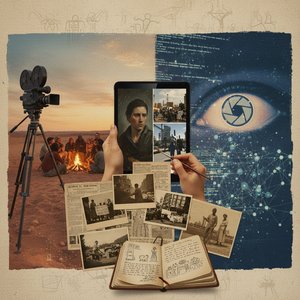
Early Life & Photographic Beginnings: A Foundation Forged in East Africa
 Awards Ceremony for Boy Scouts, Patterson Park, from the East Baltimore Documentary Survey Project
1980 photo by Elinor Cahn captures a joyous Boy Scout awards ceremony in Baltimore. Documenting community spirit & youth achievement through candid black & white photography.
Mohamed Amin’s story isn't simply that of a photojournalist; it is the chronicle of a continent awakening, seen through the unwavering lens of a man who became its visual conscience. Born in 1943 in Nairobi, Kenya, to parents who had emigrated from Punjab, Amin’s early life was steeped in the vibrant tapestry of East African society. His father's work on the railway—the very “lunatic line” that carved through the landscape and connected communities—instilled a sense of place and an understanding of the region’s burgeoning identity. It wasn’t merely a geographical upbringing, but one imbued with the spirit of change as independence movements began to ripple across the continent. The pivotal moment arrived at age eleven when he purchased a second-hand Box Brownie camera for 40 shillings – a modest investment that would irrevocably alter his destiny and, ultimately, shape how the world perceived Africa.
This wasn’t simply about acquiring a tool; it was an embrace of observation, a desire to capture fleeting moments before they vanished. School events became his initial canvas, honing his skills while simultaneously providing a small income. This early entrepreneurial spirit—selling photographs and sharing profits with his subjects—foreshadowed a career built not just on artistic talent but also on genuine connection and respect for the communities he documented. By 1963, at the tender age of twenty, Amin established Camerapix in Dar es Salaam, laying the groundwork for an agency that would become synonymous with fearless reporting and unparalleled access.
Documenting Independence: Amin's Role in Visualizing a New Continent
The early years of Camerapix were defined by a relentless pursuit of stories often overlooked by Western media. Amin wasn’t content to simply record events; he sought to *visualize* the complex process of decolonization, capturing the hopes, anxieties, and triumphs of newly independent nations. His breakthrough came with coverage of the Zanzibar Revolution in 1963, a tumultuous period that saw him briefly detained by the KGB after uncovering a secret Soviet military training camp. This early brush with danger underscored his commitment to truth-telling, even at personal risk.
Throughout the 1960s and 70s, Amin became a trusted chronicler of Africa’s transformation. He photographed Charles de Gaulle's attempts to maintain control over French Somaliland (later Djibouti), documenting the stubborn resistance against colonial rule. He captured the historic embrace between Jomo Kenyatta of Kenya and Kwame Nkrumah of Ghana at Pan-African conferences—a powerful symbol of unity and self-determination. These weren’t merely photographs; they were visual manifestos, asserting African agency on a global stage. Amin's ability to gain access – often through shared heritage or sheer persistence – allowed him to document moments others couldn’t reach, establishing his reputation as the ‘top-dog’ in the news world.
The Ethiopian Famine & Global Impact: Beyond the Iconic Images
While Amin’s career spanned decades and encompassed a vast range of subjects, he is perhaps most widely recognized for his coverage of the 1984 famine in Ethiopia. Working with BBC journalist Michael Buerk, Amin's images—gaunt faces, skeletal limbs, and scenes of unimaginable suffering—shocked the world. These weren’t abstract statistics; they were portraits of individual human beings stripped bare by circumstance. The broadcast reached a staggering audience, galvanizing international public opinion and prompting an unprecedented outpouring of aid.
The resulting response culminated in Live Aid in 1985, a monumental concert that raised over $150 million for famine relief. While often credited as “the man who moved the world,” reducing Amin’s legacy to this single event diminishes the breadth and depth of his work. His photographs weren't simply about tragedy; they were a call to action, a demand for accountability, and a testament to the resilience of the Ethiopian people. However, it is crucial to acknowledge that these images also sparked debate regarding representation and the potential for exploitation in documentary photography.
A Pioneering Style: Candid Realism and Unwavering Perspective
Amin’s photographic style was characterized by a raw, unflinching honesty. He eschewed staged compositions and dramatic lighting, opting instead for candid realism that captured the immediacy of the moment. His images weren't about imposing his own perspective; they were about bearing witness, allowing the subjects to speak for themselves. This approach extended beyond technical skill; it was rooted in a deep respect for the people he photographed.
He possessed an uncanny ability to connect with individuals from all walks of life, whether it was Idi Amin Dada during his reign or the families struggling to survive in Korem. This rapport allowed him access and intimacy that few other journalists could achieve. His photographs often reveal a subtle humor, even amidst hardship—a recognition of the enduring human spirit. The use of black and white further amplified the emotional impact of his work, stripping away distractions and focusing attention on the essential elements of each scene.
Legacy of an Icon: Preserving Amin’s Work for Future Generations
Tragically, Mohamed Amin's life was cut short in 1996 when Ethiopian Airlines Flight 961 was hijacked and crashed into the Indian Ocean. His untimely death left a void in the world of photojournalism, but his legacy continues to inspire. The vast archive he amassed—over 8,000 hours of video and approximately 3.5 million photographs spanning from 1956 to 1996—represents an unparalleled visual record of postcolonial Africa.
Today, the Mohamed Amin Foundation is dedicated to preserving this invaluable collection and making it accessible to future generations. Through digitization efforts and ongoing exhibitions, they are ensuring that Amin’s work continues to educate, provoke thought, and foster a deeper understanding of the continent. His images serve as a powerful reminder of both the challenges Africa has faced and its remarkable resilience—a testament to the enduring power of visual storytelling.
Mohamed Amin's Influence on Contemporary Wildlife Photography
 Nick Brandt
Nick Brandt: Haunting black & white photography documenting environmental destruction & wildlife loss in Africa. Explore 'On This Earth' trilogy & conservation work.
While renowned for his coverage of political events and humanitarian crises, Amin’s influence extends significantly into wildlife photography. His early work documenting East African fauna established a standard for capturing the beauty and fragility of the natural world. He wasn’t merely taking pictures of animals; he was telling stories about their habitats, their behaviors, and the threats they faced.
Photographers like Nick Brandt, known for his haunting black-and-white portraits of African wildlife, acknowledge Amin as a key inspiration. Brandt's work shares Amin’s commitment to realism and emotional depth, using photography as a tool for conservation advocacy. Amin’s pioneering spirit—his willingness to venture into remote locations and capture intimate moments—paved the way for a new generation of wildlife photographers dedicated to raising awareness about environmental issues. His legacy is not just in the images he created but also in the ethical standards he upheld, emphasizing respect for both the subjects and the environment.
To explore more about Mohamed Amin’s extraordinary life and work, visit OriginalUniqueArt.com where you can discover a curated selection of historical photographs and learn more about the artists who have shaped our understanding of the world.