Preview
 Send
Send Share
Share
 Details
 Guide
Guide

 Download
 Similars
 X-Ray
X-Ray Diaporama
 Stats
StatsSt. Francis in Ecstasy


 Read More
Hand Made Oil Reproduction
Hand-painted oil on canvas in your size and frame, made to order by our artists. ( Switch to Print Switch to Digital Image)




P118B $10

P118H $10

P118W $10

P438Z $10

P508JH $12

P508YH $12

P805H $10

P805Z $10

P919BZ $10

P919G $10

P919XJ $10

P959ZH $10

P968JZ $12

W106C $8

W218G $10

W218JH $8

W218Y $10

W307PJ $10

W316G $10

W316PJ $8

W316Y $10

W398PJ $8

W4111J $10

W500HY $15

W500JH $15

W692G $12

W849H $8

W940BG $15

W953PJ $8




Pick from our preset sizes that match the artwork's original proportions.

Type the width and the height you need, to fit your frame or your wall. This is hand-painted, so for a size with a different shape the artist can paint a bit more around the picture, or cut a bit — you choose. We send you a digital mockup to approve before the painting starts. The picture shown on this page does not show the real result — only the mockup does.
After order, OriginalUniqueArt.com team will email client for instructions and provide a mockup preview
Worldwide Delivery () in 3/4 weeks instead of standard 5 weeks. (23 October). No compromise on quality.

Free Worldwide Express Shipping

High-Quality Linen Canvas

Full Shipping Insurance

Customs Tax Refund Guarantee

True Color Matching Guarantee

100-Day Return Policy (Defects Only)

100% Money-Back Guarantee

Bulk Discount Offer
 Glass option is only available in size under 110 CM

St. Francis in Ecstasy
Reproduction Medium
Reproduction Size
-


Total Price
$ 300
Salvator Rosa’s “St. Francis in Ecstasy”: A Baroque Vision of Divine Connection
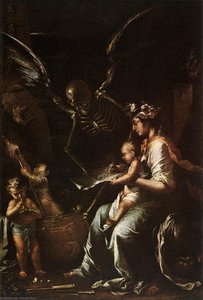
Salvator Rosa's "St. Francis in Ecstasy," painted circa 1647, isn’t merely a depiction of a saint; it’s a profound meditation on the intersection of earthly experience and divine revelation. This arresting work, currently residing within the Phillips Collection in Washington D.C., embodies the artist’s signature blend of dramatic landscape, intense emotion, and philosophical depth – hallmarks that cemented his place as a pivotal figure in the transition from Mannerism to Baroque painting. Rosa masterfully captures a moment of profound spiritual intensity, transforming a simple religious scene into a visually arresting exploration of faith and nature.
The composition immediately draws the eye to St. Francis himself, kneeling within a shadowed cave entrance. He’s not presented as an idealized figure of serene piety but rather as a man consumed by ecstatic fervor. His arms are outstretched, palms open towards a radiant light that streams down from above, piercing through the turbulent sky and illuminating the surrounding landscape. This dramatic use of chiaroscuro – the interplay of light and dark – is characteristic of Baroque painting and serves to heighten the emotional impact of the scene. The stark contrast between the darkness of the cave and the brilliance of the divine light underscores the transformative nature of Francis’s experience.
A Landscape as Theology: Rosa's Revolutionary Approach
What distinguishes “St. Francis in Ecstasy” is not simply its religious subject matter, but rather Rosa’s innovative approach to landscape painting. He moves beyond traditional depictions of pastoral beauty, instead presenting a rugged, almost hostile environment – a rocky hillside, tangled vegetation, and a distant mountain range – as the backdrop for this profound spiritual encounter. This wasn't merely an aesthetic choice; it reflected Rosa’s belief that nature itself was imbued with divine presence. He saw in the wildness of the landscape a reflection of God’s power and majesty, mirroring the intensity of Francis’s ecstatic experience.
Rosa’s technique is equally remarkable. He employs loose, expressive brushstrokes – a deliberate departure from the polished surfaces favored by many of his contemporaries – to convey a sense of movement and dynamism. The colors are rich and saturated, particularly in the depiction of the light, which seems to emanate from within the canvas itself. The layering of paint creates a palpable texture, inviting the viewer to engage with the work on a tactile level. Notice how he uses subtle variations in tone to suggest depth and atmosphere, creating a convincing illusion of space.
Symbolism and Spiritual Resonance
Beyond its visual impact, “St. Francis in Ecstasy” is laden with symbolic meaning. The cave itself represents the earthly realm, a place of solitude and introspection where Francis sought communion with God. The thorny crown, depicted amongst his possessions within the cave, symbolizes the stigmata – the wounds received by St. Francis as a sign of his identification with Christ’s suffering. The light streaming down from above signifies divine grace and redemption.
Rosa's choice to depict Francis *in* the act of ecstasy—not simply after it—is crucial. He captures the very moment of transformation, when the saint is enveloped in a state of heightened awareness and connection with the divine. The painting isn’t about depicting faith; it’s about illustrating its transformative power – a power that can be experienced through direct engagement with nature and a willingness to surrender oneself to the unknown.
A Legacy of Romantic Vision
“St. Francis in Ecstasy” stands as a pivotal work in the development of landscape painting, foreshadowing the rise of Romanticism. Rosa’s emphasis on emotional intensity, dramatic lighting, and the sublime beauty of nature paved the way for later artists who sought to capture the power of individual experience within the vastness of the natural world. Reproductions of this powerful image continue to resonate with viewers today, offering a glimpse into a profound spiritual vision—a testament to Rosa’s artistic genius and his enduring legacy.
Questions & Answers
How does "St. Francis in Ecstasy" by Salvator Rosa connect Baroque to the artist's home country?
"St. Francis in Ecstasy" was created by Salvator Rosa, born in Italy, within the Baroque movement. The artist's origin links the work to Baroque as practiced by artists from Italy.
What placement suits the format of "St. Francis in Ecstasy" by Salvator Rosa?
The portrait format of "St. Francis in Ecstasy" by Salvator Rosa is recommended for a living room. Format and space together guide the placement of a reproduction.
How do medium and movement combine in "St. Francis in Ecstasy"?
"St. Francis in Ecstasy" by Salvator Rosa combines the oil on canvas technique with the Baroque style. Technique and movement describe the making and the style of the work.
Artist Biography
**early life and training**
salvator rosa, an italian baroque painter, poet, and printmaker, was born in arenella, naples, on either june 20 or july 21, 1615. his mother, giulia greca rosa, was a member of one of the greek families of sicily. despite his father's wishes for him to become a lawyer or priest, salvator showed a preference for the arts from an early age.**artistic career**
salvator rosa's artistic career was marked by his unorthodox and extravagant style, which set him apart from his contemporaries. he was active in naples, rome, and florence, and his work was influenced by the naturalism of ribera and the classicism of poussin. however, he refused to be tied down by any particular style or movement.- pythagoras emerging from the underworld (kimbell art museum, fort worth, united states), one of his most famous works, showcases his unique blend of philosophical and artistic themes.
- his the baptism of the eunuch (chrysler museum of art, norfolk, united states) demonstrates his ability to infuse high drama into even minor bible stories.
**influences and legacy**
salvator rosa's work had a significant impact on the development of baroque art. his influence can be seen in the works of later artists, such as luca giordano, who continued to push the boundaries of artistic expression. **important links:** salvator rosa's profile on OriginalUniqueArt wikipedia: salvator rosa pythagoras emerging from the underworld on OriginalUniqueArt**conclusion**
salvator rosa's life and work continue to fascinate art lovers and historians alike. his unorthodox style and perpetual rebellion against the norms of his time have cemented his place in the annals of baroque art. as a painter, poet, and printmaker, he remains an enigmatic figure, and his work continues to inspire new generations of artists and art enthusiasts.
Salvator Rosa
1615 - 1673 , Italy
Quick Facts
- Full Name: Salvator Rosa
- Nationality: Italian
- Date Of Birth: 1615
- Date Of Death: 1673
- Place Of Birth: Arenella, Italy
- Notable Artworks:
- View of the Gulf of Salerno
- Study for 'Il Genio di Rosa
- Grotto with Cascades
- Artistic Movement Or Style: Baroque art
- Artists Who Influenced This Artist: ['José de Ribera']
- Artists Or Movements Influenced By This Artist: ['Luca Giordano']
Related Articles
Francis Bacon's Masterpieces: Exploring 25 Iconic Paintings | OriginalUniqueArt
Delve into the haunting world of Francis Bacon with OriginalUniqueArt. Explore 25 iconic paintings, from his visceral portraits to powerful triptychs. Discover the stories behind these masterpieces & find museum-quality art reproductions for your home. Explore the full collection online!
The Dramatic Flourish: Exploring Themes of Power, Faith & Emotion in Baroque Artworks
Explore the dramatic world of Baroque art! Discover masters like Zurbarán & the powerful influence of religious zeal on painting techniques. Expert insights for collectors and enthusiasts.

El Greco's Masterpieces: Explore 25 Iconic Paintings & Spiritual Visions | OriginalUniqueArt
Journey through El Greco's 25 most iconic paintings! Explore the spiritual depth & dramatic beauty of this Spanish Renaissance master. Discover art history, techniques & find museum-quality reproductions for your home at OriginalUniqueArt.com.

The Dramatic Flourish: Exploring the Baroque Movement's Enduring Legacy in Art History
Explore the dramatic world of Baroque art! Discover iconic artists like Caravaggio & Rubens, defining techniques, and its lasting impact on art history. Expert insights for collectors & enthusiasts at OriginalUniqueArt.

Salvator Rosa: A Baroque Rebel's Vision of Landscape, Allegory & the Human Condition
Explore the captivating world of Salvator Rosa, a rebellious Baroque master. Discover his dramatic landscapes, allegorical paintings & lasting influence on Romanticism. Hand-painted reproductions available at OriginalUniqueArt.