Preview
 Send
Send Share
Share
 Details
 Guide
Guide

 Download
 Similars
 X-Ray
X-Ray Diaporama
 Stats
StatsPlane/Figure Series (Double Panel) F


 Read More
The artwork displayed on this page is protected by copyright law, which means we cannot legally create or sell an identical reproduction. This protection is enforced under international agreements such as the Berne Convention and by national laws, including those outlined by the U.S. Copyright Law - Title 17.
This method fully complies with copyright regulations because it does not involve copying or duplicating the protected artwork. Instead, it is a creative reinterpretation - a new painting that is influenced by the original but not identical to it.
Giclée / Art Print
Museum-quality giclée or canvas print with fast production and flexible finish options. ( Buy Hand Made Painting Switch to Digital Image)




P118B $10

P118H $10

P118W $10

P438Z $10

P508JH $12

P508YH $12

P805H $10

P805Z $10

P919BZ $10

P919G $10

P919XJ $10

P959ZH $10

P968JZ $12

W106C $8

W218G $10

W218JH $8

W218Y $10

W307PJ $10

W316G $10

W316PJ $8

W316Y $10

W398PJ $8

W4111J $10

W500HY $15

W500JH $15

W692G $12

W849H $8

W940BG $15

W953PJ $8




Pick from our preset sizes that match the artwork's original proportions.

Type the width and the height you need, to fit your frame or your wall. A print can only be cut, never made bigger than the picture, so a size with a different shape loses a part of the image. We send you a digital mockup to approve before we print anything. The picture shown on this page does not show the real cut — only the mockup does.
Worldwide Delivery () in 2 weeks instead of standard 4/5 weeks. (26 October)

Free Worldwide Express Shipping

High-Quality Linen Canvas

Full Shipping Insurance

Customs Tax Refund Guarantee

True Color Matching Guarantee

100-Day Return Policy (Defects Only)

100% Money-Back Guarantee

Bulk Discount Offer
 Glass option is only available in size under 110 CM

Plane/Figure Series (Double Panel) F
Giclée / Art Print
Reproduction Size
-


Total Price
$ 81
A Quiet Revolution: Deconstructing Form in Robert Mangold’s ‘Plane/Figure Series’
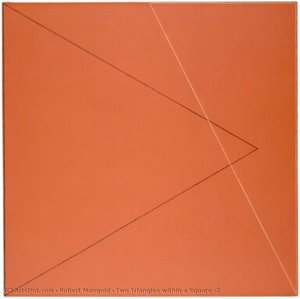
Robert Mangold's 'Plane/Figure Series (Double Panel) F,' a deceptively simple yet profoundly resonant work from 1993, represents a pivotal moment in the evolution of American painting. Emerging from the shadow of Abstract Expressionism and Minimalism, Mangold deliberately stripped away illusionistic depth and narrative complexity, focusing instead on the inherent qualities of paint itself – its materiality, its flatness, and its capacity to exist as an object in space. This piece isn’t about depicting a scene; it's about exploring the very essence of painting, a quiet revolution that challenged established conventions and paved the way for subsequent generations of artists.
The work immediately commands attention not through grand gestures or vibrant hues, but through its stark geometry and deliberate restraint. Two rectangular canvases, joined seamlessly to form an irregular quadrilateral, are presented against a neutral white wall – a strategic choice that amplifies their physical presence and emphasizes the materiality of the surfaces. The olive-green and brown-red colors, applied in broad, solid blocks with minimal blending or gradation, create a subtle tension between the two panels, suggesting a dialogue rather than a unified whole. This deliberate lack of integration speaks to Mangold’s core philosophy: painting is not about creating a seamless illusion but about presenting distinct elements within a carefully constructed composition.
The Language of Geometry and Space
Mangold's approach can be understood through the lens of Minimalism, yet his work transcends simple geometric abstraction. The canvases aren’t merely squares or rectangles; they possess an inherent dynamism due to their irregular shape and the oblique edges that hint at a vanishing point beyond the frame. Two ellipses, delicately placed within each panel, act as visual connectors, subtly suggesting spatial relationships and inviting the viewer to contemplate the interplay between figure and ground – a concept central to Renaissance art but deliberately deconstructed here. The layering of paint itself contributes to this sense of depth, creating a subtle illusion of recession that contrasts sharply with the flat surfaces.
The deliberate positioning of the upper and lower edges parallel while the oblique sides indicate a vanishing point outside the canvas is a key element in Mangold’s design. This creates an intriguing visual paradox – a sense of depth and perspective achieved through purely formal means, without relying on traditional representational techniques. It's as if the painting is actively resisting our ingrained expectations of how space should be depicted.
Materiality and Process: A Meditation on Paint
‘Plane/Figure Series (Double Panel) F’ is a testament to Mangold’s meticulous approach to painting. Executed in oil paint on canvas, the work showcases a straightforward yet sophisticated technique. The broad blocks of color are applied directly to the surface with a matte finish, suggesting a deliberate avoidance of glossy effects and emphasizing the tactile quality of the paint itself. The use of acrylic and colored pencil adds another layer of complexity, grounding the composition in a tangible reality while simultaneously exploring the possibilities of mixed media.
Considering Mangold’s broader body of work, this piece exemplifies his ongoing investigation into the properties of painting – its surface, its texture, its color, and its relationship to space. It's not simply about creating an image; it’s about revealing the inherent qualities of the medium itself, a quiet meditation on the fundamental elements that constitute a painting.
A Legacy of Quiet Innovation
Robert Mangold’s ‘Plane/Figure Series (Double Panel) F’ stands as a significant contribution to American art history. It represents a shift away from grand narratives and emotional expression towards a more conceptual and material-driven approach to painting. His work continues to resonate with contemporary artists and collectors alike, offering a compelling example of how simplicity can be profoundly powerful. The piece invites contemplation on the nature of perception, representation, and the enduring fascination with the fundamental elements that define the art of painting.
Questions & Answers
Does "Plane/Figure Series (Double Panel) F" by Robert Mangold use strong contrasts or soft harmonies?
The color analysis of "Plane/Figure Series (Double Panel) F" by Robert Mangold records a statement contrast and a balanced harmony harmony.
Is "Plane/Figure Series (Double Panel) F" by Robert Mangold in the public domain?
The copyright answer for "Plane/Figure Series (Double Panel) F" by Robert Mangold: the work is still protected by copyright. This determines whether reproductions of the image may be freely made.
What mood and emotion come together in "Plane/Figure Series (Double Panel) F"?
In "Plane/Figure Series (Double Panel) F", a calm mood accompanies a reflective emotion.
Artist Biography
A Quiet Revolution in Form: The World of Robert Mangold
Robert Mangold emerged as a pivotal figure in the American art landscape of the 1960s, though his impact wasn’t one of bombast or overt gesture. Instead, it was a quiet revolution—a subtle dismantling of traditional painting conventions that paved the way for new explorations of form, color, and perception. Born in North Tonawanda, New York, in 1937, Mangold's path to becoming a leading minimalist painter wasn’t immediately clear. He initially pursued engineering studies before recognizing the compelling pull of artistic expression, ultimately earning degrees from the University of Buffalo and Yale University School of Art. This early exposure to technical disciplines perhaps informed his later meticulous approach to painting, where precision and conceptual rigor are paramount. Mangold's journey began within the shadow of Abstract Expressionism, but he quickly discerned a desire for something more restrained, more intellectual—a move away from the subjective emotionality toward an objective exploration of the fundamental elements of art.The Influence of Pioneers and the Birth of a Style
Mangold’s artistic development was profoundly shaped by encounters with the giants of abstraction who preceded him. The austere geometries of Kazimir Malevich, the carefully calibrated compositions of Piet Mondrian, and the expansive color fields of Barnett Newman all resonated deeply, providing a foundation for his own unique vision. He wasn’t simply imitating these masters; rather, he was absorbing their core principles—the reduction to essential forms, the emphasis on flatness, the exploration of spatial relationships—and reinterpreting them through a distinctly contemporary lens. This period marked a deliberate rejection of the gestural intensity that characterized Abstract Expressionism. Mangold sought to eliminate any trace of the artist’s hand, striving for a sense of impersonal objectivity. It was in this pursuit that he began experimenting with shaped canvases – a defining characteristic of his mature style. These weren't arbitrary forms; they were carefully considered interventions, challenging the very notion of what a painting *could* be.Shaped Canvases and Conceptual Rigor
The introduction of shaped canvases wasn’t merely an aesthetic choice for Mangold; it was a conceptual one. By abandoning the traditional rectangular format, he disrupted the established relationship between image and support, forcing viewers to confront the physicality of the painting as an object in space. His compositions typically feature geometric abstraction—simplified shapes and lines arranged with meticulous precision. These forms aren’t representational; they don't refer to anything outside themselves. Instead, they exist purely as arrangements of color and line, inviting contemplation of their inherent qualities. Mangold’s palette is often muted, favoring subtle pastel tones that create atmospheric effects without overwhelming the viewer. This restraint extends to his technique: surfaces are smooth and even, devoid of brushstrokes or any other evidence of manual manipulation. The result is a sense of serene detachment—a painting that feels both present and remote, inviting prolonged observation. Major series like the Plane/Figure Series, with its explorations of divided canvas compositions, and the Ring Series, featuring circular forms within rectangular fields, demonstrate his consistent engagement with these core principles.Legacy and Lasting Impact
Robert Mangold’s influence on contemporary art is undeniable. He played a crucial role in shaping the development of minimalist painting, expanding the possibilities of abstract art and challenging conventional notions of representation. Alongside artists like Robert Ryman, he represents the heart of minimalist painting—a commitment to conceptual rigor and formal reduction. His work has been widely exhibited in museums and galleries around the world, finding homes in prominent collections such as The Museum of Modern Art and The Metropolitan Museum of Art in New York, and The Tate Modern in London. Beyond his paintings, Mangold’s explorations extended into wall paintings, large-scale works designed to interact with architectural spaces, and the Column Structure Series, which investigated verticality and spatial relationships. His legacy isn't simply about the specific forms he created; it’s about the questions he raised—questions that continue to resonate with artists today who grapple with the fundamental elements of art and the possibilities of abstraction. He demonstrated that profound artistic expression could emerge not from grand gestures, but from a quiet, persistent exploration of form and color.
Robert Mangold
1937 - , United States of America
Quick Facts
- Full Name: Robert Mangold
- Nationality: American
- Date Of Birth: 1937
- Place Of Birth: North Tonawanda, United States of America
- Notable Artworks:
- Untitled
- 1/2 V Series (Medium Scale)
- Untitled (Skowhegan Suite)
- Artistic Movement Or Style: Minimalism
- Artists Who Influenced This Artist:
- Kazimir Malevich
- Piet Mondrian
- Barnett Newman
- Artists Or Movements Influenced By This Artist:
- Robert Ryman
- Contemporary artists
Related Articles

Geometric Abstraction's 10 Defining Masterpieces | Art for Your Home - OriginalUniqueArt
Explore 10 defining masterpieces of Geometric Abstraction! Discover Kandinsky, Mondrian & Malevich’s iconic works. Find museum-quality art reproductions and curated decor ideas to elevate your home at OriginalUniqueArt.com.
Beyond Form & Color: Geometric Abstraction's Enduring Legacy in Art History
Explore the captivating world of geometric abstraction! Discover its origins, key artists like Malevich & Mondrian, and why this movement remains highly valued by art collectors today. Expert insights at OriginalUniqueArt.

Beyond Form & Color: Geometric Abstraction's Evolution in 20th/21st Century Art
Explore the evolution of geometric abstraction from Cubism to contemporary art. Discover key artists like Malevich & Mondrian, investment insights, and expert collecting advice at OriginalUniqueArt.

Neo-Abstract Art: The High-Impact Evolution of Modern Visual Energy and Geometric Sophistication
Discover the power of Neo-Abstract art. Explore how bold geometric forms and high-impact visual energy are redefining modern design. Learn to curate sophisticated, high-energy spaces with the latest trends in contemporary abstraction and structural color.

Kandinsky's Masterpieces: 25 Paintings That Define Abstract Art | OriginalUniqueArt
Journey through Wassily Kandinsky's 25 most iconic abstract paintings. Explore his revolutionary use of color, form & spiritual expressionism. Find museum-quality Kandinsky reproductions and elevate your home decor with OriginalUniqueArt.com. Discover all masterpieces on OriginalUniqueArt.com!