Text size

() ·

A painting made for you, by hand

Self-portrait

Hand Made Oil Reproduction

Hand-painted oil on canvas in your size and frame, made to order by our artists. ( Switch to Print Switch to Digital Image)

Collectible Description

Artist Biography

A master of chiaroscuro known for The Night Watch. Explore his legendary Dutch Golden Age paintings and etchings today.

from ·

Chapter 1

How large should it be?

Slide to change the size; the picture on the left shows the frame at its real width. The proportions of the original are kept.

Standard
custom
CM
INCH

Pick from our preset sizes that match the artwork's original proportions.

width
height

Type the width and the height you need, to fit your frame or your wall. This is hand-painted, so for a size with a different shape the artist can paint a bit more around the picture, or cut a bit — you choose. We send you a digital mockup to approve before the painting starts. The picture shown on this page does not show the real result — only the mockup does.

Chapter 2

How should it arrive?

Choose the edges of the stretched canvas

Choose your frame

Corner sample of the WhiteWrap canvas edge finish, stretched on solid wood bars
White $1
Corner sample of the BlurSideWrap canvas edge finish, stretched on solid wood bars
Blurside $1
Corner sample of the ExtendedWrap canvas edge finish, stretched on solid wood bars
Extended $1
Corner sample of the P118B picture frame: moulded polystyrene, 5 cm wide and 3 cm thick
P118B $10
Corner sample of the P118H picture frame: moulded polystyrene, 5 cm wide and 3 cm thick
P118H $10
Corner sample of the P118W picture frame: moulded polystyrene, 5 cm wide and 3 cm thick
P118W $10
Corner sample of the P438Z picture frame: moulded polystyrene, 5.5 cm wide and 3.5 cm thick
P438Z $10
Corner sample of the P508JH picture frame: moulded polystyrene, 7 cm wide and 3.5 cm thick
P508JH $12
Corner sample of the P508YH picture frame: moulded polystyrene, 7 cm wide and 3.5 cm thick
P508YH $12
Corner sample of the P805H picture frame: moulded polystyrene, 5 cm wide and 3.5 cm thick
P805H $10
Corner sample of the P805Z picture frame: moulded polystyrene, 5 cm wide and 3.5 cm thick
P805Z $10
Corner sample of the P919BZ picture frame: moulded polystyrene, 7 cm wide and 3.5 cm thick
P919BZ $10
Corner sample of the P919G picture frame: moulded polystyrene, 7 cm wide and 3.5 cm thick
P919G $10
Corner sample of the P919XJ picture frame: moulded polystyrene, 7 cm wide and 3.5 cm thick
P919XJ $10
Corner sample of the P959ZH picture frame: moulded polystyrene, 5 cm wide and 3 cm thick
P959ZH $10
Corner sample of the P968JZ picture frame: moulded polystyrene, 6 cm wide and 4 cm thick
P968JZ $12
Corner sample of the W106C picture frame: solid wood, 5 cm wide and 3 cm thick
W106C $8
Corner sample of the W218G picture frame: solid wood, 5 cm wide and 3 cm thick
W218G $10
Corner sample of the W218JH picture frame: solid wood, 5 cm wide and 3 cm thick
W218JH $8
Corner sample of the W218Y picture frame: solid wood, 5 cm wide and 3 cm thick
W218Y $10
Corner sample of the W307PJ picture frame: solid wood, 6 cm wide and 3 cm thick
W307PJ $10
Corner sample of the W316G picture frame: solid wood, 6 cm wide and 3 cm thick
W316G $10
Corner sample of the W316PJ picture frame: solid wood, 6 cm wide and 3 cm thick
W316PJ $8
Corner sample of the W316Y picture frame: solid wood, 6 cm wide and 3 cm thick
W316Y $10
Corner sample of the W398PJ picture frame: solid wood, 5 cm wide and 3 cm thick
W398PJ $8
Corner sample of the W4111J picture frame: solid wood, 6.5 cm wide and 3.5 cm thick
W4111J $10
Corner sample of the W500HY picture frame: solid wood, 7 cm wide and 5 cm thick
W500HY $15
Corner sample of the W500JH picture frame: solid wood, 7 cm wide and 5 cm thick
W500JH $15
Corner sample of the W692G picture frame: solid wood, 8 cm wide and 4 cm thick
W692G $12
Corner sample of the W849H picture frame: solid wood, 5 cm wide and 3 cm thick
W849H $8
Corner sample of the W940BG picture frame: solid wood, 7.5 cm wide and 4.5 cm thick
W940BG $15
Corner sample of the W953PJ picture frame: solid wood, 6 cm wide and 3.5 cm thick
W953PJ $8
Corner sample of the H24-GOLD picture frame: carved wood with gesso, 10 cm wide and 6 cm thick
H24-GOLD $30
Corner sample of the H24-SILVER picture frame: carved wood with gesso, 10 cm wide and 6 cm thick
H24-SILVER $30
Corner sample of the H36-GOLD picture frame: carved wood with gesso, 15 cm wide and 6.5 cm thick
H36-GOLD $45
Corner sample of the H36-SILVER picture frame: carved wood with gesso, 15 cm wide and 6.5 cm thick
H36-SILVER $45
Frame preview
Framed

Moulding: . Overall size with the frame: .

Chapter 3

Who paints it, and should anything change?

Examples of what can be changed: Replace face with customer photo; Add pet (e.g., replace cat with dog); Include hidden message in background; Change background landscape or elements.
After order, OriginalUniqueArt.com team will email client for instructions and provide a mockup preview

Worldwide Delivery () in 3/4 weeks instead of standard 5 weeks. (4 November). No compromise on quality.

Chapter 4

The finishing touches

A nameplate, as in a museum?

Engraved Bronze Plaque Details

This elegant plaque features the artist's name and the title of the artwork, finely engraved for a timeless presentation.

It is made from bronze with a refined, elegant finish. The text is precisely laser-engraved for a sharp and permanent result. Measuring 9x2 cm, the plaque is compact yet easy to read. It's built to be durable and scratch-resistant, offering a professional, museum-quality look. Mounting is simple thanks to the included adhesive backing.

Transparent Acrylic Plaque Details

The plaque includes essential engraved details such as the artist's name, the title of the artwork, the date it was created, the type of media used-like oil on canvas or watercolor-a brief description of the piece, and a QR code that links to the complete artwork information.

It is crafted from clear acrylic, offering a sleek, modern appearance. The text is UV-engraved in black to ensure strong visual contrast. With a size of 10x15 cm, it ensures optimal readability. It comes equipped with two metal hooks for secure wall mounting. The plaque is designed to be weather-resistant, making it suitable for various environments, and it includes interactive features that work seamlessly with smartphone scanning.

Black Acrylic Plaque Details

This elegant plaque includes engraved information such as the artist's name, the title of the artwork, the date it was created, the type of media used (like oil on canvas or watercolor), a short description of the artwork, and a QR code for quick access to more information.

The plaque itself is made from refined black acrylic with a premium finish. The text is laser-engraved in white for high contrast and readability. Its size is 10x15 cm, designed to be easy to read. It comes with two metal hooks for professional mounting. The design is sleek and fits any interior style. It is also weather-resistant and durable, with built-in digital integration for mobile compatibility.

A protective varnish?

When do you need it?

Chapter 5

Your painting, as you ordered it

Self-portrait

Reproduction Medium

Reproduction Size

-

Elite Senior Artist

More detail, finesse, and extra production time

-

Reproduction Frame

-

-

For artworks or reproductions larger than 105 cm (approximately 41 inches) on any side, the frame will be shipped as a kit, disassembled. This method ensures safe delivery and prevents damage during transport.

Professional assembly required - this is not a DIY product.
The kit must be assembled and the canvas stretched by an experienced professional framer, using wood glue (not supplied), a canvas stretching plier and clamps to hold the bars square while the glue dries. Incorrect assembly or uneven canvas tension can permanently damage the artwork and is not covered by our warranty.

  • All solid wood bars are included, precisely cut to size.

  • Assembled with the screws provided, plus wood glue for the corner joints, which is not supplied and must be sourced by your framer.

  • Professional tools are required and not included: a canvas stretching plier (tensioner) and clamps to hold the bars square while the glue dries.

Important:
The corner joints require wood glue, the bars must be held with clamps until the glue is fully dry, and tightening the canvas on the assembled frame requires a canvas stretching plier. None of these are included in the kit. Please arrange an experienced professional framer before ordering this size.

Nameplate

-

-

Protective Varnish

Glossy Varnish (enhances colors, protects against light/moisture)

-

Customize My Artwork

Examples of what can be changed: Replace face with customer photo; Add pet (e.g., replace cat with dog); Include hidden message in background; Change background landscape or elements.

-

Urgent

Worldwide Delivery () in 3/4 weeks instead of standard 5 weeks. (4 November). No compromise on quality.

-

Express Shipping

Worldwide Delivery () in 5 weeks. (11 November).

Included

Total Price

$ 300

Total Price $ 300

Glass option is only available in size under 110 CM

Included with every order

  • Free Worldwide Express Shipping
  • High-Quality Linen Canvas
  • Full Shipping Insurance
  • Customs Tax Refund Guarantee
  • True Color Matching Guarantee
  • 100-Day Return Policy (Defects Only)
  • 100% Money-Back Guarantee
  • Bulk Discount Offer

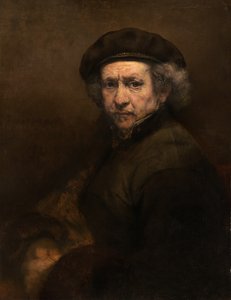
Self-Portrait from 1632: A Window Into Rembrandt’s Soul

Rembrandt van Rijn's Self-Portrait from 1632 stands as one of the most poignant and enduring images of the Dutch Golden Age, capturing not merely a likeness but an essence—a profound meditation on identity, aging, and artistic contemplation. More than just a depiction of a man in black attire, it’s a masterful exploration of psychological depth achieved through Rembrandt's unparalleled command of chiaroscuro, a technique that elevates the portrait beyond mere representation into a realm of emotional resonance. Located within the Glasgow Art Gallery and Museum, this oil on panel painting measures 64 x 47 cm—dimensions that convey both grandeur and intimacy simultaneously. The composition is deceptively simple: Rembrandt sits before a dark background, bathed in diffused light emanating from an unseen source, creating dramatic contrasts between illuminated flesh tones and shadowed recesses. This masterful use of light isn’t merely aesthetic; it serves as a conduit for conveying inner turmoil—a subtle suggestion of melancholy that speaks volumes about the artist's state of mind during this turbulent period of his life. The portrait itself is meticulously rendered with painstaking detail. Rembrandt’s gaze directs outwards, engaging the viewer in an unspoken dialogue—a gesture of vulnerability and self-awareness that distinguishes it from many portraits of its time. The inclusion of a black hat adorned with white lace adds formality to his appearance, yet beneath the surface lies a palpable sense of unease. His beard and mustache are rendered with remarkable accuracy, capturing the texture and contours of aging flesh—a visual reminder of mortality and the passage of time. The ruffled collar further emphasizes Rembrandt’s status as an artist, signaling both ambition and adherence to prevailing stylistic conventions.


Context Within Rembrandt's Oeuvre: A Reflection of Artistic Evolution

Rembrandt produced numerous self-portraits throughout his career, each offering invaluable insights into his artistic development and personal experiences. This particular portrait marks a significant shift from his earlier works—characterized by brighter palettes and more optimistic expressions—towards a darker, more introspective aesthetic. It’s notable that Rembrandt created several similar portraits during this period, demonstrating an unwavering fascination with exploring the complexities of human psychology through visual representation. Considered alongside other self-portraits like Self-Portrait (20) housed in the Musée du Louvre, Paris, and Richard Rothwell's Self Portrait (copy after Rembrandt van Rijn) at the Ulster Museum in Ireland—all demonstrate a similar preoccupation with capturing inner emotion and psychological nuance. These works underscore Rembrandt’s commitment to portraying not just outward appearances but also the internal landscape of the artist’s consciousness. Furthermore, Rembrandt’s exploration of light and shadow—a hallmark of his style—is particularly evident in this Self-Portrait from 1632. The dramatic interplay between illumination and darkness serves as a powerful metaphor for confronting existential questions—a visual representation of the artist's wrestling with themes of vulnerability, mortality, and artistic identity. It’s a technique that anticipates the expressive innovations of later artists like Caravaggio and continues to inspire painters today.

Art History Significance: A Legacy of Psychological Portraiture

Rembrandt’s Self-Portrait from 1632 occupies a pivotal position within art history—a cornerstone of the tradition of psychological portraiture that flourished during the Dutch Golden Age. Artists such as Titus van Rijn created copies after Rembrandt's works, like Discover the Masterpieces of Mauritshuis, The Hague—demonstrating a profound admiration for Rembrandt’s artistic genius and his ability to convey inner emotion through visual means. The influence of Rembrandt extends far beyond its immediate context—inspiring generations of artists who sought to emulate his mastery of technique and his unwavering commitment to exploring the human psyche. As Kenneth Clark famously remarked, “Rembrandt is with the possible exception of Van Gogh, the only artist who has made the self-portrait a major means of artistic self-expression, and he is absolutely the one who has turned self-portraiture into an autobiography.” This enduring legacy testifies to Rembrandt’s unparalleled contribution to the history of art—a testament to his ability to transform a simple depiction of a man into a profound meditation on human experience. View the painting on OriginalUniqueArt List of paintings by Rembrandt on Wikipedia Richard Rothwell's Self Portrait (copy after Rembrandt van Rijn)

Questions & Answers

How is the color composition of "Self-portrait" by Rembrandt van Rijn built?

In "Self-portrait", a statement contrast is paired with a strong color unity harmony.

What placement suits the format of "Self-portrait" by Rembrandt van Rijn?

Format (portrait) and recommended space (living room) are the two placement facts recorded for "Self-portrait" by Rembrandt van Rijn.

Can I see "Self-portrait" by Rembrandt van Rijn under different lights?

The X-Ray page of "Self-portrait" by Rembrandt van Rijn is an interactive viewer that lets you slide through eleven optical layers of the artwork's image, including an X-ray style view.

More about this painting

Preview AR preview Switch to Print Switch to Digital Image Send
Details Guide Add to favorites Download Similars X-Ray Diaporama Q&A Stats

In numbers

  • 1632the year it was painted
  • 29frames to choose from
  • standard sizes, in its own proportions
  • 5weeks to paint and deliver it
Rembrandt van Rijn

Rembrandt van Rijn

1606 - 1669, Netherlands

Quick facts about Rembrandt van Rijn

  • Artistic Movement Or Style: Dutch Golden Age, Baroque
  • Artists Or Movements Influenced By This Artist: Generations of artists
  • Artists Who Influenced This Artist:
    • Pieter Lastman
    • Jacob van Swanenburg
  • Full Name: Rembrandt Harmenszoon van Rijn
  • Nationality: Dutch
  • Notable Artworks:
    • The Night Watch
    • Anatomy Lesson of Dr. Nicolaes Tulp
    • Belshazzar's Feast
  • Place Of Birth: Leiden, Netherlands
  • Date Of Birth: 1606
  • Date Of Death: 1669

Artist Biography

The Light of Leiden

In the quiet streets of Leiden, Netherlands, a boy named Rembrandt Harmenszoon van Rijn grew up in a house filled with the scent of flour and grain. His father, Harmen, ran a mill, while his mother, Neeltgen, came from a family of bakers. This middle-class stability provided enough for a seat at the Leiden Latin School, where he spent seven years studying classical texts. He later sat in classrooms at the University of Leiden, though his eyes often drifted toward the brush and the plate.

His hands learned their trade through apprenticeships. First, there was Jacob van Swanenburg in Leiden, followed by a short, intense period under Pieter Lastman in Amsterdam. It was from Lastman that he learned to use shadow to create weight. He returned to Leiden to share a studio with Jan Lievens, working alongside a peer who understood the same pull of the dark and the light. By 1631, the pull of Amsterdam, a city of growing trade and heavy commerce, led him to relocate permanently.

Shadow and Substance

The way he applied paint changed as the years passed. In his early years, there was a focus on fine detail and clear lines, much like the style of his teachers. As he matured, the brushwork grew thicker and more textured. He began to use chiaroscuro, not merely as a trick of lighting, but as a way to sculpt faces out of the darkness. He used thick, textured paint to catch the light on a forehead or a cheek, while thin, transparent layers allowed the shadows to recede into deep, velvety blacks.

His subjects were as varied as the people he encountered in the Dutch Republic. He painted:

  • Group portraits of civic militias, such as the 1642 work known as The Night Watch.
  • Intimate self-portraits that tracked the physical changes in his own face over decades.
  • Biblical scenes that used dramatic lighting to highlight human emotion.
  • Etchings where he mastered the use of line and tone to create depth on paper.

A Life of Change

Personal shifts often dictated the mood of his canvases. His marriage to Saskia van Uylenburgh in 1634 brought a period of social connection and initial stability, yet it was also marked by the loss of several children. The death of Saskia in 1642 left a visible mark on his later work, which turned toward more somber, introspective themes. He lived through financial highs and the heavy reality of bankruptcy in 1656, a period that forced him to move from fashionable houses to more modest lodgings.

Despite the loss of wealth, his output remained steady. He continued to find models among the people of Amsterdam, including his son Titus and later Hendrickje Stoffels. His ability to capture the weight of an expression or the texture of a weathered hand ensured that his work remained a central part of the Dutch Golden Age. He died in 1669, leaving behind hundreds of paintings, etchings, and drawings that remain fixed in their study of the human condition.

Quick Facts

  • Medium: Oil on panel
  • Notable elements or techniques: Detailed shading, expressive gaze
  • Dimensions: 64 x 47 cm
  • Artist: Rembrandt van Rijn
  • Title: Self-portrait
  • Influences: Richard Rothwell