Renaissance · 1504
The Three Graces (Raphael, 1504)
Raphael (1483–1520) made The Three Graces. It dates from 1504. It belongs to the Renaissance movement. It is made in oil on panel. It is kept at Condé Museum in Chantilly, France. It measures 17 × 17 cm.
- 1504
- Oil On Panel
- 17 × 17 cm
- Condé Museum, Chantilly

 Preview

 Hand Made Oil Painting
 Send
 Share
 Fact sheet


 Download
 Similars
 X-Ray
 Diaporama
 Q&A

 Stats
The Three Graces, in brief
- Title
- The Three Graces
- Artist
- Raphael (1483–1520)
- Artist born in
- Urbino, Italy
- Date
- 1504
- Medium
- Oil On Panel
- Dimensions
- 17 × 17 cm
- Where to see it
- Condé Museum, Chantilly, France
- Movement
- Renaissance
- Period
- Renaissance
- Subject
- mythology, grace, beauty, nude, renaissance, figures
What does The Three Graces depict?
The Allure of Raphael's "The Three Graces"
Raphael’s “The Three Graces,” painted around 1504, is more than just a beautiful depiction of mythological figures; it's a testament to the High Renaissance ideal of harmony, grace, and classical beauty. This intimate oil on panel artwork, measuring a mere 17 x 17 cm and currently residing in the Musée Condé at Chantilly, France, encapsulates Raphael’s mastery of form and composition within a remarkably small space.
Inspiration and Classical Roots
The painting draws its inspiration from antiquity. Art historians believe Raphael was captivated by a fragmented Roman marble statue displayed in the Piccolomini Library of Siena Cathedral. This ancient relic, depicting similar figures, profoundly influenced his interpretation of the Three Graces – Aglaia (Splendor), Euphrosyne (Joy), and Thalia (Good Cheer) – goddesses associated with beauty, charm, creativity, and natural gifts. Raphael’s work isn't a direct copy but rather a reimagining, imbued with Renaissance sensibilities and artistic innovation. The subtle shift from the more rigid forms of earlier classical depictions to the softer, more fluid lines characteristic of Raphael demonstrates his unique contribution.
Artistic Technique and Compositional Brilliance
Raphael’s skill shines through in the painting's delicate execution. The oil on panel medium allows for rich textures and vibrant colors, contributing to the artwork’s luminous quality. The composition is deceptively simple yet incredibly sophisticated. The three women are positioned closely together, their bodies intertwined in a gentle dance. Each holds an apple – a symbol of beauty, temptation, and knowledge—adding a layer of symbolic depth to their pose. Raphael's use of sfumato (a technique employing subtle gradations of light and shadow) softens the edges and creates a sense of ethereal beauty. The figures are not static; there’s a feeling of movement and fleeting grace captured in their gestures and expressions.
Symbolism and Renaissance Ideals
Beyond its aesthetic appeal, "The Three Graces" embodies key ideals of the Renaissance. It reflects the renewed interest in classical mythology and philosophy that characterized the period. The painting celebrates human beauty and harmony—values highly prized by Renaissance thinkers. Some scholars interpret the work as an allegory for generosity, drawing on Seneca's writings about the three graces representing giving, receiving, and returning gifts. Others see it as a representation of Chastity, Beauty, and Love – reflecting the complex interplay of virtues explored during the Renaissance.
Raphael: A Legacy of Grace and Innovation
“The Three Graces” stands as one of Raphael’s most celebrated works, showcasing his ability to synthesize classical influences with innovative artistic techniques. It exemplifies his mastery of human anatomy, composition, and color—qualities that made him a leading figure in the High Renaissance. Other notable works by Raphael include the "Madonna of Loreto (Madonna del Velo)," “Two naked children mounted on boars and playing with spears in the presence of six other naked children,” and another version of "The Three Graces," each demonstrating his evolving artistic style and enduring legacy.
Which museum holds The Three Graces?
Condé Museum
Chantilly, France
The History of Condé Museum The Condé Museum is situated within the Château de Chantilly in Chantilly, France. The site is composed of two primary attached structures: the Petit Château and the Grand Château. The Petit Château was constructed around 1560 for Anne de Montmorency.


High-resolution images of The Three Graces

Raphael, The Three Graces (1504), Condé Museum. Public domain.
Questions on The Three Graces, answered
Where can I see the original "The Three Graces" by Raphael?
The original "The Three Graces" by Raphael is held at the Condé Museum, Chantilly, France. A reproduction allows the work to be displayed at home.
In what year was "The Three Graces" by Raphael created?
"The Three Graces" dates from 1504. The date places the work within Raphael's career and its era.
What medium is "The Three Graces" by Raphael executed in?
Raphael used the oil on panel technique for "The Three Graces". The technique defines the material nature of the original work.
What size is "The Three Graces" by Raphael in real life?
"The Three Graces" measures 17 x 17 cm in its original form. Original dimensions are a useful reference when choosing a reproduction size.
What subjects appear in "The Three Graces" by Raphael?
The subjects of "The Three Graces" are mythology, grace, beauty, nude, renaissance, figures, condé museum.
Can the image of "The Three Graces" by Raphael be freely reproduced?
The copyright answer for "The Three Graces" by Raphael: the work is in the public domain - its copyright has expired. This determines whether reproductions of the image may be freely made.
Which artist is "The Three Graces" attributed to?
"The Three Graces" is attributed to Raphael.
What style does "The Three Graces" belong to?
"The Three Graces" by Raphael belongs to the Renaissance movement. This movement provides the stylistic context of the work.
What stage of Raphael's development does "The Three Graces" represent?
"The Three Graces" belongs to the Early Period of Raphael's career. This classification relates the work to the artist's development.
About the artist, Raphael

1483–1520, Italy
Raphael
The Life and Identity of Raphael Raphael, known to history by several names including Raffaello Sanzio, Raffaello Santi, and Raffaello Sanzio da Urbino, was a central figure of the Italian High Renaissance. His life was defined by a dual mastery of painting and architecture, a versatility that allowed him to move seamlessly between the intimate scale of a portrait and the monumental demands of papal construction. He was born in Urbino, Italy, on April 6, 1483, into a world of intellectual and artistic activity. His career was marked by an immense productivity that required the management of a large workshop to meet the needs of his patrons.
Also by Raphael
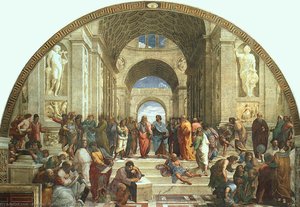 School of Athens1511
 The Sistine Madonna1513
 The Transfiguration1520
 Marriage of the Virgin1504

Essays around The Three Graces
 Timeless Grace: Curating the Most Captivating Masterpieces of Elegant Women for the Discerning CollectorDiscover the profound beauty of timeless grace through a curated selection of masterworks. From Renaissance elegance to Neo-Classical allur…
 Masterpieces of Perfection: The Top 25 Greatest Artworks by RaphaelJourney through the sublime beauty of the High Renaissance with our curated list of Raphael's top 25 masterpieces. From iconic Madonnas to …
 Pietro Perugino: Umbrian Master of Serenity & Precursor to Raphael's High RenaissanceExplore the life & art of Pietro Perugino, a pivotal Renaissance master and Raphael’s influential teacher. Discover his serene compositions…