High Renaissance
St. Michael and Satan (Raphael)
Raphael (1483–1520) made St. Michael and Satan. It belongs to the High Renaissance movement. It is made in oil on panel.
- Oil On Panel

 Preview

 Hand Made Oil Painting
 Send
 Share
 Fact sheet


 Download
 Similars
 X-Ray
 Diaporama
 Q&A

 Stats
St. Michael and Satan, in brief
- Title
- St. Michael and Satan
- Artist
- Raphael (1483–1520)
- Artist born in
- Urbino, Italy
- Medium
- Oil On Panel
- Movement
- High Renaissance
- Period
- Renaissance
- Subject
- christianity, mythology, angel, demon, victory, renaissance
What does St. Michael and Satan depict?
St. Michael and Satan: A Triumph of Renaissance Faith
The painting St. Michael and Satan by Raphael, a cornerstone of High Renaissance art, transcends mere visual representation; it embodies the spiritual fervor and intellectual ambition that defined its era. Completed in 1518 during Pope Leo X’s reign, this monumental oil on wood panel resides within the Louvre Museum in Paris, continuing to captivate audiences centuries later with its masterful execution and profound symbolism. Raphael's initial inspiration stemmed from a smaller devotional piece – St. Michael – executed around 1504 or 1505—a testament to his unwavering commitment to exploring religious themes through artistic innovation. Commissioned by Francesco Maria I della Rovere, Urbino’s heir, this miniature served as an expression of gratitude for the papal honor bestowed upon him, foreshadowing Raphael's later ambition to tackle grand narratives with unparalleled artistry.- Composition and Narrative: Raphael skillfully employs a pyramidal structure, positioning St. Michael at its apex—a deliberate choice reflecting Christian theology’s emphasis on divine majesty. Beneath him lies Satan, depicted in contorted agony, symbolizing the defeat of evil by righteous force. The dynamic diagonal lines created by the figures propel the viewer's gaze across the canvas, intensifying the dramatic tension inherent in the biblical tale.
- Color Palette and Technique: Raphael’s palette is characterized by earthy browns and blues—muted hues that convey solemnity and grandeur—contrasting sharply with Satan’s darker tones of grey and brown. His meticulous brushwork achieves remarkable textural detail, capturing the musculature of St. Michael's body and the drapery of their garments with breathtaking realism. The use of oil paint on wood allows for subtle gradations of color and ensures exceptional durability, guaranteeing that Raphael’s vision persists through time.
- Symbolism and Spiritual Significance: Beyond its aesthetic beauty, St. Michael and Satan is laden with religious symbolism. St. Michael embodies divine protection and righteousness—a warrior angel battling the forces of darkness—while Satan represents temptation and despair. The bird soaring above symbolizes hope and ascension, reinforcing the overarching message of triumph over adversity.
- Influence and Legacy: Raphael’s artistic prowess profoundly impacted subsequent generations of painters, notably Charles Le Brun at Académie royale de peinture et de sculpture, establishing a foundational aesthetic for French classicism. His meticulous attention to detail and harmonious balance continue to inspire artists today, cementing St. Michael and Satan's place as an enduring masterpiece of Renaissance art.
Further Exploration & Inspiration
Consider commissioning a high-quality reproduction of Raphael’s St. Michael and Satan for your home or studio—a tangible connection to one of the most celebrated artworks in Western history. Explore similar pieces from other masters of the Renaissance, delving into themes of faith, heroism, and artistic excellence. Visit Michaelskirche in Munich or explore the Michael C. Carlos Museum in Atlanta for immersive experiences showcasing comparable artistic traditions.High-resolution images of St. Michael and Satan

Raphael, St. Michael and Satan. Public domain.
Questions on St. Michael and Satan, answered
What technique was used for "St. Michael and Satan" by Raphael?
Raphael used the oil on panel technique for "St. Michael and Satan". The technique defines the material nature of the original work.
What does "St. Michael and Satan" by Raphael depict?
The subjects of "St. Michael and Satan" are christianity, mythology, angel, demon, victory, renaissance, allegory.
Is "St. Michael and Satan" free of copyright?
"St. Michael and Satan" by Raphael is in the public domain - its copyright has expired. This status governs how the image of the work may be reproduced.
Which artist is "St. Michael and Satan" attributed to?
"St. Michael and Satan" is attributed to Raphael.
What art movement does "St. Michael and Satan" by Raphael belong to?
"St. Michael and Satan" by Raphael belongs to the High Renaissance movement. This movement provides the stylistic context of the work.
Where does "St. Michael and Satan" fall in Raphael's career?
Within Raphael's career, "St. Michael and Satan" falls in the Mature. The phase helps compare it with the artist's other works.
Why is the copyright status of "St. Michael and Satan" what it is?
"St. Michael and Satan" by Raphael is in the public domain - its copyright has expired. Copyright duration runs from the artist's death, which occurred in 1520.
Where does "St. Michael and Satan" sit within Raphael's body of work?
Within Raphael's output, "St. Michael and Satan" sits in the High Renaissance style, alongside the themes of divine triumph, renaissance ideals, christian symbolism, patronage, artistic legacy.
Is "St. Michael and Satan" typical of what Raphael usually created?
Among Raphael's recorded themes - divine triumph, renaissance ideals, christian symbolism, patronage, artistic legacy - "St. Michael and Satan" brings its own focus on christianity, mythology, angel, demon, victory, renaissance, allegory.
About the artist, Raphael

1483–1520, Italy
Raphael
The Life and Identity of Raphael Raphael, known to history by several names including Raffaello Sanzio, Raffaello Santi, and Raffaello Sanzio da Urbino, was a central figure of the Italian High Renaissance. His life was defined by a dual mastery of painting and architecture, a versatility that allowed him to move seamlessly between the intimate scale of a portrait and the monumental demands of papal construction. He was born in Urbino, Italy, on April 6, 1483, into a world of intellectual and artistic activity. His career was marked by an immense productivity that required the management of a large workshop to meet the needs of his patrons.
Also by Raphael
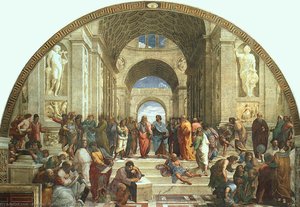 School of Athens1511
 The Sistine Madonna1513
 The Transfiguration1520
 Marriage of the Virgin1504
Essays around St. Michael and Satan
 Masterpieces of Perfection: The Top 25 Greatest Artworks by RaphaelJourney through the sublime beauty of the High Renaissance with our curated list of Raphael's top 25 masterpieces. From iconic Madonnas to …
 Renaissance Visions: Exploring Themes & Techniques in 16th-Century PaintingExplore the captivating world of Renaissance painting! Discover key themes, masterful techniques & iconic artworks from Leonardo da Vinci t…
 25 Masterpieces of the Sistine Chapel: A Journey Through Michelangelo's Divine ArtStep into the divine beauty of the Sistine Chapel. Explore 25 iconic Renaissance masterpieces by Michelangelo and beyond. From breathtaking…