 Switch to Print
 Read More







































 For artworks or reproductions larger than 105 cm (approximately 41 inches) on any side, the frame will be shipped as a kit, disassembled. This method ensures safe delivery and prevents damage during transport.


A Geometry of Feeling: Deconstructing Reality in Piet Mondrian’s Composition with Grid VII
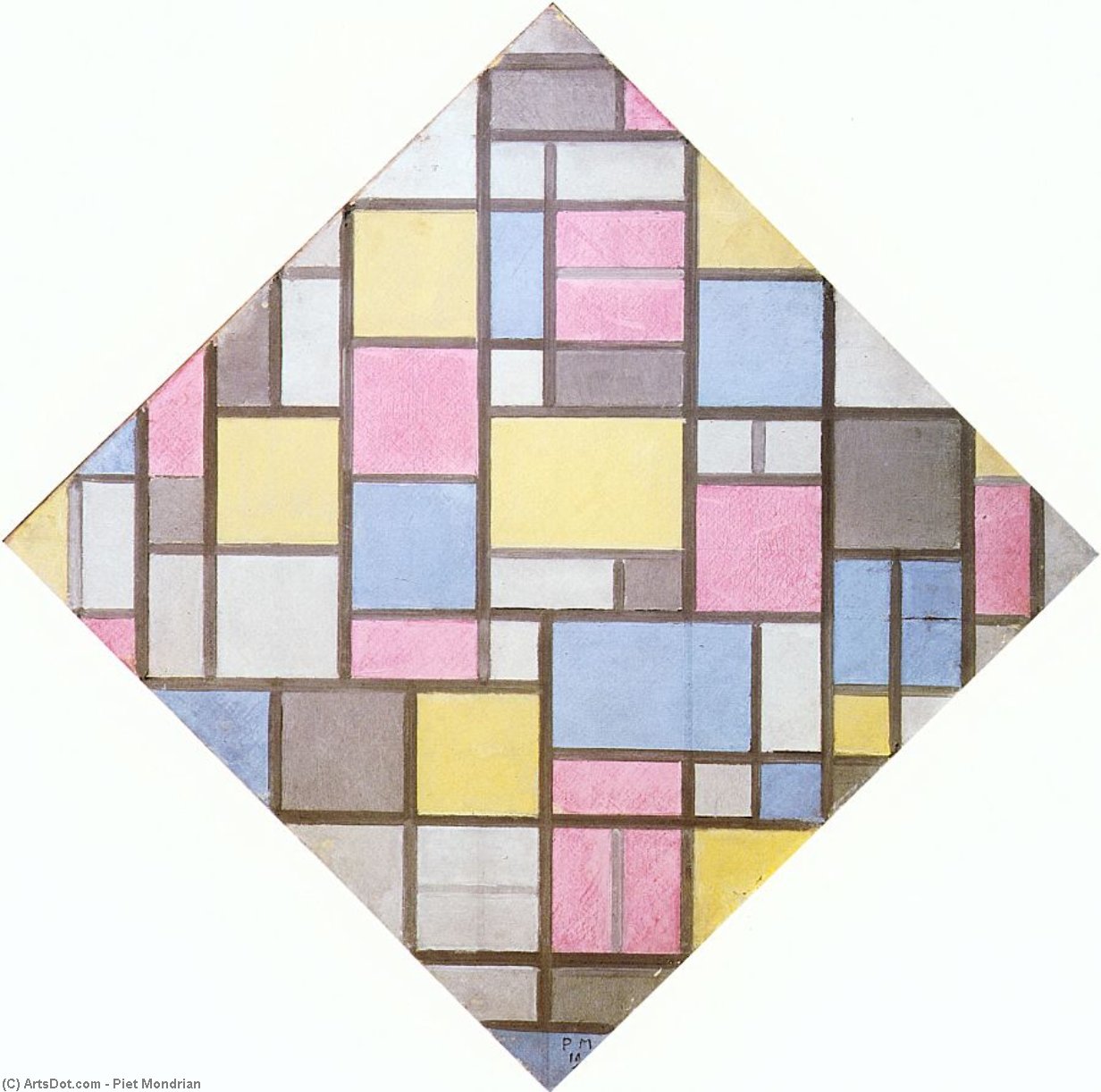
Piet Mondrian's Composition with Grid VII, created in 1919, is not merely an arrangement of colored squares and black lines; it is a visual manifesto of a radical artistic philosophy. Emerging from the tumultuous aftermath of World War I, this work embodies a yearning for order and universality amidst chaos – a distillation of reality into its most fundamental components. The painting presents a carefully calibrated grid structure populated with rectangles of varying sizes, each filled with hues of blue, yellow, pink, and gray, alongside areas of stark white. This isn’t about depicting the world *as* it is seen, but rather exploring the underlying principles that govern existence itself.
The Path to Neoplasticism: A Journey of Abstraction
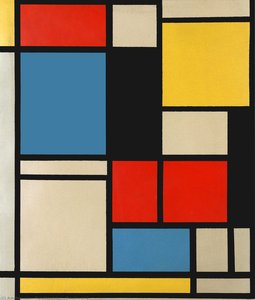
To understand Composition with Grid VII, one must trace Mondrian's artistic evolution. Born Pieter Cornelis Mondriaan in Amersfoort, Netherlands, he began his career painting naturalistic landscapes, influenced by the Hague School and Dutch Impressionism. However, a restless spirit drove him to experiment – Pointillism, Fauvism, and ultimately, Cubism. His pivotal move to Paris in 1912 exposed him to the avant-garde, sparking a deconstruction of form that would define his life’s work. He began stripping away representational elements, seeking an art free from the subjective distortions of individual perception. This quest culminated in Neoplasticism (also known as De Stijl), a style predicated on pure abstraction and universal harmony. Composition with Grid VII stands as a crucial stepping stone within this journey; it’s not yet the fully realized, rigorously geometric aesthetic of his later works like Composition with Red, Blue and Yellow, but rather a dynamic exploration *towards* that endpoint. The grid isn't absolute here – lines are slightly irregular, colors subtly nuanced – hinting at the organic origins from which this abstract language emerged.
Beyond Aesthetics: A Spiritual and Philosophical Undertone
Mondrian wasn’t simply interested in creating visually pleasing arrangements; his art was deeply rooted in spiritual and philosophical beliefs. Influenced by Theosophy, he believed that underlying all of reality were fundamental geometric forms and primary colors – the building blocks of the universe. By reducing painting to these essential elements, he aimed to express a universal truth, transcending individual experience and cultural specificity. The horizontal and vertical lines, in particular, represented opposing forces—masculine and feminine, static and dynamic—brought into equilibrium. The limited palette wasn’t arbitrary; it was chosen for its purity and symbolic resonance. The grid itself can be interpreted as a metaphor for the structure of existence, while the colored rectangles represent individual energies contained within that framework. This isn't cold intellectualism, however. There is an emotional current running through the work – a sense of calm, balance, and quiet contemplation.
A Lasting Legacy: Mondrian’s Influence on Modern Design
The impact of Piet Mondrian extends far beyond the realm of painting. His aesthetic principles have profoundly influenced countless designers, architects, and artists. From fashion to furniture, the clean lines, geometric forms, and primary color palettes characteristic of Neoplasticism continue to resonate in contemporary design. Composition with Grid VII, as a key work within this movement, serves as a powerful reminder of Mondrian’s enduring vision – a vision that sought not merely to depict the world, but to reshape our perception of it. Owning a reproduction of this artwork isn't just acquiring a beautiful object; it is inviting a piece of art history and philosophical inquiry into your space—a testament to the power of abstraction to evoke emotion, inspire thought, and transform our surroundings.
Questions & Answers
What space matches the colors of "Composition with Grid VII" by Piet Mondrian?
The pastels colors of "Composition with Grid VII" by Piet Mondrian match its recommended space: a living room.
What are the date and style of "Composition with Grid VII" by Piet Mondrian?
"Composition with Grid VII" by Piet Mondrian is dated 1919 and belongs to Neoplasticism.
Are there works similar to "Composition with Grid VII"?
Works similar to "Composition with Grid VII" are listed on the artwork's Similars page.
More about this painting
 Preview
 Send
Send Share
Share
 Details
 Guide
Guide

 Download
 Similars
 X-Ray
X-Ray Diaporama
 Q&A
Q&A Stats
Stats