

 Preview
 Send
Send Share
Share
 Details
 Guide
Guide

 Download
 Similars
 X-Ray
X-Ray Diaporama
 Stats
StatsUntitled (D2X835)
 Acrylic On Canvas
- WallArt
- Neoclassical Romanticism
 1817
1817 216.0 x 142.0 cm
 Metropolitan Museum of Art
 Read More
Giclée / Art Print
Museum-quality giclée or canvas print with fast production and flexible finish options. ( Buy Hand Made Painting Switch to Digital Image)




P118B $10

P118H $10

P118W $10

P438Z $10

P508JH $12

P508YH $12

P805H $10

P805Z $10

P919BZ $10

P919G $10

P919XJ $10

P959ZH $10

P968JZ $12

W106C $8

W218G $10

W218JH $8

W218Y $10

W307PJ $10

W316G $10

W316PJ $8

W316Y $10

W398PJ $8

W4111J $10

W500HY $15

W500JH $15

W692G $12

W849H $8

W940BG $15

W953PJ $8




Pick from our preset sizes that match the artwork's original proportions.

You may enter your own dimensions to fit a specific frame or space. If your selected size does not match the original image's proportions, we will either crop the artwork or extend the image with a mirrored or solid-fill edge. A digital mockup will be sent for your approval before production begins.
Please note that the on-screen preview does not reflect the actual cropping or extension. Only the mockup will accurately show the final composition.
While custom sizes are available, we recommend selecting a dimension from the predefined list to preserve the original proportions.
Worldwide Delivery () in 2 weeks instead of standard 4/5 weeks. (11 October)

Free Worldwide Express Shipping

High-Quality Linen Canvas

Full Shipping Insurance

Customs Tax Refund Guarantee

True Color Matching Guarantee

100-Day Return Policy (Defects Only)

100% Money-Back Guarantee

Bulk Discount Offer
 Glass option is only available in size under 110 CM

Untitled (D2X835)
Giclée / Art Print
Reproduction Size
-


Total Price
$ 81
A Portrait of Refined Elegance: Pierre-Paul Prud’hon's “Untitled (D2X835)”
Pierre-Paul Prud’hon’s “Untitled (D2X835),” painted in 1817, offers a captivating glimpse into the world of Parisian society during the early 19th century. More than just a simple portrait, it's a carefully constructed tableau vivant—a staged scene brimming with subtle social commentary and an exquisite mastery of chiaroscuro, a technique that defines Prud’hon’s distinctive style. The painting depicts a gentleman in formal attire – a dark suit, top hat, and crisp tie – positioned beside a chair, creating an immediate sense of quiet contemplation. His clasped hands suggest both formality and perhaps a touch of restrained emotion.
Prud’hon, a pivotal figure bridging the Neoclassical and Romantic movements in French art, was deeply influenced by classical antiquity yet possessed a sensitivity that foreshadowed the emotional intensity of the Romantics. Born in Cluny, he spent formative years in Rome, absorbing the ideals of Greco-Roman sculpture and architecture, which informed his meticulous draftsmanship and his preference for idealized forms. This painting showcases this influence; the gentleman’s posture, attire, and overall composition echo the formality and restraint characteristic of Neoclassical portraiture, while the subtle play of light and shadow—the hallmark of *chiaroscuro*—injects a dramatic depth that hints at the Romantic sensibility he would later embrace.
The Setting: A Window into 19th-Century Domesticity
Beyond the central figure, Prud’hon skillfully employs background elements to enrich the scene and provide context. The presence of several individuals – partially visible in the distance – suggests a gathering or social event, hinting at the importance of hospitality and social interaction within Parisian society. A comfortable couch and another smaller one further contribute to the atmosphere of an affluent home, reflecting the lifestyle of the upper class. Notably, a vase on the left adds a touch of decorative elegance, demonstrating Prud’hon's attention to detail and his understanding of how objects could enhance a scene’s narrative.
The inclusion of these secondary figures isn’t merely decorative; it subtly underscores the social dynamics at play. They are less defined, almost like ghosts in the background, suggesting a hierarchy within the gathering – the central figure commanding attention while others remain peripheral. This layering of detail is characteristic of Prud'hon’s approach, inviting viewers to actively interpret the scene and consider its broader implications.
Symbolism and Emotional Resonance
While the subject matter appears straightforward—a portrait of a gentleman—Prud’hon imbues the painting with layers of symbolic meaning. The man’s posture, the formality of his attire, and the quiet contemplation suggested by his clasped hands invite speculation about his thoughts and feelings. The top hat, a symbol of status and sophistication during this period, further emphasizes his position within society.
Furthermore, Prud'hon’s masterful use of light and shadow—the *chiaroscuro* technique—creates an emotional atmosphere that is both elegant and subtly melancholic. The deep shadows cast upon the background figures and the subtle highlighting of the central figure contribute to a sense of intimacy and introspection. It’s as if we are privy to a private moment, observing a man lost in thought amidst the backdrop of refined domesticity.
A Legacy of Artistic Innovation
"Untitled (D2X835)" stands as a testament to Pierre-Paul Prud’hon's artistic genius and his pivotal role in bridging the gap between Neoclassicism and Romanticism. His meticulous draftsmanship, combined with his innovative use of *chiaroscuro* and his keen eye for detail, produced works that continue to captivate viewers today. OriginalUniqueArt’s hand-painted reproduction faithfully captures the essence of this remarkable painting, offering a stunning addition to any art collection or interior space. The meticulous attention to color, texture, and composition ensures an authentic representation of Prud'hon’s vision, allowing you to experience the beauty and emotional depth of this iconic artwork firsthand.
Questions & Answers
What underlying hue runs through "Untitled (D2X835)" by Pierre-Paul Prud'hon?
An ochre to sepia hue runs through "Untitled (D2X835)" by Pierre-Paul Prud'hon.
Who created "Untitled (D2X835)"?
The artist behind "Untitled (D2X835)" is Pierre-Paul Prud'hon. The work is catalogued under Pierre-Paul Prud'hon's name.
In what year was "Untitled (D2X835)" by Pierre-Paul Prud'hon created?
"Untitled (D2X835)" dates from 1817. The date places the work within Pierre-Paul Prud'hon's career and its era.
Can I examine "Untitled (D2X835)" in more detail?
The X-Ray view of "Untitled (D2X835)" by Pierre-Paul Prud'hon is on the artwork's X-Ray page: an interactive examination of the image through eleven optical layers.
Is there a guide for "Untitled (D2X835)" by Pierre-Paul Prud'hon?
The Guide page of "Untitled (D2X835)" by Pierre-Paul Prud'hon offers a printable two-sheet factsheet: the artwork with its identity table, a decade band placing it in the artist's lifetime, other works by the artist, the measured color palette, and ready-to-copy citations in four styles.
How old was Pierre-Paul Prud'hon when creating "Untitled (D2X835)" in 1817?
When "Untitled (D2X835)" was created in 1817, Pierre-Paul Prud'hon - born in 1758 - was 59 years old.
What is the dominant color of "Untitled (D2X835)" by Pierre-Paul Prud'hon?
espresso (#3b2e1c) is the leading color of "Untitled (D2X835)" by Pierre-Paul Prud'hon.
Artist Biography
Pierre-Paul Prud'hon: A Life in Art
- Born: Cluny, France (1758)
- Died: 1823
- Nationality: French
Pierre-Paul Prud’hon was a pivotal figure in French art, bridging the transition from Neoclassicism to Romanticism. Born in Cluny, Saône-et-Loire, France, his artistic journey reflects the changing aesthetic landscape of late 18th and early 19th century Europe. He is celebrated for both his allegorical paintings and portraits, demonstrating a mastery of chiaroscuro and realism that captivated audiences and influenced subsequent generations.
Early Life and Training
- Provincial Beginnings: Prud’hon received his initial artistic training in the French provinces.
- Dijon Scholarship: In 1774, he secured a municipal scholarship to attend the École de Dessin in Dijon, marking a significant step towards formal artistic education.
- Rome and Neoclassical Influences: He traveled to Rome in 1784, where he immersed himself in the study of classical art, particularly admiring the works of Canova and Correggio. This period profoundly shaped his early style, imbuing it with a sense of elegance and idealized form characteristic of Neoclassicism.
Artistic Career and Royal Patronage
- Revolutionary Allegories: Prud’hon's work gained prominence during the French Revolution, producing vignettes, book illustrations, and allegorical paintings that resonated with republican ideals.
- Napoleon's Court Painter: His talent attracted the attention of Napoleon Bonaparte, who commissioned him to paint portraits of both Joséphine de Beauharnais and Marie-Louise d’Autriche. The portrait of Joséphine, in particular, depicted her not as an empress but as a captivating woman, fueling speculation about a possible romantic relationship between the artist and the former queen.
- Bridging Styles: Prud'hon skillfully navigated the evolving artistic trends of his time, incorporating elements of both Neoclassicism and Romanticism into his work. While maintaining a classical foundation in composition and form, he infused his paintings with emotional depth and dramatic lighting that foreshadowed the Romantic movement.
Major Works and Artistic Legacy
- Madame Georges Anthony and Her Two Sons (1796): An early example of his portraiture skills, showcasing a refined elegance.
- The Soul Breaking the Links Holding it to the Earth: A powerful allegorical work demonstrating his ability to convey complex emotions through symbolic imagery.
- The Dream of Happiness: A poignant exploration of human aspirations and desires.
- Crucifixion (1822): Commissioned for St. Etienne's Cathedral in Metz, now housed in the Louvre, this work is considered one of his most significant achievements.
- Justice and Divine Vengeance Pursuing Crime: A monumental masterpiece that anticipates the dramatic intensity of Géricault’s *The Raft of the Medusa*.
Influence and Historical Significance
Prud'hon exerted a considerable influence on subsequent generations of French artists. His mastery of chiaroscuro, his ability to imbue portraits with psychological depth, and his synthesis of Neoclassical and Romantic styles made him a highly respected figure in the art world. Artists such as Théodore Géricault and Eugène Delacroix acknowledged his impact, drawing inspiration from his dramatic compositions and emotional expressiveness. Stendhal, Millet, and Baudelaire also recognized Prud'hon’s artistic merit, further solidifying his place in French cultural history.

Pierre-Paul Prud'hon
1758 - 1823 , France
Quick Facts
- Full Name: Pierre-Paul Prud'hon
- Nationality: French
- Date Of Birth: 1758
- Date Of Death: 1823
- Place Of Birth: Cluny, France
- Notable Artworks:
- Madame Georges Anthony and her sons
- The Soul Breaking the Links
- The Dream of Happiness
- Crucifixion
- Justice and Divine Vengeance
- Artistic Movement Or Style: Neoclassicism & Romanticism
- Artists Who Influenced This Artist:
- Antonio Canova
- Leonardo da Vinci
- Correggio
- Artists Or Movements Influenced By This Artist:
- Théodore Géricault
- Delacroix
Related Articles

Anne-Louis Girodet: Bridging Neoclassicism & Romanticism with Emotional Truth
Explore the captivating world of Anne-Louis Girodet, a pivotal figure bridging Neoclassicism & Romanticism. Discover his masterpieces and unique artistic vision with OriginalUniqueArt.

Neoclassical Portraiture: The Timeless Elegance of Order, Grace, and Academic Mastery
Explore the refined world of Neoclassical portraiture. Discover the mastery of line, light, and order through an expert exploration of academic art history, from Jacques-Louis David to Jean-Antoine Houdon. Immerse yourself in the timeless elegance of classical realism.
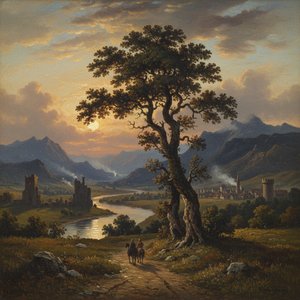
Paul Huet: Capturing the Essence of French Romanticism Through Light and Landscape
Explore the captivating world of Paul Huet (1803-1869), a master of French Romantic landscape painting. Discover his influence on Barbizon & Impressionism, and browse high-quality reproductions at OriginalUniqueArt.
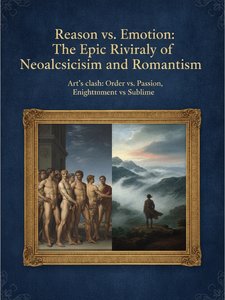
Reason vs. Emotion: The Epic Clash of Neoclassicism and Romanticism in Art History
Explore the profound tension between Neoclassicism's rational order and Romanticism's emotional depth. An expert journey through the masters of art history, from David to Delacroix, perfect for collectors and enthusiasts seeking a deeper understanding of artistic evolution.
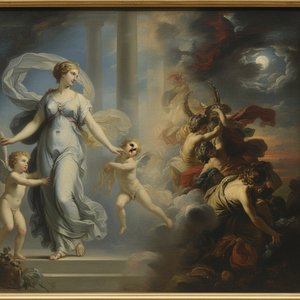
Pierre-Paul Prud'hon: Exploring Neoclassical Sensibility & Romantic Precursors
Explore the captivating world of Pierre-Paul Prud'hon, a pivotal French painter bridging Neoclassicism & Romanticism. Discover his allegorical masterpieces and lasting influence on 19th-century art history.


