 Preview
 Send
Send Share
Share
 Details
 Guide
Guide

 Download
 Similars
 X-Ray
X-Ray Diaporama
 Stats
StatsMother Love

 Read More
Giclée / Art Print
Museum-quality giclée or canvas print with fast production and flexible finish options. ( Buy Hand Made Painting Switch to Digital Image)




































Pick from our preset sizes that match the artwork's original proportions.

Type the width and the height you need, to fit your frame or your wall. A print can only be cut, never made bigger than the picture, so a size with a different shape loses a part of the image. We send you a digital mockup to approve before we print anything. The picture shown on this page does not show the real cut — only the mockup does.
Worldwide Delivery () in 2 weeks instead of standard 4/5 weeks. (27 October)

Free Worldwide Express Shipping

High-Quality Linen Canvas

Full Shipping Insurance

Customs Tax Refund Guarantee

True Color Matching Guarantee

100-Day Return Policy (Defects Only)

100% Money-Back Guarantee

Bulk Discount Offer
 Glass option is only available in size under 110 CM

Mother Love
Giclée / Art Print
Reproduction Size
-


Total Price
$ 81
Composition and Symbolism
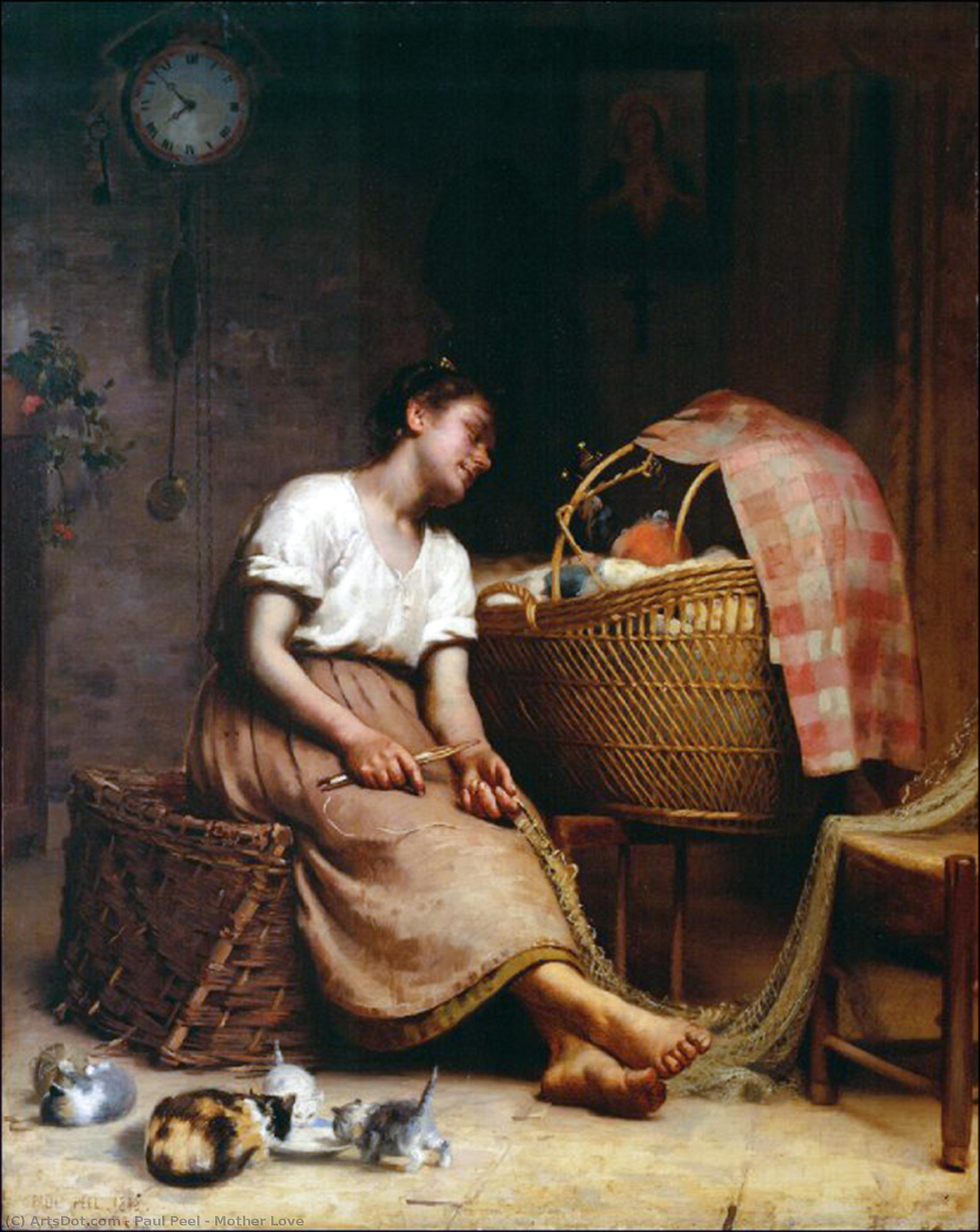
The painting features a serene scene where a mother sits beside her cradle, gently holding her baby while gazing at something beyond the viewer's sight. The room is adorned with everyday items such as a clock on the wall, two chairs, a bowl, and a resting cat, which add to the sense of domestic tranquility. Each element in the composition serves to underscore the theme of maternal love and the quiet moments shared between mother and child.Artistic Technique
Paul Peel's use of color and light is noteworthy. The soft, muted tones create a warm and intimate atmosphere, drawing the viewer into the private moment being depicted. The artist's skillful brushwork and attention to detail are evident in the textures of the furniture and the gentle folds of the mother's clothing.Historical Context
Painted in 1888, Mother Love reflects the societal values of the late 19th century, where family and domestic life were highly esteemed. Peel's work captures the essence of this period, showcasing the importance placed on maternal care and the nurturing role of women.Relevance in Modern Times
Despite being created over a century ago, Mother Love remains a timeless piece that resonates with audiences today. The universal theme of motherly love transcends time and culture, making this painting a cherished work for many art enthusiasts.Acquiring a Reproduction
For those who wish to bring the beauty of Mother Love into their own homes, OriginalUniqueArt.com offers high-quality, handmade oil painting reproductions. Our skilled artists meticulously recreate each detail, ensuring that every reproduction captures the essence of Peel's original work.- View "Mother Love" by Paul Peel on OriginalUniqueArt.com
- Explore other works by Paul Peel and similar artists on our platform.
- Discover the process of creating handmade oil painting reproductions at OriginalUniqueArt.com.
Questions & Answers
Is a high-resolution download of "Mother Love" available?
To get a digital file of "Mother Love" by Paul Peel, order a high-resolution digital image download on its Digital Image page.
Are the colors of "Mother Love" by Paul Peel vivid or muted?
The colors of "Mother Love" by Paul Peel show a subtle color saturation with a monochromatic intensity.
What does "Mother Love" share with the rest of Paul Peel's output?
"Mother Love" shares with Paul Peel's other works its Contemporary Realism style and the recorded themes: early sentimental works, exploration of human emotion, character studies, canadian artistic identity, academic painting, romantic sentimentality, realist detail, domestic genre.
Artist Biography
A Canadian Voice in the Parisian Art World
Paul Peel, a name perhaps less instantly recognizable than some of his contemporaries, nevertheless occupies a pivotal position in the narrative of Canadian art history. Born in London, Ontario, in 1860, Peel’s tragically short life – he died at just thirty-one years old – belied an artistic maturity and international recognition rarely achieved by Canadian painters of his era. His story is one of dedicated study, a bold embrace of European artistic currents, and a pioneering spirit that helped to establish Canada as a legitimate force within the global art landscape. From early lessons with his father, a stone-carver and drawing instructor, Peel’s innate talent was nurtured, setting him on a path toward formal training under William Lees Judson before he ventured further afield. This initial grounding in academic principles would prove crucial to his later development, providing a solid foundation upon which he could build his unique artistic vision.Formative Years and Parisian Influences
The pursuit of that vision led Peel to Philadelphia’s Pennsylvania Academy of the Fine Arts in 1877, where he studied under the exacting eye of Thomas Eakins. This period was transformative, instilling in him a commitment to realism and a nuanced understanding of light and form – a “tonal” approach that would characterize much of his early work. However, it was Peel’s move to Paris in 1881 that truly ignited his artistic evolution. The French capital was then the undisputed epicenter of the art world, a magnet for ambitious artists from across the globe. He enrolled at both the École nationale supérieure des Arts Décoratifs and the prestigious École des Beaux-Arts, seeking guidance from luminaries like Jean-Léon Gérôme. Gérôme encouraged Peel to work *en plein air*, sketching directly from nature, a practice that infused his canvases with a newfound vibrancy and immediacy. Further studies under Jean-Joseph Benjamin-Constant, Henri Doucet, and Jules Lefebvre at the Académie Julian honed his academic skills, yet Peel wasn’t content merely to replicate established styles. He began to subtly integrate Impressionistic principles into his work, experimenting with color and light in ways that set him apart from many of his peers.Themes of Innocence and International Acclaim
Peel's artistic output centered around a captivating trio of themes: sentimental nudes, charming depictions of children, and serene genre scenes. He possessed an exceptional ability to capture not only physical beauty but also the emotional depth within his subjects. This talent culminated in his masterpiece, After the Bath (1890), a painting that catapulted him to international fame. The work earned him a bronze medal at the Paris Salon – a remarkable achievement for a Canadian artist – and solidified his reputation as a rising star. The Young Gleaner (1888) and Mother Love (1888) are equally compelling examples of his skill, portraying rural life and maternal bonds with tenderness and grace. Other notable works like The Young Botanist, Before the Bath, and Japanese Dolls and Fan further demonstrate his versatility and mastery of technique. Peel’s paintings weren't simply exercises in technical skill; they were imbued with a sense of narrative, inviting viewers to contemplate the stories behind the images.A Lasting Legacy
Paul Peel’s significance extends beyond his individual artistic achievements. He was among the first Canadian painters to boldly explore the nude as a legitimate subject matter, challenging prevailing societal norms and paving the way for future generations of artists to experiment with new themes and styles. His success at the Paris Salon demonstrated that Canadian artists could compete successfully on the international stage, fostering a sense of national pride and inspiring others to pursue their artistic ambitions abroad. He was an active member of both the Ontario Society of Artists and the Royal Canadian Academy of Arts, contributing significantly to the development of Canada’s burgeoning art community. Though his life was cut short by a lung infection in 1892, his legacy endures. His childhood home is preserved as an attraction at Fanshawe Pioneer Village in London, Ontario, serving as a poignant reminder of his artistic contributions and the enduring power of his vision. Peel’s work continues to resonate with audiences today, offering a glimpse into a bygone era while simultaneously celebrating the timeless beauty of innocence, emotion, and the human spirit.
Paul Peel
1860 - 1892 , Canada
Quick Facts
- Full Name: Paul Peel
- Nationality: Canadian
- Date Of Birth: 1860
- Date Of Death: 1892
- Place Of Birth: London, Canada
- Notable Artworks:
- After the Bath
- The Young Gleaner
- Mother Love
- Artistic Movement Or Style: Academic painting
- Artists Who Influenced This Artist:
- Thomas Eakins
- Jean-Léon Gérôme
- Artists Or Movements Influenced By This Artist: ['Future Canadian artists']
Related Articles

Paul Klee's Masterpieces: Explore 25 Iconic Paintings & Prints | OriginalUniqueArt
Journey through Paul Klee's 25 most iconic paintings & prints. Explore his abstract style, Bauhaus influence, and vibrant color palettes. Find museum-quality art reproductions & decor ideas at OriginalUniqueArt.com. Discover all masterpieces online.
Oil on Board Masters: 10 Paintings That Redefined Art | OriginalUniqueArt
Explore 10 legendary 'Oil on Board' masterpieces by Van Gogh, Monet & more! Discover art history, iconic styles like Impressionism, and find museum-quality reproductions to elevate your home decor. Explore the full collection online at OriginalUniqueArt.com.

The Enduring Legacy of Oil on Canvas: Technique, History & Aesthetic Impact
Explore the rich history & techniques of oil painting – from Renaissance masters to Impressionism. Discover pigments, layering methods, and why this timeless medium endures. Expert insights for artists & art enthusiasts.

Cézanne's Masterpieces: 25 Iconic Artworks to Transform Your Space
Journey through 25 iconic artworks by Paul Cézanne – a master of Impressionism and Post-Impressionism. Explore his landscapes, still lifes, and the stories behind these timeless masterpieces. Discover museum-quality reproductions & curated decor at OriginalUniqueArt.com.

Oil on Canvas: A Historical & Technical Exploration of a Timeless Artistic Medium
Explore the rich history & enduring techniques of oil painting on canvas. Discover the science behind its longevity, conservation practices, and contemporary relevance. Expert insights for art enthusiasts.