Text size

() ·

A painting made for you, by hand

With the Mauve Triangle

Hand Made Oil Reproduction

Hand-painted oil on canvas in your size and frame, made to order by our artists. ( Switch to Print Switch to Digital Image)

Collectible Description

Paul Klee, born in Münchenbuchsee, Switzerland, revolutionized art with his fusion of Expressionism, Cubism, and Surrealism. Influenced by music and characterized by playful abstraction, he created a distinctive visual language marked by simplified forms and emotive color palettes.

Artist Biography

Paul Klee blended Expressionism and Cubism in works like Ships in the Dark. Discover his vibrant world of color and form today.

from ·

Chapter 1

How large should it be?

Slide to change the size; the picture on the left shows the frame at its real width. The proportions of the original are kept.

Standard
custom
CM
INCH

Pick from our preset sizes that match the artwork's original proportions.

width
height

Type the width and the height you need, to fit your frame or your wall. This is hand-painted, so for a size with a different shape the artist can paint a bit more around the picture, or cut a bit — you choose. We send you a digital mockup to approve before the painting starts. The picture shown on this page does not show the real result — only the mockup does.

Chapter 2

How should it arrive?

Choose the edges of the stretched canvas

Choose your frame

Corner sample of the WhiteWrap canvas edge finish, stretched on solid wood bars
White $1
Corner sample of the BlurSideWrap canvas edge finish, stretched on solid wood bars
Blurside $1
Corner sample of the ExtendedWrap canvas edge finish, stretched on solid wood bars
Extended $1
Corner sample of the P118B picture frame: moulded polystyrene, 5 cm wide and 3 cm thick
P118B $10
Corner sample of the P118H picture frame: moulded polystyrene, 5 cm wide and 3 cm thick
P118H $10
Corner sample of the P118W picture frame: moulded polystyrene, 5 cm wide and 3 cm thick
P118W $10
Corner sample of the P438Z picture frame: moulded polystyrene, 5.5 cm wide and 3.5 cm thick
P438Z $10
Corner sample of the P508JH picture frame: moulded polystyrene, 7 cm wide and 3.5 cm thick
P508JH $12
Corner sample of the P508YH picture frame: moulded polystyrene, 7 cm wide and 3.5 cm thick
P508YH $12
Corner sample of the P805H picture frame: moulded polystyrene, 5 cm wide and 3.5 cm thick
P805H $10
Corner sample of the P805Z picture frame: moulded polystyrene, 5 cm wide and 3.5 cm thick
P805Z $10
Corner sample of the P919BZ picture frame: moulded polystyrene, 7 cm wide and 3.5 cm thick
P919BZ $10
Corner sample of the P919G picture frame: moulded polystyrene, 7 cm wide and 3.5 cm thick
P919G $10
Corner sample of the P919XJ picture frame: moulded polystyrene, 7 cm wide and 3.5 cm thick
P919XJ $10
Corner sample of the P959ZH picture frame: moulded polystyrene, 5 cm wide and 3 cm thick
P959ZH $10
Corner sample of the P968JZ picture frame: moulded polystyrene, 6 cm wide and 4 cm thick
P968JZ $12
Corner sample of the W106C picture frame: solid wood, 5 cm wide and 3 cm thick
W106C $8
Corner sample of the W218G picture frame: solid wood, 5 cm wide and 3 cm thick
W218G $10
Corner sample of the W218JH picture frame: solid wood, 5 cm wide and 3 cm thick
W218JH $8
Corner sample of the W218Y picture frame: solid wood, 5 cm wide and 3 cm thick
W218Y $10
Corner sample of the W307PJ picture frame: solid wood, 6 cm wide and 3 cm thick
W307PJ $10
Corner sample of the W316G picture frame: solid wood, 6 cm wide and 3 cm thick
W316G $10
Corner sample of the W316PJ picture frame: solid wood, 6 cm wide and 3 cm thick
W316PJ $8
Corner sample of the W316Y picture frame: solid wood, 6 cm wide and 3 cm thick
W316Y $10
Corner sample of the W398PJ picture frame: solid wood, 5 cm wide and 3 cm thick
W398PJ $8
Corner sample of the W4111J picture frame: solid wood, 6.5 cm wide and 3.5 cm thick
W4111J $10
Corner sample of the W500HY picture frame: solid wood, 7 cm wide and 5 cm thick
W500HY $15
Corner sample of the W500JH picture frame: solid wood, 7 cm wide and 5 cm thick
W500JH $15
Corner sample of the W692G picture frame: solid wood, 8 cm wide and 4 cm thick
W692G $12
Corner sample of the W849H picture frame: solid wood, 5 cm wide and 3 cm thick
W849H $8
Corner sample of the W940BG picture frame: solid wood, 7.5 cm wide and 4.5 cm thick
W940BG $15
Corner sample of the W953PJ picture frame: solid wood, 6 cm wide and 3.5 cm thick
W953PJ $8
Corner sample of the H24-GOLD picture frame: carved wood with gesso, 10 cm wide and 6 cm thick
H24-GOLD $30
Corner sample of the H24-SILVER picture frame: carved wood with gesso, 10 cm wide and 6 cm thick
H24-SILVER $30
Corner sample of the H36-GOLD picture frame: carved wood with gesso, 15 cm wide and 6.5 cm thick
H36-GOLD $45
Corner sample of the H36-SILVER picture frame: carved wood with gesso, 15 cm wide and 6.5 cm thick
H36-SILVER $45
Frame preview
Framed

Moulding: . Overall size with the frame: .

Chapter 3

Who paints it, and should anything change?

Examples of what can be changed: Replace face with customer photo; Add pet (e.g., replace cat with dog); Include hidden message in background; Change background landscape or elements.
After order, OriginalUniqueArt.com team will email client for instructions and provide a mockup preview

Worldwide Delivery () in 3/4 weeks instead of standard 5 weeks. (1 November). No compromise on quality.

Chapter 4

The finishing touches

A nameplate, as in a museum?

Engraved Bronze Plaque Details

This elegant plaque features the artist's name and the title of the artwork, finely engraved for a timeless presentation.

It is made from bronze with a refined, elegant finish. The text is precisely laser-engraved for a sharp and permanent result. Measuring 9x2 cm, the plaque is compact yet easy to read. It's built to be durable and scratch-resistant, offering a professional, museum-quality look. Mounting is simple thanks to the included adhesive backing.

Transparent Acrylic Plaque Details

The plaque includes essential engraved details such as the artist's name, the title of the artwork, the date it was created, the type of media used-like oil on canvas or watercolor-a brief description of the piece, and a QR code that links to the complete artwork information.

It is crafted from clear acrylic, offering a sleek, modern appearance. The text is UV-engraved in black to ensure strong visual contrast. With a size of 10x15 cm, it ensures optimal readability. It comes equipped with two metal hooks for secure wall mounting. The plaque is designed to be weather-resistant, making it suitable for various environments, and it includes interactive features that work seamlessly with smartphone scanning.

Black Acrylic Plaque Details

This elegant plaque includes engraved information such as the artist's name, the title of the artwork, the date it was created, the type of media used (like oil on canvas or watercolor), a short description of the artwork, and a QR code for quick access to more information.

The plaque itself is made from refined black acrylic with a premium finish. The text is laser-engraved in white for high contrast and readability. Its size is 10x15 cm, designed to be easy to read. It comes with two metal hooks for professional mounting. The design is sleek and fits any interior style. It is also weather-resistant and durable, with built-in digital integration for mobile compatibility.

A protective varnish?

When do you need it?

Chapter 5

Your painting, as you ordered it

With the Mauve Triangle

Reproduction Medium

Reproduction Size

-

Elite Senior Artist

More detail, finesse, and extra production time

-

Reproduction Frame

-

-

For artworks or reproductions larger than 105 cm (approximately 41 inches) on any side, the frame will be shipped as a kit, disassembled. This method ensures safe delivery and prevents damage during transport.

Professional assembly required - this is not a DIY product.
The kit must be assembled and the canvas stretched by an experienced professional framer, using wood glue (not supplied), a canvas stretching plier and clamps to hold the bars square while the glue dries. Incorrect assembly or uneven canvas tension can permanently damage the artwork and is not covered by our warranty.

  • All solid wood bars are included, precisely cut to size.

  • Assembled with the screws provided, plus wood glue for the corner joints, which is not supplied and must be sourced by your framer.

  • Professional tools are required and not included: a canvas stretching plier (tensioner) and clamps to hold the bars square while the glue dries.

Important:
The corner joints require wood glue, the bars must be held with clamps until the glue is fully dry, and tightening the canvas on the assembled frame requires a canvas stretching plier. None of these are included in the kit. Please arrange an experienced professional framer before ordering this size.

Nameplate

-

-

Protective Varnish

Glossy Varnish (enhances colors, protects against light/moisture)

-

Customize My Artwork

Examples of what can be changed: Replace face with customer photo; Add pet (e.g., replace cat with dog); Include hidden message in background; Change background landscape or elements.

-

Urgent

Worldwide Delivery () in 3/4 weeks instead of standard 5 weeks. (1 November). No compromise on quality.

-

Express Shipping

Worldwide Delivery () in 5 weeks. (8 November).

Included

Total Price

$ 300

Total Price $ 300

Glass option is only available in size under 110 CM

Included with every order

  • Free Worldwide Express Shipping
  • High-Quality Linen Canvas
  • Full Shipping Insurance
  • Customs Tax Refund Guarantee
  • True Color Matching Guarantee
  • 100-Day Return Policy (Defects Only)
  • 100% Money-Back Guarantee
  • Bulk Discount Offer

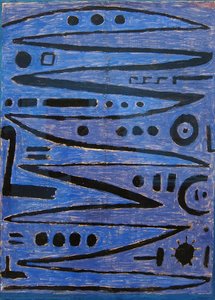
With the Mauve Triangle – A Symphony of Geometric Harmony

Paul Klee’s “With the Mauve Triangle” isn't merely a painting; it’s an invitation into a realm where color and form coalesce to evoke profound contemplation. Executed around 1937, during his prolific period at Bauhaus Dessau, this watercolor on paper embodies Klee’s unwavering commitment to exploring the expressive potential of abstraction—a pursuit that firmly established him as one of the foremost figures in European modern art. The artwork immediately captivates with its deceptively simple composition: a series of overlapping rounded shapes – reminiscent of hills or abstracted landscapes – arranged across a canvas that exudes an understated elegance. Dominating the upper right quadrant is a striking triangular form, aptly named “With the Mauve Triangle,” which serves as both structural element and focal point for visual attention.

Decoding Geometric Expressionism

Klee’s approach to painting transcends representational accuracy; instead, he prioritizes conveying emotion and psychological states through carefully considered geometric shapes. Influenced by Piet Mondrian's reductive style and underpinned by his fascination with musical notation—a connection that profoundly shaped his artistic process—Klee utilizes a palette dominated by yellows, oranges, reds, greens, blues, purples, and pinks. These hues aren’t blended seamlessly but applied in flat planes, creating vibrant contrasts that heighten the artwork's visual dynamism. The strategic placement of complementary colors like orange and blue underscores Klee’s deliberate manipulation of color theory to stimulate the viewer’s senses and provoke emotional resonance.

The Language of Line and Shape

Beyond color, “With the Mauve Triangle” speaks volumes through its masterful use of line and shape. Rounded forms—domes, hills, and gentle curves—prevail, eschewing sharp angles or rigid lines characteristic of earlier artistic movements. These shapes subtly bleed into one another, fostering a sense of fluidity and spontaneity that aligns perfectly with Klee’s expressive vision. Sparse red lines punctuate the canvas, injecting movement and energy into the otherwise tranquil arrangement. They act as visual conduits, guiding the eye across the composition and reinforcing the artwork's underlying rhythm.

A Reflection of Bauhaus Ideals

The painting’s genesis within the Bauhaus Dessau school—a bastion of modernist design and artistic experimentation—further illuminates its significance. Founded in 1925 by Walter Gropius, Bauhaus championed a holistic approach to art education, integrating craftsmanship with theoretical inquiry. Klee's involvement at Bauhaus solidified his belief that art should serve as a tool for social betterment, fostering creativity and promoting harmonious relationships between humanity and nature. “With the Mauve Triangle” embodies these Bauhaus ideals—a testament to the transformative power of geometric abstraction combined with an unwavering sensitivity to color and texture.

Emotional Resonance: Beyond Representation

Ultimately, "With the Mauve Triangle" transcends mere visual aesthetics; it invites viewers into a meditative experience. The absence of traditional perspective compels us to engage actively with the artwork, interpreting its forms and colors through our own emotional lens. Like many of Klee’s works, this piece doesn't depict recognizable objects or scenes but rather strives to capture intangible feelings—a quiet contemplation punctuated by bursts of vibrant color. It’s a reminder that art can communicate truths beyond words, resonating with viewers on a deeply personal level and offering a glimpse into the artist’s inner landscape.

Questions & Answers

What emotional tone accompanies the Abstract Expressionism style of "With the Mauve Triangle"?

Within the Abstract Expressionism movement, "With the Mauve Triangle" is recorded with a calm tone.

Do the colors of "With the Mauve Triangle" appear strong or soft?

"With the Mauve Triangle" by Paul Klee shows a vivid color intensity.

Where do the visitors of "With the Mauve Triangle" by Paul Klee come from?

Statistics about "With the Mauve Triangle" by Paul Klee are on the artwork's Stats page: monthly visits of the artwork, visits of the artist's works, and country and language breakdowns of recent visitors.

More about this painting

Preview AR preview Switch to Print Switch to Digital Image Send
Details Guide Add to favorites Download Similars X-Ray Diaporama Q&A Stats

In numbers

  • 29frames to choose from
  • standard sizes, in its own proportions
  • 5weeks to paint and deliver it
Paul Klee

Paul Klee

1879 - 1940, Switzerland

Quick facts about Paul Klee

  • Artistic Movement Or Style:
    • Expressionism
    • Cubism
    • Surrealism
  • Artists Who Influenced This Artist:
    • Pablo Picasso
    • Georges Braque
    • Robert Delaunay
    • Vincent van Gogh
    • Paul Cézanne
  • Full Name: Paul Klee
  • Nationality: German and Swiss
  • Notable Artworks:
    • Hammamet with Its Mosque
    • Ships in the Dark
    • Walpurgis Night
    • The Protector
  • Place Of Birth: Münchenbuchsee, Switzerland
  • Date Of Birth: 1879
  • Date Of Death: 1940

Artist Biography

A Life of Line and Lyricism

Born in Münchenbuchsee, Switzerland, on December 18, 1879, Paul Klee entered a world shaped by the rhythms of music. His father, Hans Wilhelm Klee, was a German music teacher, and his mother, Ida Marie, was a Swiss singer. This early immersion in sound provided a foundation for a visual language that often mirrored musical arrangement. While he initially pursued the violin with great talent, eventually deciding that modern music lacked the creative pull he craved, he turned his focus toward the Academy of Fine Arts in Munich. His studies there between 1898 and 1901 were marked by an early mastery of drawing, though he famously struggled with color during those first cold winters.

The transition from a draftsman to an abstract thinker was not immediate. Klee’s early years involved exploring the boundaries of Symbolism and Art Nouveau, often working in black and white or through experimental techniques like needle drawing on blackened glass. A significant shift occurred in 1914 during a visit to Tunisia. The intense light of North Africa allowed him to detach color from physical description, using it instead as an independent force. This period provided the necessary push toward abstraction, moving his work away from mere representation and toward a more personal, symbolic vocabulary.

The Bauhaus Years and Political Shadows

Klee’s career reached a period of intense theoretical and creative activity during his time at the Bauhaus. From 1920 to 1930, he joined the faculty of this influential school of design and architecture, working alongside figures like Wassily Kandinsky. It was here that much of his prolific output occurred, particularly small-scale watercolors and drawings on paper. His teaching allowed him to explore the relationship between color and form with scientific precision, a subject he documented extensively in his notebooks. These writings, which examined the mechanics of design, are now regarded as essential texts for understanding modern composition.

The stability of this era was abruptly interrupted by the rise of National Socialism. In 1933, Klee was dismissed from his position at the Academy of Fine Arts in Düsseldorf because the Nazi regime classified his work as “degenerate.” Forced to return to his native Bern, his later years were marked by a shift in tone. As political turmoil grew and his own health declined, his lines became heavier, turning into black bars, and his forms grew more generalized. The whimsicality of his earlier years gave way to a more somber, melancholic perspective, reflecting the gravity of the era.

A Lasting Visual Language

The breadth of Klee’s output is immense, totaling some 10,000 works that range from delicate sketches to larger, more structured compositions. His ability to blend influences from Cubism, Expressionism, and Surrealism resulted in a style that felt both childlike and deeply intellectual. He utilized a variety of media, including:

  • Zinc-plate etchings
  • Watercolor on gauze and paper
  • Lithographs
  • Charcoal and pencil drawings

His work remains a study in balance, where titles often provided the necessary context for his often cryptic imagery. Whether through the use of simple stick figures or complex, colorful grids, he sought to express the inner world of ideas rather than the surface of reality. He died on June 29, 1940, in Muralto, Switzerland, leaving behind a body of work that bridged the gap between the figurative and the abstract.

Quick Facts

  • Title: With the Mauve Triangle
  • Subject or theme: Landscape abstraction
  • Artistic style: Abstract Expressionism
  • Dimensions: 15 x 9 cm
  • Influences:
    • Cubism
    • Folk Art

Art Quiz

There is only one correct answer for each question.

Question 1:
What artistic movement is Paul Klee’s ‘With the Mauve Triangle’ primarily associated with?
Question 2:
The artwork utilizes a predominantly flat color palette. What technique is most likely employed to achieve this effect?
Question 3:
'With the Mauve Triangle' exemplifies Klee’s characteristic style by prioritizing geometric shapes and simplified forms. Where does Klee’s influence from Bauhaus originate?
Question 4:
What is the dominant form in ‘With the Mauve Triangle’?
Question 5:
Considering Klee's artistic philosophy, how would you describe the artwork's intention?