Symbolism · 1882
Madness (Odilon Redon, 1882)
Odilon Redon (1840–1916) made Madness. It dates from 1882. It belongs to the Symbolism movement. It is made in lithograph.
- 1882
- Lithograph

 Preview

 Hand Made Oil Painting
 Send
 Share
 Fact sheet


 Download
 Similars
 X-Ray
 Diaporama
 Q&A

 Stats
Madness, in brief
- Title
- Madness
- Artist
- Odilon Redon (1840–1916)
- Artist born in
- Bordeaux, France
- Date
- 1882
- Medium
- Lithograph
- Movement
- Symbolism
- Period
- 19th Century
- Subject
- face, profile, head, hair, shadow, black
What does Madness depict?
Identification of Madness by Odilon Redon
In this 1882 lithograph, titled Madness, Odilon Redon presents a portrait that moves beyond mere likeness to explore the internal landscape of the human psyche. The work is a significant example of the artist's early period, a time when he focused intensely on his noirs, creating compositions that relied on the stark interplay of light and shadow. By working within this monochromatic realm, Redon seeks to give form to the intangible, moving away from the literal world to find a language of pure darkness and light.
The subject matter of Madness is a profound exploration of isolation and psychological distress. Rather than depicting a specific individual, the work functions as a window into the subconscious, capturing a sense of introspection and despair. It is a quiet, unsettling study of the mind, where the figure's downward gaze and the heavy, obscuring shapes suggest a state of profound mental confinement. Through this approach, Redon invites a contemplation of the unseen forces that influence the human spirit.
Composition and Visual Elements
The composition is centered upon a profile view of a head, angled slightly toward the viewer. A large, dark triangular shape overlays the face, creating a sense of confinement. This geometric form creates a sharp tension against the organic curves of the head and neck. The figure's gaze is directed downward, a posture that suggests a state of deep introspection or perhaps a quiet despair. At the bottom of the work, the inscription "LA FOLIE" is placed, grounding the visual weight of the piece.
The lighting is highly directional and dramatic. A strong light source illuminates one side of the face, while the other side remains shrouded in deep shadow. This chiaroscuro effect emphasizes the psychological weight of the subject. The entire scene is rendered in a monochromatic palette, relying exclusively on black, white, and various shades of gray to build its atmosphere. There is a deliberate absence of color, which focuses the attention entirely on the interplay of light and shadow.
Technique and Artistic Materials
In this lithograph, Redon employs a process that relies on the fundamental tension between grease and water. He began by drawing directly onto a stone or metal plate using greasy drawing materials to map out the form. Once the composition was established, chemicals were applied to fix the image onto the surface, allowing it to be transferred onto paper through the printing process. This method allows for a specific kind of precision in the monochromatic range.
The artist’s hand is visible in the fine, delicate lines used to render the facial features and the strands of hair. To achieve the necessary tonal variations and a sense of tactile texture, Redon utilized hatching and cross-hatching techniques extensively. These layered marks create the subtle shifts in gray that define the figure's form against the darker elements of the composition. The interplay of these marks provides a structural depth to the print, moving from the softest shadows to the sharpest, most defined edges.
High-resolution images of Madness
Odilon Redon, Madness (1882). Public domain.
Questions on Madness, answered
When was "Madness" made?
"Madness" dates from 1882. The date places the work within Odilon Redon's career and its era.
What medium is "Madness" by Odilon Redon executed in?
Odilon Redon used the lithograph technique for "Madness". The technique defines the material nature of the original work.
What does "Madness" by Odilon Redon depict?
The subjects of "Madness" are face, profile, head, hair, shadow, black, white, gray.
Is "Madness" free of copyright?
The copyright answer for "Madness" by Odilon Redon: the work is in the public domain - its copyright has expired. This determines whether reproductions of the image may be freely made.
Who created "Madness"?
"Madness" is attributed to Odilon Redon.
Which artistic current is "Madness" by Odilon Redon part of?
"Madness" is a work of Symbolism. The movement indicates the artistic tradition the work is part of.
What stage of Odilon Redon's development does "Madness" represent?
"Madness" represents the Noirs Period of Odilon Redon.
At what age did Odilon Redon make "Madness"?
When "Madness" was created in 1882, Odilon Redon - born in 1840 - was 42 years old.
Why is the copyright status of "Madness" what it is?
"Madness" by Odilon Redon is in the public domain - its copyright has expired. Copyright duration runs from the artist's death, which occurred in 1916.
About the artist, Odilon Redon

1840–1916, France
Odilon Redon
Early Life, Family and Training Born Bertrand-Jean Redon on 20 April 1840 in Bordeaux, Aquitaine, France, the boy who would become known as Odilon Redon entered a world shaped by his family's origins. His mother, Marie Guérin, was a French Creole from Île Bourbon, and it was from her name that he eventually acquired his chosen moniker. Even in his youth, a certain visual aptitude was evident; at the age of ten, he was awarded a drawing prize at school, a small triumph that hinted at the sensitivity he would later apply to his craft. The path toward an artistic life was not a straight one.
Also by Odilon Redon
 The cyclops1914
 The Black Pegasus
 Woman and Centaur1900
 Saint Sebastian1900
Essays around Madness
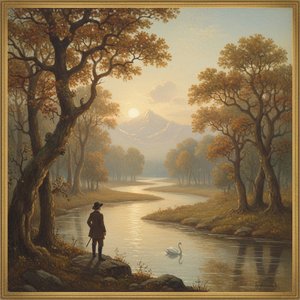 Amédée Masclef: Navigating Symbolism & Sentiment in Late 19th-Century French Landscape PaintingExplore the evocative landscapes of Amédée Masclef, a key figure bridging Barbizon realism & Symbolist sentiment. Discover his exquisite bo…
 Dreaming in Color and Shadow: The 25 Most Iconic Artworks by Odilon RedonExplore 25 iconic Odilon Redon masterpieces, from dark Noirs to vibrant Symbolism. Discover the full collection online at OriginalUniqueArt…
 The Art of Lithography: Mastering the Alchemy of Stone, Ink, and ImpressionDiscover the sophisticated world of lithography. Explore the alchemy of stone and ink, the history of this master printmaking technique, an…