The Geometry of Emotion: How Shape Dictates Visual Narrative
To the discerning eye, a painting is never merely a collection of pigments upon canvas; it is a carefully orchestrated dialogue between form and feeling. Before the mind processes color or subject matter, the subconscious responds to the fundamental architecture of shape. There is an inherent psychological weight to certain geometries that governs our emotional response to art. A sharp, angular line possesses an aggressive, piercing energy, capable of instating tension or dynamism within a composition, much like the jagged edges found in the works of the Cubist pioneers. Conversely, the soft curve of a circle or an ellipse invites a sense of continuity, grace, and organic wholeness, evoking the rhythmic breathing of the natural world.
This silent language of geometry serves as the skeletal structure of visual storytelling. When we observe a masterpiece, the interplay of these shapes directs our gaze, creating a path of discovery that leads us through the artist's intention. A triangle, resting on its base, provides a sense of monumental stability and permanence, often utilized in classical compositions to ground the viewer. Yet, when tilted or fragmented, that same shape can suggest instability or movement. By manipulating these primordial forms, artists transcend mere representation, tapping into a universal lexicon of symbols that resonate across cultures and eras, turning a flat surface into a profound emotional landscape.
From Cubism to Op Art: A Chronology of Geometric Evolution
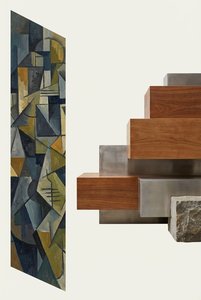
The history of modern art is, in many ways, a progressive liberation of shape from the constraints of literal representation. The dawn of the twentieth century brought with it a radical reconfiguration of reality through movements like Cubism. Artists such as Auguste Herbin revolutionized the canvas by deconstructing objects into their essential geometric components, proving that vibrant color theories and structured compositions could convey depth without traditional perspective. This era marked a departure from the mimetic, moving instead toward an exploration of how planes and volumes interact within a two-scale space.
As the century progressed, this geometric experimentation evolved into even more distilled forms. The mid-century period saw the rise of American Modernism, where artists like Vaclav Vytlacil utilized bold lines and textures to create dynamic triptychs that balanced abstraction with structural rhythm. This evolution reached a hypnotic peak with the advent of Op Art, exemplified by the legendary Victor Vasarely. In works such as Abstract Composition 31, the use of concentric circles in gold and black creates an optical illusion of depth and movement, where geometry is no longer just a container for meaning but the very engine of visual perception itself. This lineage demonstrates a continuous journey toward finding the ultimate truth within the simplest of forms.
The Mathematical Sublime: Precision and Movement in Abstract Composition
There exists a specific, almost spiritual resonance found in the intersection of mathematics and art—a phenomenon often referred to as the mathematical sublime. In the realm of abstract composition, precision is not merely about accuracy; it is about achieving a state of perfect equilibrium. When we examine works like John Piper’s Abstract Composition, we see how layered acrylics in blues and ochre create a sense of structured chaos. The artist employs geometric abstraction to navigate the delicate boundary between controlled order and spontaneous expression, much like a composer managing notes within a symphony.
This precision allows for the creation of movement within a static medium. Through the strategic placement of intersecting lines and overlapping planes, an artist can simulate the sensation of expansion or contraction. The viewer’s eye is caught in a perpetual loop of scanning and re-evaluating, drawn into the depths of the composition by the rhythmic repetition of shapes. This mastery of geometric tension ensures that the artwork remains "alive," possessing a kinetic energy that prevents the eye from ever truly resting, thereby sustaining a state of intellectual and aesthetic engagement.
Structural Harmony: Integrating Geometric Masterpieces into Modern Interiors
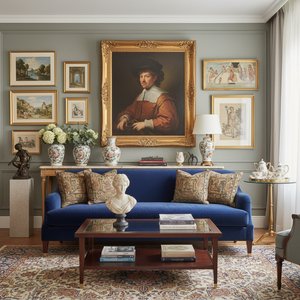
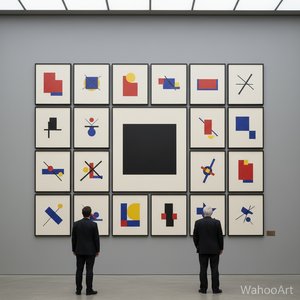
For the sophisticated collector, the challenge lies in integrating these powerful, often commanding works into the architectural fabric of a contemporary home. Geometric abstractions, by their very nature, act as anchors within a room. A large-scale, multi-panel triptych can serve to define a wide wall or a grand staircase, providing a sense of direction and structural continuity that mirrors the lines of the architecture itself. The clean edges of a geometric piece complement the minimalist aesthetics of modern design, creating a cohesive environment where art and space exist in total synergy.
However, the integration of such works requires a nuanced understanding of balance. A highly dynamic Op Art piece may require a more neutral surrounding palette to allow its optical effects to flourish without visual competition. When selecting pieces for a collection, one must consider how the geometric rhythm of the art interacts with the light and scale of the room. Whether through the use of expansive murals or carefully curated group sets, the goal is to create an atmosphere where the structural harmony of the painting enhances the lived experience of the space, turning a residence into a curated gallery of personal expression.
The Tactile Dimension: Recreating Geometric Depth through Impasto and Texture
While the concept of geometry is often associated with flatness and precision, the true mastery of the medium lies in adding a tactile dimension to these forms. The most profound geometric works are those that embrace the physical reality of paint. Through the technique of impasto—the thick, sculptural application of oil paint—an artist can transform a simple circle or line into a three-dimensional relief. This texture catches the light, creating micro-shadows that change as the viewer moves around the piece, adding a temporal element to the geometric structure.
In high-quality reproductions, such as those meticulously crafted by the specialists at OriginalUniqueArt.com, this tactile depth is preserved through layers of heavy-duty cotton canvas and premium pigments. Unlike a flat digital print, a hand-painted reproduction captures the visible, rhythmic brushstrokes that define the edges of each shape. This "living" quality ensures that the geometric form possesses not just visual impact, but a physical presence. By honoring the original artist's texture—from the delicate glazes to the heavy, textured peaks—the collector acquires more than an image; they acquire the very soul and substance of the masterpiece.