Surrealism
Le oiseau (Nick James)
Nick James (1980) made Le oiseau. It belongs to the Surrealism movement. It is kept at Coventry University in Coventry, United Kingdom. It measures 183 × 133 cm.
- 183 × 133 cm
- Coventry University

 Preview

 Hand Made Oil Painting
 Send
 Share
 Fact sheet


 Download
 Similars
 X-Ray
 Diaporama
 Q&A

 Stats
Le oiseau, in brief
- Title
- Le oiseau
- Artist
- Nick James (1980)
- Dimensions
- 183 × 133 cm
- Where to see it
- Coventry University, Coventry, United Kingdom
- Movement
- Surrealism
- Subject
- surreal wildlife, bold line art, dreamlike imagery, abstract animal, vibrant color palette, folk art style
Which museum holds Le oiseau?
Coventry University
Coventry, United Kingdom
A Tapestry of Innovation and Heritage In the heart of England’s West Midlands, Coventry University emerges not merely as an academic institution but as a vibrant sanctuary where scholarly rigor meets the boundless possibilities of public accessibility. Its story is one of profound metamorphosis, tracing a lineage that began in 1843 with the prestigious Coventry School of Design. This evolution—from its origins as a specialized design school to the era of Lanchester Polytechnic and finally attaining university status in 1992—mirrors the very resilience and adaptability of Coventry itself.

High-resolution images of Le oiseau
Protected by copyright: these files are for personal reference, not a licence to republish.
Nick James, Le oiseau, Coventry University.
Questions on Le oiseau, answered
Where is "Le oiseau" by Nick James on display today?
"Le oiseau" by Nick James is on display at the Coventry University, Coventry, United Kingdom. The museum listing refers to the original work, not to reproductions.
What are the dimensions of the original "Le oiseau" by Nick James?
"Le oiseau" measures 183 x 133 cm in its original form. Original dimensions are a useful reference when choosing a reproduction size.
What does "Le oiseau" by Nick James depict?
The themes present in "Le oiseau" by Nick James include surreal wildlife, bold line art, dreamlike imagery, abstract animal, vibrant color palette, folk art style, symbolic composition. Together they summarize the artwork's subject matter.
Can the image of "Le oiseau" by Nick James be freely reproduced?
The copyright answer for "Le oiseau" by Nick James: the work is still protected by copyright. This determines whether reproductions of the image may be freely made.
Who created "Le oiseau"?
"Le oiseau" is attributed to Nick James.
What art movement does "Le oiseau" by Nick James belong to?
"Le oiseau" by Nick James belongs to the Surrealism movement. This movement provides the stylistic context of the work.
Where does "Le oiseau" fall in Nick James's career?
"Le oiseau" belongs to the Mature Period of Nick James's career. This classification relates the work to the artist's development.
Where does "Le oiseau" sit within Nick James's body of work?
"Le oiseau" belongs to Nick James's Surrealism work, whose recorded themes include exploration of the unconscious, recurring animal motifs, bold visual language, personal mythology, folk art traditions, naive painting style, surrealist symbolism, graphic design roots.
How does the subject of "Le oiseau" relate to Nick James's usual themes?
Among Nick James's recorded themes - exploration of the unconscious, recurring animal motifs, bold visual language, personal mythology, folk art traditions, naive painting style, surrealist symbolism, graphic design roots - "Le oiseau" brings its own focus on surreal wildlife, bold line art, dreamlike imagery, abstract animal, vibrant color palette, folk art style, symbolic composition.
About the artist, Nick James
1980
Nick James
The Poetics of Salvage: Introducing Nick James Nick James is an artist who doesn’t so much *create* sculpture as he exhumes it, breathing new life into the discarded fragments of our collective past. Emerging from a foundation at WahooArt, his work isn't rooted in traditional artistic training but rather in a deeply intuitive understanding of material and memory. He operates not within the pristine realm of untouched canvas or virgin clay, but amongst the detritus of everyday existence – forgotten toys, corroded metal, chipped porcelain, and weathered wood. These aren’t simply objects repurposed; they are vessels carrying echoes of previous lives, carefully assembled into hauntingly beautiful wearable assemblages that explore themes of vulnerability, loss, and the surreal nature of recollection.
Also by Nick James
 Peligro, enfermo, no pasar
 Se estremeció solo de pensarlo
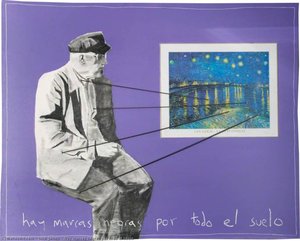 Hay marcas negras por todo el suelo
 Pruneau
Essays around Le oiseau
 Whistler's Masterpieces: Explore 25 Iconic Paintings & Aesthetic Art for Your HomeJourney through 25 iconic James Abbott McNeill Whistler paintings! Explore his masterpieces of Aestheticism, from 'Nocturne in Black and Go…
 Awe vs. Charm: Understanding the Sublime and the PicturesqueMaster the distinction between the Sublime and the Picturesque through Romantic era art. Explore the beauty of awe and charm today.
 Jacques-Laurent Agasse: Pioneering Animalier Painting & Romantic NaturalismExplore the captivating animal paintings of Jacques-Laurent Agasse (1767-1849). Discover his pioneering realism, Romantic influences & lega…