Color Field Painting · 1961
Phi (Morris Louis, 1961)
Morris Louis (1912–1962) made Phi. It dates from 1961. It belongs to the Color Field Painting movement. It is made in acrylic on canvas. It is kept at Tate Modern in London, United Kingdom.
- 1961
- Acrylic On Canvas
- Tate Modern, London

 Preview

 Hand Made Oil Painting
 Send
 Share
 Fact sheet


 Download
 Similars
 X-Ray
 Diaporama
 Q&A

 Stats
Phi, in brief
- Title
- Phi
- Artist
- Morris Louis (1912–1962)
- Artist born in
- Baltimore, United States
- Date
- 1961
- Medium
- Acrylic On Canvas
- Where to see it
- Tate Modern, London, United Kingdom
- Movement
- Color Field Painting
- Subject
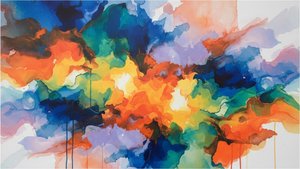
- color, flowing, ribbon, white background, purple, geometric
What does Phi depict?
Phi – A Ripple of Color Against White
Morris Louis’s “Phi,” created in 1961, stands as a quintessential example of Color Field painting—a movement that sought to elevate abstraction beyond mere visual stimulation and delve into its emotional resonance. More than just pigment on canvas, it's an exploration of proportion, harmony, and the elusive beauty found within simplicity. The artwork’s genesis lies in Louis’s pioneering use of Magna paint, a revolutionary emulsion resin developed specifically for him by Leo Sewell—a material that allowed for unprecedented fluidity and spontaneity during application.- Composition & Technique: Louis employed his signature “stain” technique, pouring diluted Magna onto the canvas and allowing it to spread organically across its surface. This method eschewed brushstrokes altogether, resulting in soft edges and blurred transitions—a deliberate rejection of traditional representational art and a commitment to capturing the essence of color itself. The ribbons of pigment cascade diagonally across the white expanse, creating an illusion of movement and depth without resorting to linear perspective.
- Color Palette & Symbolism: Dominant hues include shades of purple, blue, green, and yellow—a carefully considered palette that reflects Louis’s fascination with the golden ratio (approximately 1.618), a mathematical concept believed to represent divine proportion found throughout nature. The colors aren't blended; instead, they exist as distinct masses, mirroring the idea of interconnectedness and balance. Purple, often associated with spirituality and contemplation, juxtaposed against serene blues evokes feelings of tranquility and introspection.
- Historical Context & Influence: Color Field painting emerged in the wake of Abstract Expressionism, reacting against its gestural brushwork and prioritizing pure color as a primary expressive element. Louis’s work aligns closely with this aesthetic, drawing inspiration from artists like Josef Albers and Barnett Newman—figures who similarly championed flatness and chromatic harmony. The piece embodies the spirit of experimentation and intellectual inquiry that characterized the mid-century art scene.
- Emotional Impact & Aesthetic Response: “Phi” invites viewers to engage in a sensory experience—to contemplate the interplay of color and form without preconceived notions of narrative or subject matter. It’s designed to elicit an emotional response, prompting contemplation on themes of order, balance, and beauty. The artwork's subtle luminosity contributes to its contemplative atmosphere, encouraging reflection on fundamental questions about perception and artistic intention.
- Further Research: For a deeper understanding of Louis’s artistic vision, explore Tate Britain’s online exhibition featuring “Alpha Phi,” alongside reproductions of Newman’s “Virgil” and Albers' "Homage to the Cube." These works exemplify the broader Color Field aesthetic and offer valuable insights into Louis’s conceptual framework.
Which museum holds Phi?
Tate Modern
London, United Kingdom
The History and Origins of Tate Modern The presence of Tate Modern in London, United Kingdom, is rooted in the industrial history of the Southwark skyline. The site was originally occupied by the Bankside Power Station, a structure that functioned for three decades before its eventual decommissioning. Economic shifts, specifically oil price hikes, led to the station being shut down on 31 October 1981.


High-resolution images of Phi

Protected by copyright: the image is shown for reference only.
Other sizes, crops and citation →Morris Louis, Phi (1961), Tate Modern.
Questions on Phi, answered
Where is "Phi" by Morris Louis on display today?
The original "Phi" by Morris Louis is held at the Tate Modern, London, United Kingdom. A reproduction allows the work to be displayed at home.
When was "Phi" made?
The creation of "Phi" by Morris Louis is dated 1961.
What medium is "Phi" by Morris Louis executed in?
Morris Louis used the acrylic on canvas technique for "Phi". The technique defines the material nature of the original work.
What subjects appear in "Phi" by Morris Louis?
The subjects of "Phi" are color, flowing, ribbon, white background, purple, geometric, ratio.
Is "Phi" by Morris Louis in the public domain?
The copyright answer for "Phi" by Morris Louis: the work is still protected by copyright. This determines whether reproductions of the image may be freely made.
Who created "Phi"?
The artist behind "Phi" is Morris Louis. The work is catalogued under Morris Louis's name.
Which artistic current is "Phi" by Morris Louis part of?
"Phi" is a work of Color Field Painting. The movement indicates the artistic tradition the work is part of.
Which period of Morris Louis's career does "Phi" belong to?
"Phi" belongs to the Mid Century Modern of Morris Louis's career. This classification relates the work to the artist's development.
How old was Morris Louis when creating "Phi" in 1961?
When "Phi" was created in 1961, Morris Louis - born in 1912 - was 49 years old.
About the artist, Morris Louis

1912–1962, United States
Morris Louis
Early Life and Education Born: Morris Louis Bernstein, November 28, 1912, Baltimore, Maryland Parents: Louis Bernstein (furniture salesman) and Cecelia Luckman Bernstein. Education: Attended public schools in Baltimore; Maryland Institute of Fine and Applied Arts (now MICA), 1929-1932. Did not complete a degree. Early influences included Eugene Speicher and Paul Cézanne.
Also by Morris Louis
 Seal1959
 Ambi I1960
 Number 281961
 Para III1959
Essays around Phi
 Paul Jenkins: Abstraction, Color Field Painting & the Pursuit of Lyrical ExpressionExplore the captivating world of Paul Jenkins, a pioneer of abstract expressionism & color field painting. Discover his unique ‘Phenomena’ …
 Morris Louis: Pioneering Color Field Painting & Abstract Expressionism's LegacyExplore the groundbreaking abstract expressionism of Morris Louis, a pioneer of Color Field painting. Discover his innovative techniques, i…
 25 Masterpieces by Édouard Manet: The Rebel Who Redefined Modern ArtJourney through the rebellious soul of French Impressionism with our curated list of Édouard Manet's top 25 masterpieces. From iconic scand…