Portrait of Morris Louis

The 92 Most Famous Morris Louis Paintings, a Gallery Selection

Updated November 2026 · ranked by our popularity score (searches, visits and orders for each work) · 115 works by Morris Louis in our catalogue

In short

Of all the originals Morris Louis left, the most famous is Seal (1959), in the collection of the The Phillips Collection, Washington, D.C.. Close behind it come Ambi I (1960) and Number 28 (1961). Our catalog holds 115 works by Morris Louis; the gallery has kept the 92 the world admires most, each shown with its date, its museum and its story.

1912 – 1962, Baltimore Color field Most works: The Phillips Collection

Morris Louis's top 10 paintings: the gallery's choice

1
Seal (1959) by Morris Louis

Seal

1959 · Acrylic On Canvas · The Phillips Collection, Washington, D.C.

To stand before Seal is to witness a moment where the physical properties of paint and fabric become indistinguishable. Created in 1959, this work belongs to a period of intense experimentation with what is known as the "veil" technique. There are no visible brushstrokes here to guide the eye; instead, the artist utilized Magna acrylic paint, applied in thin, diluted layers onto unprimed linen. The pigment does not sit upon…

2
Ambi I (1960) by Morris Louis

Ambi I

1960 · Acrylic On Canvas · San Francisco Museum of Modern Art, San Francisco

To stand before Ambi I is to step into a realm where pigment itself becomes the primary subject. This monumental canvas by Morris Louis is not merely a depiction of color, but an immersion within it—a breathtaking study in atmospheric depth and fluid movement. The work eschews any recognizable narrative or focal point, instead inviting the viewer into a vast, breathable space built entirely from washes of diluted acrylics. It…

3
Number 28 (1961) by Morris Louis

Number 28

1961 · Acrylic On Canvas · Walker Art Center, Minneapolis

In the realm of mid-century abstraction, few works capture the ethereal essence of movement as profoundly as Morris Louis’s Number 28. Created in 1961, this masterpiece stands as a definitive pillar of the Color Field painting movement, inviting the viewer into a meditative space where boundaries between form and pigment dissolve. At first glance, the composition presents a striking minimalist architecture: two vertical bands of vibrant, saturated color that descend…

4
Para III (1959) by Morris Louis

Para III

1959 · Acrylic On Canvas · High Museum of Art, Atlanta

In the pantheon of mid-century American abstraction, few works command the room with such visceral intensity as Morris Louis’s “Para III.” Created in 1959, this monumental canvas serves as a profound testament to the power of pure color to bypass the intellect and speak directly to the soul. As a cornerstone of the Washington Color School, Louis moved away from the frantic, gestural energy of his Abstract Expressionist contemporaries, opting…

5
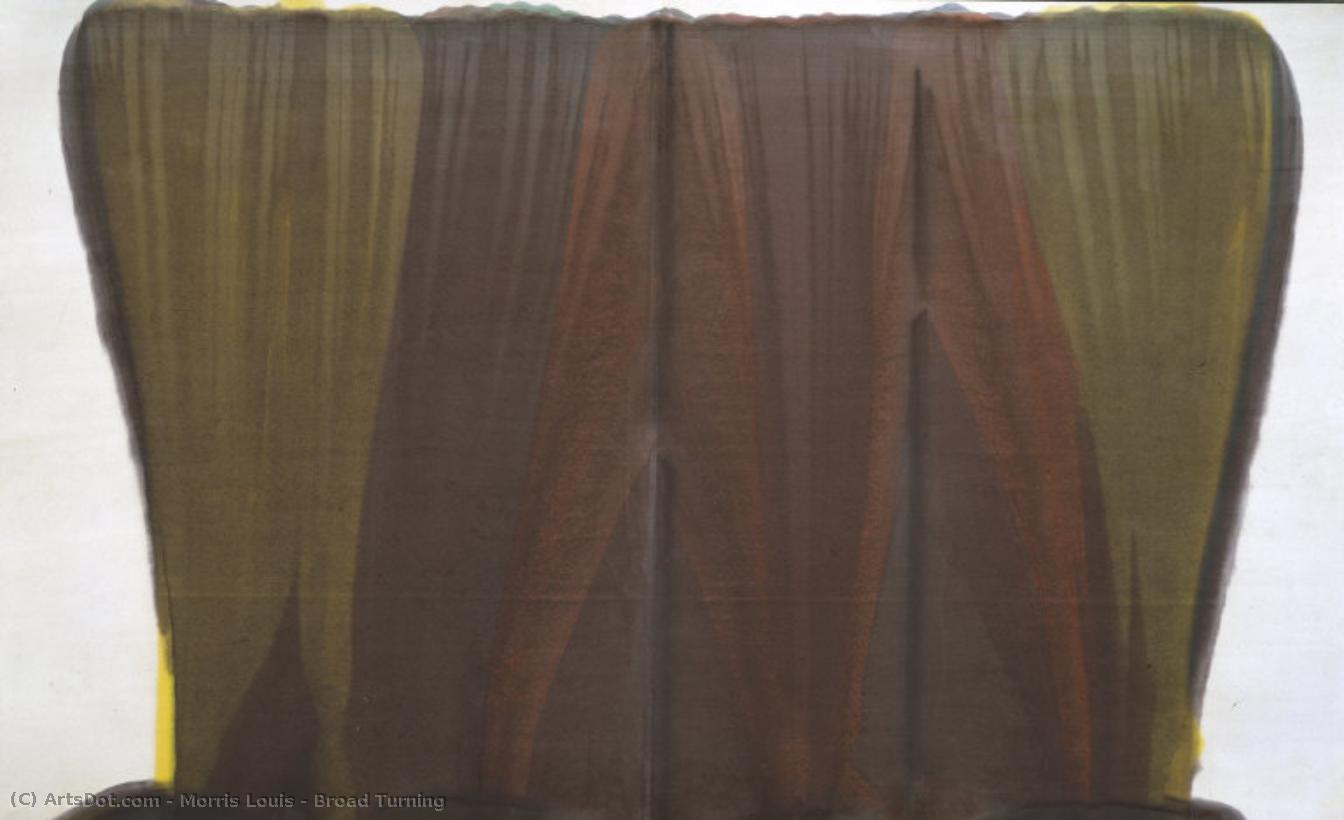
Broad Turning (1958) by Morris Louis

Broad Turning

1958 · Acrylic On Canvas · Dallas Museum of Art, Dallas

In this 1958 work, Morris Louis presents "Broad Turning," a significant example of Color Field painting. The piece occupies a substantial presence within the space it inhabits. It measures 230 x 384 cm, which is approximately 9 ft. 10 in. x 15 ft. 7 in. This scale allows the color to expand across the viewer's field of vision.

6
VAV (1960) by Morris Louis

VAV

1960 · Acrylic On Canvas · Tate Modern, London

Morris Louis's "VAV," painted in 1960, isn’t merely a canvas splashed with color; it’s an invitation to contemplate the very essence of perception and the interplay between surface and depth. This pivotal work, now residing within the esteemed collection of Tate Modern, marks a radical departure for Louis – a shift away from the gestural brushstrokes characteristic of Abstract Expressionism towards a revolutionary technique he termed “Veil Painting.” It’s a…

7
Delta Kappa (1960) by Morris Louis

Delta Kappa

1960 · Acrylic On Canvas · Dallas Museum of Art, Dallas

Morris Louis's “Delta Kappa,” painted in 1960, isn’t merely a canvas adorned with color; it’s an invitation to surrender to the ephemeral beauty of process and feeling. This seminal work from the Washington Color School represents a pivotal moment in American abstract expressionism, marking a decisive shift away from traditional figuration towards a radical exploration of pure color fields. Louis, deeply influenced by the European avant-garde – particularly the works…

8
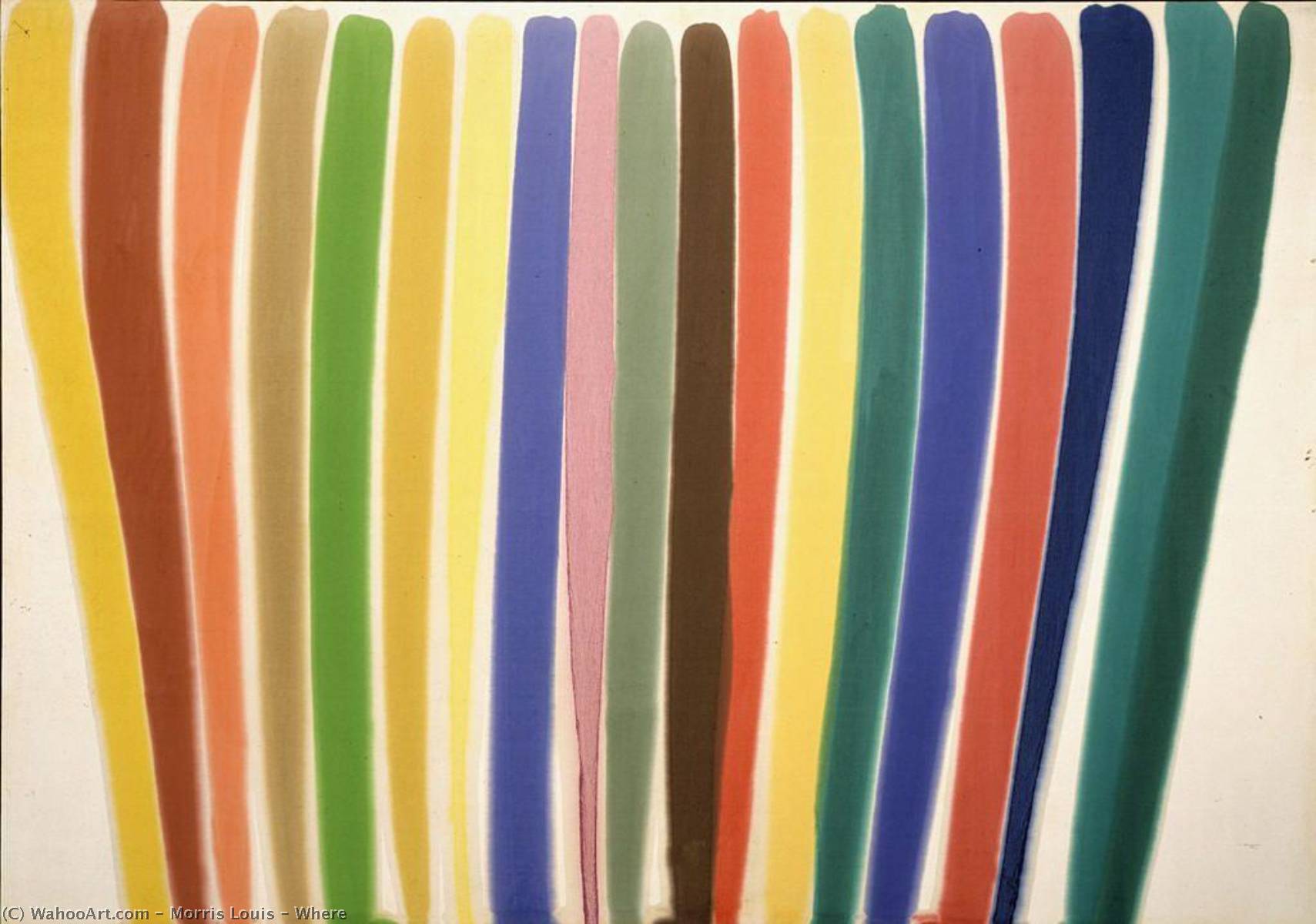
Where (1960) by Morris Louis

Where

1960 · Acrylic On Canvas

In the vast landscape of mid-century modernism, few works capture the ethereal essence of movement quite like "Where" by Morris Louis. Created in 1960, this monumental masterpiece serves as a profound testament to the era of Abstract Expressionism, specifically the evolution into Color Field painting. At first glance, the viewer is met with a breathtaking vertical composition where elongated, rectangular forms of varying hues dance across the canvas. There is…

9
Number 1-82 (1961) by Morris Louis

Number 1-82

1961 · Acrylic On Canvas · The Phillips Collection, Washington, D.C.

Morris Louis produced Number 1-82 in 1961. This work emerged during a period of intense experimentation for the artist, who was a central figure in the Washington Color School. By this stage of his career, Louis had moved toward the highly ordered and rhythmic structures that defined his later output.

10
Blue Veil (1958) by Morris Louis

Blue Veil

1958 · Watercolor · Fogg Museum, Cambridge

Blue Veil by Morris Louis is an abstract composition created about 1958. The work is dominated by flowing washes of color that lack defined forms or representational imagery. Instead of recognizable objects, the surface is defined by the interaction of pigment and space. The arrangement appears spontaneous and organic, suggesting a process governed by gravity and the movement of liquid.

The Morris Louis selection continues, 11 to 92

11Beta Upsilon (1960) by Morris LouisBeta Upsilon1960 12Beth Chaf (1959) by Morris LouisBeth Chaf1959 13Ambi II (1959) by Morris LouisAmbi II1959 14Gamma Lambda by Morris LouisGamma LambdaChrysler Museum of Art 15Partition (1962) by Morris LouisPartition1962 · Tate Modern 16Delta Lambda (1961) by Morris LouisDelta Lambda1961 · Cleveland Museum of Art 17Gamma Tau (1960) by Morris LouisGamma Tau1960 18Dalet Kaf (1959) by Morris LouisDalet Kaf1959 · Modern Art Museum of Fort Worth 19Number 2-07 (1961) by Morris LouisNumber 2-071961 20Maxine's House (1940) by Morris LouisMaxine's House1940 21Drawing [D88] (1948) by Morris LouisDrawing [D88]1948 · The Phillips Collection 22Untitled (1949) by Morris LouisUntitled1949 23Drawing [D182] (1950) by Morris LouisDrawing [D182]1950 · The Phillips Collection 24Trellis (1953) by Morris LouisTrellis1953 25Landscape (Mid-day) (1953) by Morris LouisLandscape (Mid-day)1953 26Charred Journal Firewritten I (1951) by Morris LouisCharred Journal Firewritten I1951 27Number 1 (1957) by Morris LouisNumber 11957 · Buffalo AKG Art Museum 28Alpha Tau (1961) by Morris LouisAlpha Tau1961 29Number 82 (1961) by Morris LouisNumber 821961 30Alpha Phi (1961) by Morris LouisAlpha Phi1961 31Gamma Omicron (1960) by Morris LouisGamma Omicron1960 32Blue Column (1960) by Morris LouisBlue Column1960 · The Phillips Collection 33Alpha-Pi (1960) by Morris LouisAlpha-Pi1960 34Alpha Upsilon (1960) by Morris LouisAlpha Upsilon1960 35Omega I (1960) by Morris LouisOmega I1960 36Beth Rash (1959) by Morris LouisBeth Rash1959 37Beth Chaf (1959) by Morris LouisBeth Chaf1959 38Gamma Ro (1960) by Morris LouisGamma Ro1960 39Untitled (1960) by Morris LouisUntitled1960 40Yad (1958) by Morris LouisYad1958 41Number 32 (1961) by Morris LouisNumber 321961 42Floral V (1960) by Morris LouisFloral V1960 43Pillar of Fire (1961) by Morris LouisPillar of Fire1961 44Alphard (1961) by Morris LouisAlphard1961 45Beth Zayin (1959) by Morris LouisBeth Zayin1959 46Crest of Pillar (1961) by Morris LouisCrest of Pillar1961 47Pillar of Hope (1961) by Morris LouisPillar of Hope1961 48Alpha (1960) by Morris LouisAlpha1960 · Buffalo AKG Art Museum 49Red Go (1961) by Morris LouisRed Go1961 507 Bronze (1958) by Morris Louis7 Bronze1958 51Saf (1959) by Morris LouisSaf1959 52Vertical Horizon (1961) by Morris LouisVertical Horizon1961 53Spawn (1960) by Morris LouisSpawn1960 54Third Element (1961) by Morris LouisThird Element1961 55Dalet Chet (1958) by Morris LouisDalet Chet1958 56While Series II (1960) by Morris LouisWhile Series II1960 57Addition V (1959) by Morris LouisAddition V1959 58Saf Aleph (1959) by Morris LouisSaf Aleph1959 59K S I (1959) by Morris LouisK S I1959 · Museum Folkwang 60Gamma Pi (1960) by Morris LouisGamma Pi1960 61Delta Theta (1961) by Morris LouisDelta Theta1961 62Color Line (1961) by Morris LouisColor Line1961 63Bellatrix (1961) by Morris LouisBellatrix1961 64Buskin (1959) by Morris LouisBuskin1959 65Point of Tranquility (1960) by Morris LouisPoint of Tranquility1960 66Horizontal VIII (1962) by Morris LouisHorizontal VIII1962 67Number 6 (1962) by Morris LouisNumber 61962 68Horizontal I (1962) by Morris LouisHorizontal I1962 692-68 (1962) by Morris Louis2-681962 70Gemma (1962) by Morris LouisGemma1962 711-33 (1962) by Morris Louis1-331962 72Number 39 (1962) by Morris LouisNumber 391962 73Hot Half (1962) by Morris LouisHot Half1962 74Number 1-36 (1962) by Morris LouisNumber 1-361962 75Green Picket (1962) by Morris LouisGreen Picket1962 76Apogee (1962) by Morris LouisApogee1962 77Number 1-68 (1962) by Morris LouisNumber 1-681962 · Museum Het Valkhof 78High (1959) by Morris LouisHigh1959 · Dallas Museum of Art 79Dalet Tet (1959) by Morris LouisDalet Tet1959 · Toledo Museum of Art 80Saraband (1959) by Morris LouisSaraband1959 · Solomon R. Guggenheim Museum 81Number 1-81 (1961) by Morris LouisNumber 1-811961 · High Museum of Art 82Approach (1962) by Morris LouisApproach1962 · The Phillips Collection 83Janus (1960) by Morris LouisJanus1960 · Museum f\u00fcr Moderne Kunst 84Sub-Marine (1948) by Morris LouisSub-Marine1948 85Number 99 (1960) by Morris LouisNumber 991960 · Cleveland Museum of Art 86Beta Kappa (1961) by Morris LouisBeta Kappa1961 87Airborn (1959) by Morris LouisAirborn1959 88Untitled by Morris LouisUntitled 89Russet by Morris LouisRusset 90Pungent Distances (1961) by Morris LouisPungent Distances1961 91Phi (1961) by Morris LouisPhi1961 · Tate Modern 92Untitled (1960) by Morris LouisUntitled1960

Morris Louis's famous paintings, period by period

The subjects that held Morris Louis's eye

The four subjects that come back most often in these originals, each with its finest example.

The museums that keep Morris Louis's originals

The 8 museums that hold the most of the paintings on this page.

Museum City Works by Morris Louis Paintings from this list
The Phillips Collection, Washington, D.C.The Phillips Collection Washington, D.C. 6 Seal, Number 1-82, Drawing [D88]
Dallas Museum of Art, DallasDallas Museum of Art Dallas 3 Broad Turning, Delta Kappa, High
Tate Modern, LondonTate Modern London 3 VAV, Partition, Phi
High Museum of Art, AtlantaHigh Museum of Art Atlanta 2 Para III, Number 1-81
Cleveland Museum of Art, ClevelandCleveland Museum of Art Cleveland 2 Delta Lambda, Number 99
Buffalo AKG Art Museum, BuffaloBuffalo AKG Art Museum Buffalo 2 Number 1, Alpha
San Francisco Museum of Modern Art, San FranciscoSan Francisco Museum of Modern Art San Francisco 1 Ambi I
Walker Art Center, MinneapolisWalker Art Center Minneapolis 1 Number 28

Morris Louis decade by decade: the original that defines each

Works per decade

Pick a decade to see the original that defines it.

Collectors' questions about Morris Louis's paintings

Which work is Morris Louis most famous for?Reveal the answer

Seal (1959), The Phillips Collection, Washington, D.C.. Ambi I (1960) and Number 28 (1961) come next.

What age was Morris Louis when Seal was made?Reveal the answer

47 years old: Seal dates from 1959, and Morris Louis was born in 1912.

What are the ten most famous Morris Louis paintings?Reveal the answer

Seal, Ambi I, Number 28, Para III, Broad Turning, VAV, Delta Kappa, Where, Number 1-82 and Blue Veil. The ranking above gives each one's year and museum.

How many paintings did Morris Louis leave?Reveal the answer

Our catalog holds 115 works by Morris Louis, dated from 1940 to 1962.

In which museums do Morris Louis's masterpieces hang?Reveal the answer

Mostly in The Phillips Collection (Washington, D.C.), Dallas Museum of Art (Dallas) and Tate Modern (London). The museum table above lists them all.

In which years did Morris Louis paint the most famous works?Reveal the answer

In 1960s: 58 of the 92 works on this page were made then, Ambi I among them.

What are the first and the last famous originals of Morris Louis?Reveal the answer

On this page, the earliest is Maxine's House (1940) and the latest Partition (1962).

Which subjects did Morris Louis choose most often?Reveal the answer

Abstract (10), Flowing (9) and Layers (9), across the 92 works on this page.

Which technique did Morris Louis use most?Reveal the answer

Acrylic On Canvas, for 25 of the 92 works on this page.

To which art movement does Morris Louis belong?Reveal the answer

Color field, judging by the originals on this page.

Which Morris Louis works hang at the The Phillips Collection?Reveal the answer

Seal, Number 1-82 and Drawing [D88]: the The Phillips Collection, Washington, D.C. holds 6 of the works on this page.

Morris Louis: life and work

Early Life and Education

  • Born: Morris Louis Bernstein, November 28, 1912, Baltimore, Maryland
  • Parents: Louis Bernstein (furniture salesman) and Cecelia Luckman Bernstein.
  • Education: Attended public schools in Baltimore; Maryland Institute of Fine and Applied Arts (now MICA), 1929-1932. Did not complete a degree.
  • Early influences included Eugene Speicher and Paul Cézanne.
  • Showed an early interest in art, encouraged by his family despite limited opportunities in Baltimore.

Development as an Artist & Key Influences

  • 1930s: Worked various odd jobs to support himself while painting (vegetable peeling, laundry work, Gallup Poll research).
  • 1934-1936: Participated in the Public Works of Art Project mural project under Sam Swerdloff.
  • 1936-1937: Moved to New York City; experimented with techniques at the Siqueiros Workshop.
  • Magna Paint Discovery (1948): A pivotal moment – Louis pioneered the use of Magna paint, a newly developed oil-based acrylic paint created for him by Leonard Bocour and Sam Golden. This allowed for greater fluidity and transparency in his work.
  • Influence of Helen Frankenthaler: In 1953, Louis and Kenneth Noland visited Frankenthaler's studio and were deeply impressed by her stain paintings (particularly "Mountains and Sea"). This inspired their experimentation with pouring and staining techniques.

The Veil Paintings & Color Field Innovations

  • Mature Veil Paintings (1954): Characterized by overlapping, superimposed layers of transparent color poured onto and stained into sized or unsized canvas.
  • Technique: Extremely diluted paint was applied to an unprimed, unstretched canvas, allowing it to flow over the inclined surface, creating translucent color veils. This eliminated brushstrokes and emphasized flatness.
  • Color Field Painting: Louis became a central figure in Color Field painting, simplifying pictorial space and emphasizing flat planes of intense color. He was part of the Washington Color School movement.
  • Series & Styles: Beyond the Veil paintings, he explored series like florals, columns (1960), unfurleds (1960-61) – featuring rivulets of opaque color – and stripe paintings (1961-62).

Major Achievements & Historical Significance

  • Pioneering Color Field Painting: Louis is recognized as a key innovator in Color Field painting, alongside artists like Kenneth Noland and Helen Frankenthaler.
  • Influence on Abstract Expressionism: His work expanded the boundaries of Abstract Expressionism by focusing on color and flatness rather than gesture or composition.
  • Washington Color School: A significant contributor to this influential movement, which emphasized a reductive approach to painting.
  • Destruction of Works: Notably, Louis destroyed many of his paintings between 1955 and 1957, reflecting a critical self-assessment of his work.
  • Legacy: His emphasis on color, flatness, and the materiality of paint continues to influence contemporary artists.

Later Years & Death

  • Louis continued painting prolifically until his death.
  • Death: Died September 7, 1962, in Washington, D.C., at the age of 49.
  • Memorial Exhibition (1963): A significant exhibition was held at the Solomon R. Guggenheim Museum shortly after his death.
  • Retrospective Exhibitions: Major retrospectives followed at the Museum of Fine Arts, Boston (1967), and the National Gallery of Art, Washington, D.C. (1976).