Menu

() ·

A painting made for you, by hand

Hand Made Oil Reproduction

Hand-painted oil on canvas in your size and frame, made to order by our artists. ( Switch to Print Switch to Digital Image)

Collectible Description

Moritz Daniel Oppenheim’s groundbreaking self-portrait captures the spirit of German Jewish art during Romanticism; holding his palette with pride beside a nude statue, this iconic depiction embodies a pivotal moment in Jewish artistic history. Explore and acquire this masterpiece.

Artist Biography

Moritz Daniel Oppenheim (1800-1882) was a pioneering German Jewish painter known for his intimate scenes of Jewish family life, portraits & genre paintings. A key figure in representing Jewish culture and identity in the 19th century.

from ·

Chapter 1

How large should it be?

Slide to change the size; the wall on the left shows it at its real scale. The proportions of the original are kept.

Standard
custom
CM
INCH

Pick from our preset sizes that match the artwork's original proportions.

width
height

Type the width and the height you need, to fit your frame or your wall. This is hand-painted, so for a size with a different shape the artist can paint a bit more around the picture, or cut a bit — you choose. We send you a digital mockup to approve before the painting starts. The picture shown on this page does not show the real result — only the mockup does.

Chapter 2

How should it arrive?

Choose the edges of the stretched canvas

Choose your frame

Corner sample of the WhiteWrap canvas edge finish, stretched on solid wood bars
White $1
Corner sample of the BlurSideWrap canvas edge finish, stretched on solid wood bars
Blurside $1
Corner sample of the ExtendedWrap canvas edge finish, stretched on solid wood bars
Extended $1
Corner sample of the P118B picture frame: moulded polystyrene, 5 cm wide and 3 cm thick
P118B $10
Corner sample of the P118H picture frame: moulded polystyrene, 5 cm wide and 3 cm thick
P118H $10
Corner sample of the P118W picture frame: moulded polystyrene, 5 cm wide and 3 cm thick
P118W $10
Corner sample of the P438Z picture frame: moulded polystyrene, 5.5 cm wide and 3.5 cm thick
P438Z $10
Corner sample of the P508JH picture frame: moulded polystyrene, 7 cm wide and 3.5 cm thick
P508JH $12
Corner sample of the P508YH picture frame: moulded polystyrene, 7 cm wide and 3.5 cm thick
P508YH $12
Corner sample of the P805H picture frame: moulded polystyrene, 5 cm wide and 3.5 cm thick
P805H $10
Corner sample of the P805Z picture frame: moulded polystyrene, 5 cm wide and 3.5 cm thick
P805Z $10
Corner sample of the P919BZ picture frame: moulded polystyrene, 7 cm wide and 3.5 cm thick
P919BZ $10
Corner sample of the P919G picture frame: moulded polystyrene, 7 cm wide and 3.5 cm thick
P919G $10
Corner sample of the P919XJ picture frame: moulded polystyrene, 7 cm wide and 3.5 cm thick
P919XJ $10
Corner sample of the P959ZH picture frame: moulded polystyrene, 5 cm wide and 3 cm thick
P959ZH $10
Corner sample of the P968JZ picture frame: moulded polystyrene, 6 cm wide and 4 cm thick
P968JZ $12
Corner sample of the W106C picture frame: solid wood, 5 cm wide and 3 cm thick
W106C $8
Corner sample of the W218G picture frame: solid wood, 5 cm wide and 3 cm thick
W218G $10
Corner sample of the W218JH picture frame: solid wood, 5 cm wide and 3 cm thick
W218JH $8
Corner sample of the W218Y picture frame: solid wood, 5 cm wide and 3 cm thick
W218Y $10
Corner sample of the W307PJ picture frame: solid wood, 6 cm wide and 3 cm thick
W307PJ $10
Corner sample of the W316G picture frame: solid wood, 6 cm wide and 3 cm thick
W316G $10
Corner sample of the W316PJ picture frame: solid wood, 6 cm wide and 3 cm thick
W316PJ $8
Corner sample of the W316Y picture frame: solid wood, 6 cm wide and 3 cm thick
W316Y $10
Corner sample of the W398PJ picture frame: solid wood, 5 cm wide and 3 cm thick
W398PJ $8
Corner sample of the W4111J picture frame: solid wood, 6.5 cm wide and 3.5 cm thick
W4111J $10
Corner sample of the W500HY picture frame: solid wood, 7 cm wide and 5 cm thick
W500HY $15
Corner sample of the W500JH picture frame: solid wood, 7 cm wide and 5 cm thick
W500JH $15
Corner sample of the W692G picture frame: solid wood, 8 cm wide and 4 cm thick
W692G $12
Corner sample of the W849H picture frame: solid wood, 5 cm wide and 3 cm thick
W849H $8
Corner sample of the W940BG picture frame: solid wood, 7.5 cm wide and 4.5 cm thick
W940BG $15
Corner sample of the W953PJ picture frame: solid wood, 6 cm wide and 3.5 cm thick
W953PJ $8
Corner sample of the H24-GOLD picture frame: carved wood with gesso, 10 cm wide and 6 cm thick
H24-GOLD $30
Corner sample of the H24-SILVER picture frame: carved wood with gesso, 10 cm wide and 6 cm thick
H24-SILVER $30
Corner sample of the H36-GOLD picture frame: carved wood with gesso, 15 cm wide and 6.5 cm thick
H36-GOLD $45
Corner sample of the H36-SILVER picture frame: carved wood with gesso, 15 cm wide and 6.5 cm thick
H36-SILVER $45
Frame preview
Framed

Moulding: . Overall size with the frame: .

Chapter 3

Who paints it, and should anything change?

Examples of what can be changed: Replace face with customer photo; Add pet (e.g., replace cat with dog); Include hidden message in background; Change background landscape or elements.
After order, OriginalUniqueArt.com team will email client for instructions and provide a mockup preview

Worldwide Delivery () in 3/4 weeks instead of standard 5 weeks. (29 October). No compromise on quality.

Chapter 4

The finishing touches

A nameplate, as in a museum?

Engraved Bronze Plaque Details

This elegant plaque features the artist's name and the title of the artwork, finely engraved for a timeless presentation.

It is made from bronze with a refined, elegant finish. The text is precisely laser-engraved for a sharp and permanent result. Measuring 9x2 cm, the plaque is compact yet easy to read. It's built to be durable and scratch-resistant, offering a professional, museum-quality look. Mounting is simple thanks to the included adhesive backing.

Transparent Acrylic Plaque Details

The plaque includes essential engraved details such as the artist's name, the title of the artwork, the date it was created, the type of media used-like oil on canvas or watercolor-a brief description of the piece, and a QR code that links to the complete artwork information.

It is crafted from clear acrylic, offering a sleek, modern appearance. The text is UV-engraved in black to ensure strong visual contrast. With a size of 10x15 cm, it ensures optimal readability. It comes equipped with two metal hooks for secure wall mounting. The plaque is designed to be weather-resistant, making it suitable for various environments, and it includes interactive features that work seamlessly with smartphone scanning.

Black Acrylic Plaque Details

This elegant plaque includes engraved information such as the artist's name, the title of the artwork, the date it was created, the type of media used (like oil on canvas or watercolor), a short description of the artwork, and a QR code for quick access to more information.

The plaque itself is made from refined black acrylic with a premium finish. The text is laser-engraved in white for high contrast and readability. Its size is 10x15 cm, designed to be easy to read. It comes with two metal hooks for professional mounting. The design is sleek and fits any interior style. It is also weather-resistant and durable, with built-in digital integration for mobile compatibility.

A protective varnish?

When do you need it?

Chapter 5

Your painting, as you ordered it

Self-Portrait

Reproduction Medium

Reproduction Size

-

Elite Senior Artist

More detail, finesse, and extra production time

-

Reproduction Frame

-

-

For artworks or reproductions larger than 105 cm (approximately 41 inches) on any side, the frame will be shipped as a kit, disassembled. This method ensures safe delivery and prevents damage during transport.

Professional assembly required - this is not a DIY product.
The kit must be assembled and the canvas stretched by an experienced professional framer, using wood glue (not supplied), a canvas stretching plier and clamps to hold the bars square while the glue dries. Incorrect assembly or uneven canvas tension can permanently damage the artwork and is not covered by our warranty.

  • All solid wood bars are included, precisely cut to size.

  • Assembled with the screws provided, plus wood glue for the corner joints, which is not supplied and must be sourced by your framer.

  • Professional tools are required and not included: a canvas stretching plier (tensioner) and clamps to hold the bars square while the glue dries.

Important:
The corner joints require wood glue, the bars must be held with clamps until the glue is fully dry, and tightening the canvas on the assembled frame requires a canvas stretching plier. None of these are included in the kit. Please arrange an experienced professional framer before ordering this size.

Nameplate

-

-

Protective Varnish

Glossy Varnish (enhances colors, protects against light/moisture)

-

Customize My Artwork

Examples of what can be changed: Replace face with customer photo; Add pet (e.g., replace cat with dog); Include hidden message in background; Change background landscape or elements.

-

Urgent

Worldwide Delivery () in 3/4 weeks instead of standard 5 weeks. (29 October). No compromise on quality.

-

Express Shipping

Worldwide Delivery () in 5 weeks. (5 November).

Included

Total Price

$ 300

Total Price $ 300

Glass option is only available in size under 110 CM

Included with every order

  • Free Worldwide Express Shipping
  • High-Quality Linen Canvas
  • Full Shipping Insurance
  • Customs Tax Refund Guarantee
  • True Color Matching Guarantee
  • 100-Day Return Policy (Defects Only)
  • 100% Money-Back Guarantee
  • Bulk Discount Offer

A Visionary Gaze: The Soul of Moritz Daniel Oppenheim’s Self-Portrait

In the quiet intensity of his 1814 Self-Portrait, we encounter more than just the likeness of a young man; we witness the dawn of a profound artistic identity. Moritz Daniel Oppenheim, a figure who would later become a pioneer of Jewish artistic representation in Germany, presents himself here with a striking blend of youthful ambition and classical poise. Holding his palette with a sense of quiet pride, the artist positions himself against the backdrop of a neoclassical statue, a deliberate choice that speaks to his aspirations for professional legitimacy within the rigorous academic traditions of his era. The composition is masterfully layered, featuring secondary figures that breathe life into the scene—one assisting in the portraiture process and another observing from the periphery—creating a narrative depth that hints at the social interconnectedness and the watchful eyes of a society in transition.

The technique employed in this masterpiece is a breathtaking marriage of German Romanticism and Classical restraint. Oppenheim demonstrates an extraordinary command over chiaroscuro, using dramatic contrasts between light and shadow to sculpt the forms of his own face and the cold, smooth surface of the marble statue. His brushwork is meticulous, capturing the subtle textures of fabric and the nuanced tonal shifts that give the skin a lifelike warmth. This technical precision does not merely serve to replicate reality; it serves to elevate the subject. The interplay of light suggests an inner illumination, reflecting the intellectual awakening of an artist finding his voice amidst the shifting cultural tides of nineteenth-century Europe.

Symbolism and the Weight of Heritage

Beyond the surface of the paint lies a rich tapestry of symbolism that resonates with anyone moved by the struggle for identity. The palette held in Oppenheim’s hand is not merely a tool of his trade, but a potent emblem of creative agency and the power of the intellect to document and shape culture. It represents his dedication to capturing the nuances of Jewish life during a period of immense transformation. In stark contrast, the neoclassical statue standing beside him embodies permanence, tradition, and the weight of the classical canon. This juxtaposition creates a beautiful tension between the enduring past and the dynamic, unfolding present—a central theme in Oppenheim’s life as he navigated the complexities of being a Jewish artist in a German society that was both restrictive and evolving.

For the discerning collector or interior designer, this work offers an unparalleled emotional depth. It is a piece that invites contemplation on themes of resilience, ambition, and the courage required to claim one's place in history. Whether placed in a curated gallery setting or as a focal point in a sophisticated study, this reproduction brings with it the spirit of a man who refused to let his heritage be silenced by prejudice. It is an invitation to celebrate the triumph of the human spirit and the enduring power of art to bridge the gap between tradition and modernity.

Questions & Answers

Where is "Self-Portrait" by Moritz Daniel Oppenheim on display today?

"Self-Portrait" by Moritz Daniel Oppenheim is on display at The Jewish Museum, New York City, United States of America. The museum listing refers to the original work, not to reproductions.

Who created "Self-Portrait" and in what year?

"Self-Portrait" was created by Moritz Daniel Oppenheim in 1814.

What style does "Self-Portrait" belong to?

"Self-Portrait" by Moritz Daniel Oppenheim belongs to the Baroque movement. This movement provides the stylistic context of the work.

In numbers

  • 1814the year it was painted
  • 29frames to choose from
  • standard sizes, in its own proportions
  • 5weeks to paint and deliver it
Moritz Daniel Oppenheim

Moritz Daniel Oppenheim

1800 - 1882, Germany

Quick Facts

  • Full Name: Moritz Daniel Oppenheim
  • Nationality: German
  • Date Of Birth: 1800
  • Date Of Death: 1882
  • Place Of Birth: Hanau, Germany
  • Notable Artworks:
    • Return of the Volunteer
    • Mignon and the Harper
    • Italian Genre Scene
    • Confirmation
    • Sabbath Blessing
  • Artistic Movement Or Style: Romanticism
  • Artists Who Influenced This Artist:
    • Jean-Baptiste Regnault
    • Bertel Thorwaldsen
    • Barthold Georg Niebuhr
    • Johann Friedrich Overbeck

Artist Biography

A Visionary of Jewish Identity

Moritz Daniel Oppenheim (1800-1882) stands as a singular figure in the annals of German art history, serving as a profound pioneer of Jewish artistic representation. Born in Hanau, Germany, his life and work were deeply rooted in a commitment to documenting and celebrating the nuances of Jewish life and culture during the transformative nineteenth century. He was often hailed as the first Jewish painter to achieve widespread recognition within the mainstream artistic landscape, moving beyond mere biographical detail to create an oeuvre that embodies a vital visual record of a community navigating the complexities of modernization while striving to preserve its sacred traditions.

Oppenheim's artistic journey began with foundational training under Conrad Westermayr in his birthplace, where he first absorbed the principles of German Romantic painting. However, his true professional ascent was catalyzed by his enrollment at the Munich Academy of Arts at the age of seventeen. It was within these prestigious halls that he honed his technical mastery alongside contemporaries such as Wilhelm Leibl and Johann Baptist Eberhard Krauss. Seeking to expand his horizons, Oppenheim embarked on a transformative period of study abroad, traveling to Paris to study under Jean-Baptiste Regnault and later to Rome. In Italy, mentored by luminaries like Bertel Thorwaldsen and the Nazarene painter Johann Friedrich Overbeck, his style evolved into a sophisticated blend of meticulous observation and classical influence. This Roman period was particularly pivotal, as it infused his work with a sense of historical gravity that would later inform his depictions of Jewish rituals and daily life.

The Art of Intimacy and Tradition

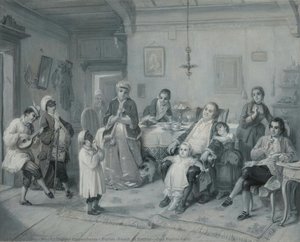
The heart of Oppenheim’s contribution to art lies in his ability to transform the domestic sphere into a stage for profound cultural narrative. His paintings often focus on intimate scenes of Jewish family life, capturing the quiet dignity of ritual and the warmth of communal bonds. Through his brush, the mundane becomes monumental. In works such as The Conclusion of the Sabbath (Sabbath-Ausgang), he employs masterful realism and subtle symbolism to depict the poignant transition from the sacred rest of the Sabbath back into the temporal world, inviting the viewer to witness the sanctity of family ritual.

His ability to weave historical context with personal emotion is perhaps most evident in his genre paintings that document specific cultural milestones. For instance:

  • The Wedding (Die Trauung): A breathtakingly detailed depiction of a 1866 Jewish wedding within the Frankfurt ghetto, where Oppenheim captures the splendor of traditional attire and the solemnity of the marriage canopy, offering a rare, preserved glimpse into a vanishing way of life.
  • The Return of the Volunteer: In this stunning oil painting from 1834, he explores the intersection of Jewish heritage and broader European history, portraying a soldier returning from the Wars of Liberation to a family still living according to ancient customs, effectively illustrating the tension between Napoleonic-era political shifts and enduring religious identity.

Legacy and Historical Significance

Beyond his technical skill, Oppenheim’s work is inextricably linked to the Wissenschaft des Judentums movement—a scholarly effort to establish Jewish history and culture as a respected academic field. His paintings functioned as visual scholarship, providing a dignified and authentic representation of a community that was often marginalized in the broader European art canon. By portraying Jewish subjects with the same level of detail, dignity, and Romantic grandeur typically reserved for aristocratic or mythological themes, he challenged existing prejudices and asserted the importance of Jewish identity within the German cultural fabric.

Ultimately, the legacy of Moritz Daniel Oppenheim is one of resilience and visibility. He did not merely paint scenes; he constructed a visual language for an era of transition. His ability to capture the delicate balance between the old world and the new ensures that his work remains a vital touchstone for understanding the nineteenth-century Jewish experience, making him an indispensable figure in the history of both German Romanticism and the global narrative of Jewish art.

Quick Facts

  • Title: Self-Portrait
  • Location: Private Collection
  • Subject or theme: Self-representation
  • Notable elements or techniques: Detailed depiction of artist's face and palette
  • Medium: Oil on canvas
  • Artistic style: Realist

More about this painting

Preview AR preview Switch to Print Switch to Digital Image Send
Details Guide Add to favorites Download Similars X-Ray Diaporama Q&A Stats