

 Preview
 Send
Send Share
Share
 Details
 Guide
Guide

 Download
 Similars
 X-Ray
X-Ray Diaporama
 Stats
StatsThe student


 Read More
The artwork displayed on this page is protected by copyright law, which means we cannot legally create or sell an identical reproduction. This protection is enforced under international agreements such as the Berne Convention and by national laws, including those outlined by the U.S. Copyright Law - Title 17.
This method fully complies with copyright regulations because it does not involve copying or duplicating the protected artwork. Instead, it is a creative reinterpretation - a new painting that is influenced by the original but not identical to it.
Giclée / Art Print
Museum-quality giclée or canvas print with fast production and flexible finish options. ( Buy Hand Made Painting Switch to Digital Image)




P118B $10

P118H $10

P118W $10

P438Z $10

P508JH $12

P508YH $12

P805H $10

P805Z $10

P919BZ $10

P919G $10

P919XJ $10

P959ZH $10

P968JZ $12

W106C $8

W218G $10

W218JH $8

W218Y $10

W307PJ $10

W316G $10

W316PJ $8

W316Y $10

W398PJ $8

W4111J $10

W500HY $15

W500JH $15

W692G $12

W849H $8

W940BG $15

W953PJ $8




Pick from our preset sizes that match the artwork's original proportions.

Type the width and the height you need, to fit your frame or your wall. A print can only be cut, never made bigger than the picture, so a size with a different shape loses a part of the image. We send you a digital mockup to approve before we print anything. The picture shown on this page does not show the real cut — only the mockup does.
Worldwide Delivery () in 2 weeks instead of standard 4/5 weeks. (25 October)

Free Worldwide Express Shipping

High-Quality Linen Canvas

Full Shipping Insurance

Customs Tax Refund Guarantee

True Color Matching Guarantee

100-Day Return Policy (Defects Only)

100% Money-Back Guarantee

Bulk Discount Offer
 Glass option is only available in size under 110 CM

The student
Giclée / Art Print
Reproduction Size
-


Total Price
$ 81
A Quiet Introspection: The Soul of Mario Sironi’s The Student
In the quiet corners of art history, certain works possess the power to halt time, inviting the viewer into a sanctuary of thought and stillness. The Student, a masterful creation by the Italian maestro Mario Sironi, is one such masterpiece. This evocative portrait captures a woman lost in a moment of profound introspection, seated at a table that serves as an altar to intellect and solitude. Clad in somber black attire, her dark hair framing a face of contemplative depth, she sits before a mirror—a classic symbol of self-reflection and the duality of identity. The scene is not merely a depiction of a person, but an invitation into a private, cerebral world where the boundaries between the physical room and the internal mind begin to blur.
The composition is rich with an atmosphere of scholarly elegance. Surrounding the central figure is a curated landscape of artistic and intellectual artifacts: statues that stand like silent sentin Riens, vases that anchor the space with classical grace, and a single book resting near her hand, suggesting a life dedicated to the pursuit of knowledge. The presence of these objects transforms the setting from a simple room into an atelier of the soul. For the discerning collector or interior designer, this painting offers more than just visual beauty; it provides a focal point of sophisticated gravity, making it an ideal centerpiece for spaces dedicated to study, libraries, or refined living areas where conversation and thought are encouraged.
Technique and the Luminosity of Divisionism
To understand the emotional weight of The Student, one must look closely at Sironi’s early mastery of Divisionism. Before his later shifts toward more monumental and architectural styles, Sironi utilized this technique to breathe life into his subjects through a delicate interplay of light. Rather than blending colors on the palette, he applied small, distinct strokes of pigment that, when viewed from a distance, coalesce in the eye of the beholder to create a shimmering, luminous effect. This method allows the shadows in the woman's black clothing to feel deep and velvety, while simultaneously capturing the subtle glints of light reflecting off the porcelain vases and the smooth surfaces of the surrounding sculptures.
This meticulous approach to color and light creates a sense of vibrating stillness. The technique lends a dreamlike quality to the scene, where the air itself feels heavy with the scent of old paper and the quiet dust of a sunlit studio. For those seeking a high-quality reproduction, this complexity of texture is what makes a hand-painted version so captivating; the physical layering of paint recreates the rhythmic energy of Sironi’s brushwork, ensuring that the light seems to dance across the canvas just as it does in the original work.
A Legacy of Intellectual Elegance
Mario Sironi’s journey from a student of engineering to a titan of modern Italian art is reflected in the structural integrity of this piece. There is an architectural precision to how he places the statues and objects within the frame, creating a balanced, harmonious environment that feels both grounded and ethereal. The Student serves as a bridge between the classical traditions of his heritage and the burgeoning modernism of the early 20th century. It captures a moment of transition—much like the subject herself—between the external world of objects and the internal world of ideas.
Integrating a reproduction of this caliber into a contemporary interior allows for a profound connection to the history of European modernism. It is a piece that speaks to the timelessness of human curiosity and the beauty found in solitude. Whether placed in a sun-drenched gallery or a moody, dark-toned study, The Student brings with it an aura of prestige and a deep, resonant emotional intelligence that continues to inspire art lovers and decorators across the globe.
Questions & Answers
Are the colors of "The student" by Mario Sironi vivid or muted?
The colors of "The student" by Mario Sironi show a muted saturation with a monochromatic intensity.
How do I download the image of "The student" by Mario Sironi?
A download is available for "The student": the artwork's Download page offers a high-resolution digital image download.
What subject and atmosphere does "The student" by Mario Sironi combine?
"The student" shows woman, black clothing, mirror, statues, vases, book, table, and its recorded mood is classic.
Artist Biography
Mario Sironi: A Life in Modern Italian Art
Early Life and Education
- Born May 12, 1885, in Sassari, Sardinia, Italy.
- His father was an engineer, and his maternal grandfather, Ignazio Villa, was a respected architect and sculptor – providing early artistic exposure.
- Initially studied engineering at the University of Rome but abandoned it in 1903 following a nervous breakdown. This marked a turning point towards art.
- Began formal artistic training at the Scuola Libera del Nudo of the Accademia di Belle Arti di Roma, where he met his first significant teacher, Giacomo Balla.
Artistic Development and Influences
- Early work was heavily influenced by Divisionism, a technique emphasizing separated colors to create luminosity – exemplified in works like “The Student.”
- Briefly experimented with Futurism around 1914, exhibiting at the Galleria Sprovieri in Rome. However, he quickly moved beyond its focus on speed and dynamism.
- A pivotal shift occurred after WWI, developing a style characterized by massive, immobile forms and geometric shapes. This was influenced by his wartime experiences and a growing sense of isolation.
- Key influences included Giacomo Balla (early training), Giorgio de Chirico & Carlo Carrà (metaphysical painting’s impact on form), and elements of Neoclassicism and Primitivist Classicism.
The Novecento Italiano and Mature Style
- In 1922, Sironi became a founding member of the Novecento Italiano movement – a return to order in post-war European art, emphasizing clarity and tradition.
- His mature style is marked by:
- Emphasis on geometric shapes and simplified forms.
- A deliberately ungainly aesthetic in later works.
- Themes of solitude, alienation, and the human condition.
- Exploration of industrial landscapes and working-class life.
- Notable works from this period include “Venere” (1921-1923) and “Solitudine” (“Solitude,” 1925).
Political Affiliations and Later Life
- Sironi was a supporter of Benito Mussolini and contributed extensively to Fascist publications with over 1700 cartoons.
- He believed in the integration of art and architecture, seeking to create monumental works for public spaces – reflecting the ideals of the Fascist regime.
- Following WWII, his association with Fascism led to a decline in his popularity and critical acclaim.
- He largely withdrew from public life, continuing to paint in relative isolation until his death.
Major Achievements and Historical Significance
- Sironi’s work represents a significant contribution to Italian Modernism, bridging the gap between Futurism and later artistic developments.
- His exploration of themes like solitude and alienation resonated with the anxieties of the 20th century.
- Despite the controversies surrounding his political affiliations, his art has been featured in major exhibitions internationally, including at the Centre Georges Pompidou (1981) and the Royal Academy, London (1989).
- Died August 13, 1961, in Milan.
- His legacy lies in his unique stylistic synthesis and his powerful depictions of the human condition within a rapidly changing world.

Mario Sironi
1885 - 1961 , Italy
Quick Facts
- Name: Mario Sironi
- Movement:
- Futurism
- Novecento Italiano
- Modernism
- Birth Date: 1885-05-12
- Death Date: 1961-08-13
- Birth Place: Sassari, Italy
- Nationality: Italian
- Date Of Birth: 1885
- Date Of Death: 1961
- Influenced By: ['Giacomo Balla']
- Notable Works:
- La Lampada (1919)
- Venere (1921-1923)
- Solitudine (1925)
- Place Of Birth: Sassari, Italy
Related Articles
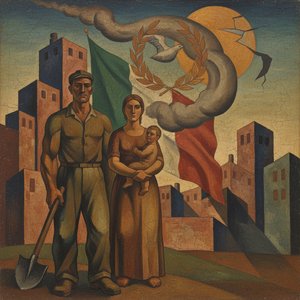
Mario Sironi: A Poetic of Modern Italian Identity Through Symbolism & Social Commentary
Explore the profound works of Mario Sironi, a key figure in Italian Modernism. Discover his evolution from Futurism to Metaphysical painting and his powerful social commentary. Learn about his legacy at OriginalUniqueArt.
Reflections of Reality: Exploring the Metaphysical Power of Mirror Images in Fine Art
Explore the profound symbolism of mirror images in fine art. From Surrealist distortions to classical self-portraits, discover how masters use reflections to explore reality, identity, and the infinite through a sophisticated art-historical lens.
Reflections of Reality: The Metaphysical Power of Mirrors in Fine Art History
Explore the profound symbolism of mirrors in fine art history. From Surrealist distortions to Vanitas themes, discover how masters use reflections to capture reality and the metaphysical soul.
The Mirror Stage of Art History: Exploring Reflection & Identity in Painting
Explore the captivating history of reflection in art! Discover symbolism, technique & psychological depth in masterpieces from Renaissance self-portraits to modern works. Expert insights for discerning collectors.

Mirroring the Soul: A Curated Exploration of Reflection and Self-Perception in Art History
Embark on a sophisticated journey through art history's most captivating masterpieces of reflection. Explore how legendary artists used mirrors to explore identity, surrealism, and the soul through expert art historical analysis.


