Send
Send Share
Share
 Details
 Guide
Guide

 Download
 Similars
 Diaporama
 Stats
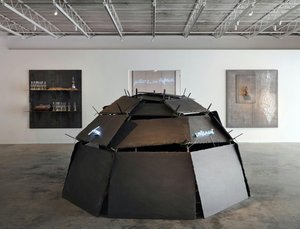
StatsSenza titolo (Triplo igloo)
 Installation Art
- Installation
- Arte Povera
 Modern
 200.0 x 100.0 cm
 MAXXI National Museum of XXI Century Arts
 Read More
The artwork displayed on this page is protected by copyright law, which means we cannot legally create or sell an identical reproduction. This protection is enforced under international agreements such as the Berne Convention and by national laws, including those outlined by the U.S. Copyright Law - Title 17.
This method fully complies with copyright regulations because it does not involve copying or duplicating the protected artwork. Instead, it is a creative reinterpretation - a new painting that is influenced by the original but not identical to it.
Giclée / Art Print
Museum-quality giclée or canvas print with fast production and flexible finish options. ( Buy Hand Made Painting Switch to Digital Image)




































Pick from our preset sizes that match the artwork's original proportions.

Type the width and the height you need, to fit your frame or your wall. A print can only be cut, never made bigger than the picture, so a size with a different shape loses a part of the image. We send you a digital mockup to approve before we print anything. The picture shown on this page does not show the real cut — only the mockup does.
Worldwide Delivery () in 2 weeks instead of standard 4/5 weeks. (28 October)

Free Worldwide Express Shipping

High-Quality Linen Canvas

Full Shipping Insurance

Customs Tax Refund Guarantee

True Color Matching Guarantee

100-Day Return Policy (Defects Only)

100% Money-Back Guarantee

Bulk Discount Offer
 Glass option is only available in size under 110 CM

Senza titolo (Triplo igloo)
Giclée / Art Print
Reproduction Size
-


Total Price
$ 81
A Cosmic Microcosm: Exploring Mario Merz’s “Senza Titolo (Triplo Igloo)”
Mario Merz's "Senza Titolo (Triplo Igloo)" isn’t merely a sculpture; it’s an invitation to contemplate the intricate dance between humanity and the cosmos. Created in 1984, this monumental installation—a trio of interconnected glass domes—represents far more than their physical form suggests. It's a distillation of Merz’s lifelong fascination with geometry, nature, and the underlying mathematical principles governing existence, all rendered through a strikingly tactile and profoundly evocative material: glass.
Born in Milan during the tumultuous years of World War II, Mario Merz’s artistic journey was deeply intertwined with resistance and a yearning for connection. Imprisoned for his involvement with antifascist groups, he began drawing as an act of defiance—a way to reclaim agency within oppressive circumstances. This early impulse toward self-expression evolved into a sustained exploration of form, ultimately leading him to the igloo – a structure that, for Merz, embodied not just shelter but also a symbolic representation of the universe itself. The choice of glass was deliberate; its transparency mirrors the vastness of space while simultaneously highlighting the fragility and preciousness of human existence.
The Geometry of Creation: Fibonacci and Beyond
At the heart of “Senza Titolo (Triplo Igloo)” lies a subtle yet powerful mathematical framework. Merz’s work is deeply rooted in the Fibonacci sequence – a series of numbers where each number is the sum of the two preceding ones (1, 1, 2, 3, 5, 8…). This sequence, found throughout nature from the spirals of seashells to the branching patterns of trees, represents the fundamental principles of growth and proportion. The artist meticulously incorporated these numerical relationships into the structure of the igloos themselves, embedding them in neon lights that cast a luminous glow upon the glass panels. This isn’t simply an aesthetic choice; it's a visual representation of the inherent order underlying the apparent chaos of the universe – a concept central to Merz’s artistic philosophy.
Beyond the Fibonacci sequence, the igloos themselves are constructed with a deliberate architectural logic. The three domes, varying in size and positioned one within the other, create a layered effect that evokes a sense of depth and complexity. The use of clamps and blocks of clay adds an earthy counterpoint to the sleekness of the glass, grounding the installation in the natural world while simultaneously elevating it to a realm of abstract contemplation.
Light, Shadow, and the Human Presence
The lighting within “Senza Titolo (Triplo Igloo)” is crucial to its overall impact. Diffused light filters through the translucent glass, creating an interplay of highlights and shadows that dramatically alters the perception of space. The neon lights, strategically placed, not only illuminate the numerical sequences but also cast a warm, ethereal glow throughout the interior, inviting viewers to step inside and become immersed in the artwork’s atmosphere.
The inclusion of furniture – chairs and a bench – further emphasizes the human element within this cosmic microcosm. These familiar objects, placed deliberately within the glass enclosure, serve as reminders of our everyday lives and our need for connection and comfort. The juxtaposition of the natural world (represented by the igloo) with the domestic sphere creates a compelling dialogue about the relationship between humanity and its environment.
A Legacy of Cosmic Reflection
“Senza Titolo (Triplo Igloo)” stands as a testament to Mario Merz’s unique artistic vision – a synthesis of geometry, nature, and human experience. It's an artwork that invites viewers to contemplate the mysteries of the universe while simultaneously acknowledging our place within it. More than just a beautiful object, it is a profound meditation on life, death, and the enduring power of art to transform our understanding of the world around us. Reproductions capture only a fraction of this immersive experience, but offer a tangible connection to Merz’s extraordinary legacy.
Questions & Answers
Is "Senza titolo (Triplo igloo)" more bright or more dark overall?
The recorded values for "Senza titolo (Triplo igloo)" by Mario Merz are: bright brightness, gentle luminance luminance.
How is the mood of "Senza titolo (Triplo igloo)" by Mario Merz described?
"Senza titolo (Triplo igloo)" by Mario Merz is described as calm in mood. This classification can help match the work to a setting.
How can I view "Senza titolo (Triplo igloo)" by Mario Merz as a slideshow?
"Senza titolo (Triplo igloo)" by Mario Merz can be viewed as a slideshow on the artwork's Diaporama page.
Artist Biography
A Life Forged in Resistance: The Early Years of Mario Merz
Mario Merz’s artistic journey was indelibly shaped by the tumultuous backdrop of 20th-century Italy. Born in Milan in 1925, his path diverged from conventional aspirations when he became involved with the antifascist group Giustizia e Libertà during World War II. Imprisonment for this commitment proved to be a crucible, not a deterrent; it was within those confining walls that Merz began to draw, initiating a lifelong exploration of form and expression. These early works weren’t merely exercises in artistic skill but rather acts of defiance, a claiming of individual voice amidst oppressive forces. He experimented with a continuous line, refusing to lift his pencil from the paper—a gesture symbolic of unbroken spirit and unwavering conviction. Even then, a fascination with the interplay between humanity and nature began to emerge, foreshadowing the organic forms and natural processes that would become central tenets of his mature style. The intellectual ferment of post-war Turin further fueled his development; surrounded by writers like Cesare Pavese, Elio Vittorini, and Ezra Pound, Merz absorbed a climate of critical thought and artistic innovation, laying the groundwork for a career that would challenge conventional boundaries.Embracing *Arte Povera*: A Rejection of Convention
The 1960s witnessed a seismic shift in the art world, and Mario Merz found himself at the forefront of this transformation with his embrace of *Arte Povera*. This Italian movement, meaning “poor art,” was a deliberate rejection of the prevailing consumer culture and the perceived elitism of established artistic norms. Artists associated with *Arte Povera* turned to unconventional materials—earth, wood, metal, fabric—objects often considered humble or discarded, imbuing them with new significance. Merz’s contribution was particularly distinctive. He moved away from the subjective expression of Abstract Expressionism, seeking instead to open art to the forces of the external world. A seed carried by the wind, a leaf spiraling downwards – these became universes on his canvas, microcosms reflecting larger cosmic principles. This shift manifested in works where energy seemed to flow between organic and inorganic elements; neon lights pierced everyday objects—umbrellas, glasses, bottles, even his own raincoat—creating startling juxtapositions that questioned our perception of reality. His marriage to fellow artist Marisa Merz proved a profound creative partnership, each influencing the other’s artistic trajectory in ways that enriched their individual explorations.The Language of Nature and Mathematics: Fibonacci and the Igloo
Merz's artistic vocabulary crystallized around two powerful symbols: the Fibonacci sequence and the igloo. The Fibonacci sequence (1, 1, 2, 3, 5, 8…), a mathematical formula found throughout nature—in the arrangement of leaves on a stem, the spiral of a seashell, the branching of trees—became a recurring motif in his work. He saw it as representing universal principles of creation and growth, a hidden order underlying the apparent chaos of existence. This fascination translated into installations, performances, and drawings that incorporated the sequence visually, often through spirals or numerical arrangements. Simultaneously, he began constructing igloo-like structures, initially from simple materials like glass and stone, later evolving to incorporate more diverse elements. These weren’t merely architectural forms; they were metaphors for prehistoric shelters, nomadic spaces, representing mobility, adaptability, and a primal connection to the earth. The neon words emblazoned on these igloos—often colloquial phrases or slogans—were not simply decorative additions but rather captured the zeitgeist of his time, possessing a resonance that transcended their literal meaning. They became, in essence, the voice of an era.A Legacy of Innovation and Interconnection
Throughout his career, Mario Merz consistently pushed the boundaries of artistic expression. His interventions were often site-specific and ambitious: climbing the Guggenheim Museum in New York (1971), scaling a Turin landmark (1984), even staging an installation within Naples’ Capodimonte Gallery (1987). These weren't simply displays of spectacle but rather attempts to disrupt conventional modes of viewing art, to integrate it into the fabric of everyday life. He illustrated the Fibonacci progression with photographs capturing the evolving density of diners in a restaurant, and created sprawling spiral installations from natural materials. His work resonated internationally, earning him recognition through exhibitions at prestigious institutions like the Walker Art Center in Minneapolis and establishing a landmark presence at the Centre for International Light Art in Unna, Germany. Merz’s legacy extends far beyond his individual artworks. He fundamentally contributed to the *Arte Povera* movement, influencing generations of artists who followed. His sensitivity to the interconnectedness of space and humanity transformed large environments into intimate, natural realms. He possessed a rare ability to synthesize seemingly disparate elements—art, science, nature, mathematics—into cohesive and thought-provoking experiences. His work remains a testament to the power of art to challenge perceptions, provoke dialogue, and reveal the hidden harmonies within our world. Mario Merz’s enduring impact lies in his ability to make vast spaces feel human, intimate, and profoundly connected to the natural order.
Mario Merz
1925 - 2003 , Italy
Quick Facts
- Artistic Movement Or Style: Arte Povera
- Artists Or Movements Influenced By This Artist: Arte Povera artists
- Artists Who Influenced This Artist:
- Cesare Pavese
- Elio Vittorini
- Ezra Pound
- Date Of Birth: 1925
- Date Of Death: 2003
- Full Name: Mario Merz
- Nationality: Italian
- Notable Artworks:
- Untitled
- Fibonacci
- Untitled (678)
- Place Of Birth: Milan, Italy
Related Articles

The Aesthetic Catalyst: Leveraging Art Installations for Guest Engagement & Organic Social Marketing
Discover how strategic art installations elevate hotel experiences & drive organic social visibility. Expert insights on design, ROI, guest engagement, and creating unforgettable spaces for luxury hospitality brands.
Luminous Masterpieces: The Captivating Beauty and Timeless Elegance of Stained Glass Artworks
Embark on a visual journey through the luminous world of stained glass art. Discover the exquisite craftsmanship, historical significance, and captivating beauty of masterworks from Art Nouveau to the Gothic era, curated for the discerning fine art enthusiast.
Richard Wilson: Deconstructing Landscape & Memory in Contemporary Installation Art
Explore Richard Wilson's groundbreaking landscape paintings & his enduring influence on contemporary installation art. Discover investment opportunities, provenance insights & the materiality of memory in this expert analysis.
Mario Sironi: A Poetic of Modern Italian Identity Through Symbolism & Social Commentary
Explore the profound works of Mario Sironi, a key figure in Italian Modernism. Discover his evolution from Futurism to Metaphysical painting and his powerful social commentary. Learn about his legacy at OriginalUniqueArt.

Transforming Hospitality Spaces: A Comprehensive Approach to Hotel Art Procurement and Installation for Consistent Brand Aesthetics
Elevate your hotel's aesthetic with expert art procurement & installation services. Discover how strategic artwork enhances guest experiences & reinforces brand identity. Get a free consultation!