
 Preview
 Send
Send Share
Share
 Details
 Guide
Guide

 Download
 Similars
 X-Ray
X-Ray Diaporama
 Q&A
Q&A Stats
StatsThe Bride Stripped Bare by her Bachelors


 Read More
The artwork displayed on this page is protected by copyright law, which means we cannot legally create or sell an identical reproduction. This protection is enforced under international agreements such as the Berne Convention and by national laws, including those outlined by the U.S. Copyright Law - Title 17.
This method fully complies with copyright regulations because it does not involve copying or duplicating the protected artwork. Instead, it is a creative reinterpretation - a new painting that is influenced by the original but not identical to it.
Giclée / Art Print
Museum-quality giclée or canvas print with fast production and flexible finish options. ( Buy Hand Made Painting Switch to Digital Image)




































Pick from our preset sizes that match the artwork's original proportions.

Type the width and the height you need, to fit your frame or your wall. A print can only be cut, never made bigger than the picture, so a size with a different shape loses a part of the image. We send you a digital mockup to approve before we print anything. The picture shown on this page does not show the real cut — only the mockup does.
Worldwide Delivery () in 2 weeks instead of standard 4/5 weeks. (31 October)

Free Worldwide Express Shipping

High-Quality Linen Canvas

Full Shipping Insurance

Customs Tax Refund Guarantee

True Color Matching Guarantee

100-Day Return Policy (Defects Only)

100% Money-Back Guarantee

Bulk Discount Offer
 Glass option is only available in size under 110 CM

The Bride Stripped Bare by her Bachelors
Giclée / Art Print
Reproduction Size
-


Total Price
$ 81
A Monument of Conceptual Art: Exploring Marcel Duchamp’s “The Bride Stripped Bare by Her Bachelors”
Marcel Duchamp's "The Bride Stripped Bare by Her Bachelors, Even (The Large Glass)" stands as an unparalleled achievement in the history of art—not for its visual beauty alone, but for its audacious challenge to artistic conventions and its profound exploration of existential themes. Created between 1915 and 1923 during the turbulent years of Dadaism, this monumental assemblage transcends traditional representation, prioritizing intellectual provocation over aesthetic pleasure.
- The Genesis of Conceptual Art: Duchamp’s decision to submit a urinal—simply titled “Fontaine”—to the Salon d'automne in Paris in 1917 irrevocably altered the landscape of artistic discourse. This act, considered scandalous by many contemporaries, signaled a decisive break from the prevailing obsession with illusionistic painting and sculpture, establishing conceptual art as a distinct genre focused on ideas rather than visual form.
- Mechanistic Cubism’s Influence: Duchamp's artistic vision was deeply rooted in Mechanistic Cubism, championed by artists like Pablo Picasso and Georges Braque. This movement sought to dissect objects into geometric fragments, mirroring the workings of machinery—a reflection of the anxieties surrounding industrialization and technological advancement prevalent at the time. The Large Glass embodies this aesthetic through its meticulous layering of materials and forms, creating a complex interplay of textures and perspectives.
Decoding Symbolism: Desire, Reality, and the Machine
“The Bride Stripped Bare by Her Bachelors” is rife with symbolic imagery that delves into the complexities of human relationships and the elusive nature of desire. The central figure—often interpreted as a representation of femininity—is juxtaposed against a machine-insect hybrid, symbolizing the tension between organic vulnerability and mechanical determinism. This duality encapsulates Duchamp’s broader critique of societal norms and his questioning of accepted truths.
- The Urinal Motif: The inclusion of the urinal itself serves as a deliberate disruption of artistic tradition—a statement that questioned what constituted art and challenged viewers to reconsider their preconceptions. It embodies Duchamp’s belief that art could be found in everyday objects when viewed through an intellectual lens.
- Geometric Precision & Industrial Materials: The meticulous arrangement of geometric shapes—circles, squares, triangles—and the incorporation of industrial materials like lead foil and wire underscore the influence of Mechanistic Cubism. These elements contribute to a sense of unease and disorientation, mirroring the anxieties of the era concerning rapid technological change.
A Legacy of Innovation: Why “The Large Glass” Remains Relevant Today
"The Bride Stripped Bare by Her Bachelors" continues to resonate with audiences today because it speaks to fundamental questions about art’s role in society and its capacity to provoke thought. Duchamp's refusal to adhere to conventional artistic standards paved the way for subsequent generations of artists who embraced conceptual approaches—artists who prioritize ideas over visual spectacle.
- Influence on Contemporary Art: Artists across disciplines—from performance art to installation art—have drawn inspiration from Duchamp’s groundbreaking work, recognizing its enduring power to challenge assumptions and stimulate dialogue.
- A Timeless Exploration of Consciousness: Ultimately, “The Large Glass” invites viewers to contemplate the relationship between consciousness and reality—a theme that remains profoundly relevant in our increasingly complex world.
Questions & Answers
What color saturation does "The Bride Stripped Bare by her Bachelors" by Marcel Duchamp have?
The palette of "The Bride Stripped Bare by her Bachelors" is muted in saturation.
Is "The Bride Stripped Bare by her Bachelors" by Marcel Duchamp in the public domain, and why?
"The Bride Stripped Bare by her Bachelors" by Marcel Duchamp is still protected by copyright. Copyright duration runs from the artist's death, which occurred in 1968.
How many people view "The Bride Stripped Bare by her Bachelors"?
A Stats page exists for "The Bride Stripped Bare by her Bachelors". It charts the monthly visits of the artwork and of the artist's other works, with country and language breakdowns.
Artist Biography
A Revolutionary Spirit: The Life and Art of Marcel Duchamp
Marcel Duchamp, born Henri-Robert-Marcel Duchamp in 1887 in Blainville-Crevon, Normandy, was more than an artist; he was a philosophical provocateur who fundamentally altered the course of modern art. His early life, though seemingly conventional – nurtured within a family that appreciated artistic expression with both brothers pursuing successful careers as artists – hinted at the iconoclasm to come. Duchamp initially pursued formal training, mastering traditional techniques and experimenting with post-impressionist styles. However, this academic foundation served not as an end in itself, but as a springboard for questioning the very nature of art, its purpose, and its definition. He wasn’t content merely to depict the world; he sought to challenge how we perceive it, and what constitutes artistic value. This restless intellectual curiosity would become the defining characteristic of his prolific career.From Cubism to Dada: A Rejection of Convention
Duchamp's artistic journey was marked by a constant evolution, a deliberate shedding of established norms. His initial engagement with Cubism, evident in works like *Portrait of Chess Players* (1911), demonstrated an interest in fragmented forms and multiple perspectives – a departure from traditional representation. Yet, he quickly moved beyond purely aesthetic concerns, recognizing that simply rearranging visual elements wasn’t enough to address the deeper questions swirling within him. The horrors of World War I fueled this discontent, leading Duchamp to embrace Dadaism, a movement born out of disillusionment and a rejection of logic, reason, and traditional artistic values. It was within the Dadaist framework that Duchamp truly began to dismantle conventional notions of art. He wasn’t interested in creating beautiful objects; he wanted to provoke thought, challenge assumptions, and expose the arbitrariness of aesthetic judgment. This period saw the birth of his most radical innovation: the ‘readymade’.The Readymades and the Subversion of Art
The introduction of readymades – ordinary manufactured objects selected and presented as art – was Duchamp’s most significant contribution to the 20th century. These weren't simply found objects; they were deliberate acts of artistic subversion. By taking an everyday item, like a urinal (*Fountain*, 1917), signing it “R. Mutt,” and submitting it to an art exhibition, Duchamp challenged the very definition of artistic skill and authorship. Was it the artist’s hand that created the work, or was it the artist's *idea*? This question became central to his practice and laid the groundwork for Conceptual Art. Other notable readymades like *L.H.O.O.Q.* (1919), a postcard reproduction of the Mona Lisa defaced with a mustache and goatee, were playful yet pointed critiques of art history and established cultural icons. These works weren’t meant to be admired for their aesthetic qualities; they were intended to provoke debate and force viewers to reconsider their preconceived notions about what constitutes art. Duchamp believed that art should reside in the mind, not merely in the eye.Legacy and Enduring Influence
Marcel Duchamp's impact on subsequent generations of artists is immeasurable. He fundamentally altered our understanding of art, paving the way for movements like Conceptual Art, Minimalism, Pop Art, and countless others. His emphasis on the artist’s idea – the concept behind the work – over its aesthetic qualities continues to inspire artists today.- Cubism: Early exploration of fractured forms and spatial representation.
- Dadaism: Rejection of logic, reason, and traditional artistic values in response to World War I.
- Conceptual Art: Emphasis on the idea behind the artwork rather than its aesthetic qualities.
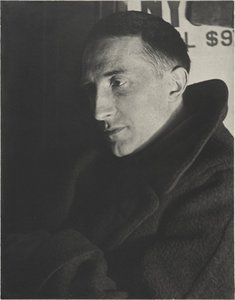
Marcel Duchamp
1887 - 1968 , France
Quick Facts
- Artistic Movement Or Style:
- Cubism
- Dadaism
- Conceptual Art
- Artists Or Movements Influenced By This Artist:
- Conceptual Art
- Minimalism
- Pop Art
- Artists Who Influenced This Artist:
- Cézanne
- Picasso
- Braque
- Full Name: Henri-Robert-Marcel Duchamp
- Nationality: French American
- Notable Artworks:
- Fountain
- Bicycle Wheel
- The Large Glass
- Place Of Birth: Blainville-sur-Mer, France
- Date Of Birth: 1887
- Date Of Death: 1968
Related Articles
Deconstructing Reality: Cubism's Revolutionary Impact on 20th-Century Art
Explore the revolutionary world of Cubism with OriginalUniqueArt. Discover Picasso & Braque's groundbreaking techniques, its philosophical roots, and lasting impact on modern art. Expert insights for collectors.

Jean Dominique Antony Metzinger: Pioneering Cubism & the Evolution of Abstract Form
Explore the life & work of Jean Metzinger, a pivotal Cubist painter and theorist. Discover his innovations in proto-Cubism, 'Du Cubisme,' and Crystal Cubism – a journey through modern art's evolution.

Cubism Unveiled: How Picasso and Braque Redefined Modern Art through Geometric Revolution
Explore the revolutionary world of Cubism. Discover how Pablo Picasso and Georges Braque dismantled perspective to redefine modern art through geometric innovation and analytical mastery. An essential guide for art students, collectors, and history enthusiasts.

Dadaism Explained: The Anti-Art Movement That Redefined Modernity
Explore the radical origins of Dadaism. From the chaos of WWI to Marcel Duchamp's revolutionary readymades, discover how this anti-art movement dismantled tradition and birthed modern conceptual art. An essential guide for students and collectors of fine art history.
Marcel Duchamp: Challenging Conventions & Redefining Art in the 20th Century
Explore the revolutionary art of Marcel Duchamp! Discover how his Dadaist readymades challenged artistic conventions & redefined modern art. A deep dive into 'Fountain', conceptual shifts, and his lasting impact.


