Switch to Print
 Read More







































 For artworks or reproductions larger than 105 cm (approximately 41 inches) on any side, the frame will be shipped as a kit, disassembled. This method ensures safe delivery and prevents damage during transport.


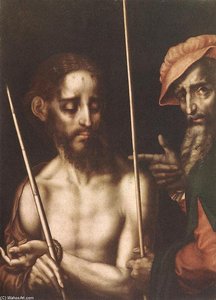
A Glimpse into Suffering: Luis de Morales' "Christ at the Column"
Luis de Morales, affectionately known as “El Divino,” was a pivotal figure in 16th-century Spanish Renaissance art. This evocative work, "Christ at the Column," exemplifies his signature style – a poignant blend of realism and spiritual depth that resonated deeply with contemporary audiences and continues to captivate viewers today. The painting offers an intimate portrayal of Christ's suffering during the Passion, focusing on raw emotion and anatomical accuracy within a framework of devout religious expression. It’s a powerful testament to Morales’ skill in conveying both physical torment and profound inner peace amidst adversity.Style & Technique: Spanish Renaissance Realism
The artwork firmly belongs to the Spanish Renaissance tradition, heavily influenced by Italian Mannerism, particularly evident in its meticulous attention to detail and dramatic use of light and shadow (chiaroscuro). Morales masterfully employs oil paints on canvas or panel – likely – layering and blending pigments to achieve remarkably smooth transitions in tone and texture. Notice how the visible brushstrokes are subtly integrated, contributing to a sense of both realism and refined artistry. The composition is tightly cropped, centering almost entirely on Christ’s torso and face, intensifying the emotional impact. Strong vertical lines established by the cylindrical column contrast with the organic curves of Christ's body, creating visual tension that mirrors the scene's inherent drama. The artist demonstrates a keen understanding of human anatomy, rendering musculature with careful precision while maintaining an overall sense of grace and dignity.Symbolism & Emotional Resonance
Beyond its immediate depiction of suffering, "Christ at the Column" is rich in symbolic meaning. The column itself represents imprisonment and sacrifice – a tangible manifestation of Christ’s ordeal. His upward gaze, directed slightly to the right, suggests a profound sense of hope or prayer amidst his anguish, hinting at the spiritual strength that sustains him through physical pain. The warm earth tones—creams, browns, and ochres—create a somber yet comforting atmosphere, while the dramatic chiaroscuro lighting emphasizes Christ’s illuminated form, drawing the viewer's eye to his face and conveying an overwhelming sense of compassion and piety. The overall effect is deeply moving, evoking feelings of sorrow, empathy, and reverence for faith.Historical Context & Morales' Legacy
Created during a period of intense religious fervor in Spain, this painting reflects the broader cultural climate that valued devotional art capable of inspiring profound spiritual contemplation. Morales’ work was highly regarded by his contemporaries, who dubbed him “El Divino” due to his ability to imbue his paintings with both startling realism and an undeniable sense of spirituality. His artistic development is often divided into two phases: an early period influenced by Florentine masters like Michelangelo, and a later phase characterized by greater anatomical accuracy and a more intense emotional expression, reflecting the influence of German and Flemish Renaissance painters. Owning a reproduction of "Christ at the Column" allows you to bring a piece of this significant artistic heritage into your home or collection – a timeless testament to faith, suffering, and the enduring power of art.Questions & Answers
Which artist is "Christ at the Column" attributed to?
The artist behind "Christ at the Column" is Luis de Morales. The work is catalogued under Luis de Morales's name.
Can I see "Christ at the Column" by Luis de Morales under different lights?
The X-Ray view of "Christ at the Column" by Luis de Morales is on the artwork's X-Ray page: an interactive examination of the image through eleven optical layers.
Where can I find statistics about "Christ at the Column" by Luis de Morales?
A Stats page exists for "Christ at the Column". It charts the monthly visits of the artwork and of the artist's other works, with country and language breakdowns.
More about this painting
 Preview
 Send
Send Share
Share
 Details
 Guide
Guide

 Download
 Similars
 X-Ray
X-Ray Diaporama
 Q&A
Q&A Stats
Stats