Text size

() ·

A painting made for you, by hand

The Fruit and Vegetable Costermonger

Hand Made Oil Reproduction

Hand-painted oil on canvas in your size and frame, made to order by our artists. ( Switch to Print Switch to Digital Image)

Collectible Description

Experience the vibrant beauty of Louise Moillon's 'The Fruit and Vegetable Costermonger'! This 1631 masterpiece showcases exquisite detail & rich colors, capturing a bustling Parisian market scene.

Artist Biography

Discover Louise Moillon: A Baroque still life painter known for exquisite detail & luminous fruit arrangements. Explore her elegant compositions from 17th-century France.

from ·

Chapter 1

How large should it be?

Slide to change the size; the picture on the left shows the frame at its real width. The proportions of the original are kept.

Standard
custom
CM
INCH

Pick from our preset sizes that match the artwork's original proportions.

width
height

Type the width and the height you need, to fit your frame or your wall. This is hand-painted, so for a size with a different shape the artist can paint a bit more around the picture, or cut a bit — you choose. We send you a digital mockup to approve before the painting starts. The picture shown on this page does not show the real result — only the mockup does.

Chapter 2

How should it arrive?

Choose the edges of the stretched canvas

Choose your frame

Corner sample of the WhiteWrap canvas edge finish, stretched on solid wood bars
White $1
Corner sample of the BlurSideWrap canvas edge finish, stretched on solid wood bars
Blurside $1
Corner sample of the ExtendedWrap canvas edge finish, stretched on solid wood bars
Extended $1
Corner sample of the P118B picture frame: moulded polystyrene, 5 cm wide and 3 cm thick
P118B $10
Corner sample of the P118H picture frame: moulded polystyrene, 5 cm wide and 3 cm thick
P118H $10
Corner sample of the P118W picture frame: moulded polystyrene, 5 cm wide and 3 cm thick
P118W $10
Corner sample of the P438Z picture frame: moulded polystyrene, 5.5 cm wide and 3.5 cm thick
P438Z $10
Corner sample of the P508JH picture frame: moulded polystyrene, 7 cm wide and 3.5 cm thick
P508JH $12
Corner sample of the P508YH picture frame: moulded polystyrene, 7 cm wide and 3.5 cm thick
P508YH $12
Corner sample of the P805H picture frame: moulded polystyrene, 5 cm wide and 3.5 cm thick
P805H $10
Corner sample of the P805Z picture frame: moulded polystyrene, 5 cm wide and 3.5 cm thick
P805Z $10
Corner sample of the P919BZ picture frame: moulded polystyrene, 7 cm wide and 3.5 cm thick
P919BZ $10
Corner sample of the P919G picture frame: moulded polystyrene, 7 cm wide and 3.5 cm thick
P919G $10
Corner sample of the P919XJ picture frame: moulded polystyrene, 7 cm wide and 3.5 cm thick
P919XJ $10
Corner sample of the P959ZH picture frame: moulded polystyrene, 5 cm wide and 3 cm thick
P959ZH $10
Corner sample of the P968JZ picture frame: moulded polystyrene, 6 cm wide and 4 cm thick
P968JZ $12
Corner sample of the W106C picture frame: solid wood, 5 cm wide and 3 cm thick
W106C $8
Corner sample of the W218G picture frame: solid wood, 5 cm wide and 3 cm thick
W218G $10
Corner sample of the W218JH picture frame: solid wood, 5 cm wide and 3 cm thick
W218JH $8
Corner sample of the W218Y picture frame: solid wood, 5 cm wide and 3 cm thick
W218Y $10
Corner sample of the W307PJ picture frame: solid wood, 6 cm wide and 3 cm thick
W307PJ $10
Corner sample of the W316G picture frame: solid wood, 6 cm wide and 3 cm thick
W316G $10
Corner sample of the W316PJ picture frame: solid wood, 6 cm wide and 3 cm thick
W316PJ $8
Corner sample of the W316Y picture frame: solid wood, 6 cm wide and 3 cm thick
W316Y $10
Corner sample of the W398PJ picture frame: solid wood, 5 cm wide and 3 cm thick
W398PJ $8
Corner sample of the W4111J picture frame: solid wood, 6.5 cm wide and 3.5 cm thick
W4111J $10
Corner sample of the W500HY picture frame: solid wood, 7 cm wide and 5 cm thick
W500HY $15
Corner sample of the W500JH picture frame: solid wood, 7 cm wide and 5 cm thick
W500JH $15
Corner sample of the W692G picture frame: solid wood, 8 cm wide and 4 cm thick
W692G $12
Corner sample of the W849H picture frame: solid wood, 5 cm wide and 3 cm thick
W849H $8
Corner sample of the W940BG picture frame: solid wood, 7.5 cm wide and 4.5 cm thick
W940BG $15
Corner sample of the W953PJ picture frame: solid wood, 6 cm wide and 3.5 cm thick
W953PJ $8
Corner sample of the H24-GOLD picture frame: carved wood with gesso, 10 cm wide and 6 cm thick
H24-GOLD $30
Corner sample of the H24-SILVER picture frame: carved wood with gesso, 10 cm wide and 6 cm thick
H24-SILVER $30
Corner sample of the H36-GOLD picture frame: carved wood with gesso, 15 cm wide and 6.5 cm thick
H36-GOLD $45
Corner sample of the H36-SILVER picture frame: carved wood with gesso, 15 cm wide and 6.5 cm thick
H36-SILVER $45
Frame preview
Framed

Moulding: . Overall size with the frame: .

Chapter 3

Who paints it, and should anything change?

Examples of what can be changed: Replace face with customer photo; Add pet (e.g., replace cat with dog); Include hidden message in background; Change background landscape or elements.
After order, OriginalUniqueArt.com team will email client for instructions and provide a mockup preview

Worldwide Delivery () in 3/4 weeks instead of standard 5 weeks. (1 November). No compromise on quality.

Chapter 4

The finishing touches

A nameplate, as in a museum?

Engraved Bronze Plaque Details

This elegant plaque features the artist's name and the title of the artwork, finely engraved for a timeless presentation.

It is made from bronze with a refined, elegant finish. The text is precisely laser-engraved for a sharp and permanent result. Measuring 9x2 cm, the plaque is compact yet easy to read. It's built to be durable and scratch-resistant, offering a professional, museum-quality look. Mounting is simple thanks to the included adhesive backing.

Transparent Acrylic Plaque Details

The plaque includes essential engraved details such as the artist's name, the title of the artwork, the date it was created, the type of media used-like oil on canvas or watercolor-a brief description of the piece, and a QR code that links to the complete artwork information.

It is crafted from clear acrylic, offering a sleek, modern appearance. The text is UV-engraved in black to ensure strong visual contrast. With a size of 10x15 cm, it ensures optimal readability. It comes equipped with two metal hooks for secure wall mounting. The plaque is designed to be weather-resistant, making it suitable for various environments, and it includes interactive features that work seamlessly with smartphone scanning.

Black Acrylic Plaque Details

This elegant plaque includes engraved information such as the artist's name, the title of the artwork, the date it was created, the type of media used (like oil on canvas or watercolor), a short description of the artwork, and a QR code for quick access to more information.

The plaque itself is made from refined black acrylic with a premium finish. The text is laser-engraved in white for high contrast and readability. Its size is 10x15 cm, designed to be easy to read. It comes with two metal hooks for professional mounting. The design is sleek and fits any interior style. It is also weather-resistant and durable, with built-in digital integration for mobile compatibility.

A protective varnish?

When do you need it?

Chapter 5

Your painting, as you ordered it

The Fruit and Vegetable Costermonger

Reproduction Medium

Reproduction Size

-

Elite Senior Artist

More detail, finesse, and extra production time

-

Reproduction Frame

-

-

For artworks or reproductions larger than 105 cm (approximately 41 inches) on any side, the frame will be shipped as a kit, disassembled. This method ensures safe delivery and prevents damage during transport.

Professional assembly required - this is not a DIY product.
The kit must be assembled and the canvas stretched by an experienced professional framer, using wood glue (not supplied), a canvas stretching plier and clamps to hold the bars square while the glue dries. Incorrect assembly or uneven canvas tension can permanently damage the artwork and is not covered by our warranty.

  • All solid wood bars are included, precisely cut to size.

  • Assembled with the screws provided, plus wood glue for the corner joints, which is not supplied and must be sourced by your framer.

  • Professional tools are required and not included: a canvas stretching plier (tensioner) and clamps to hold the bars square while the glue dries.

Important:
The corner joints require wood glue, the bars must be held with clamps until the glue is fully dry, and tightening the canvas on the assembled frame requires a canvas stretching plier. None of these are included in the kit. Please arrange an experienced professional framer before ordering this size.

Nameplate

-

-

Protective Varnish

Glossy Varnish (enhances colors, protects against light/moisture)

-

Customize My Artwork

Examples of what can be changed: Replace face with customer photo; Add pet (e.g., replace cat with dog); Include hidden message in background; Change background landscape or elements.

-

Urgent

Worldwide Delivery () in 3/4 weeks instead of standard 5 weeks. (1 November). No compromise on quality.

-

Express Shipping

Worldwide Delivery () in 5 weeks. (8 November).

Included

Total Price

$ 300

Total Price $ 300

Glass option is only available in size under 110 CM

Included with every order

  • Free Worldwide Express Shipping
  • High-Quality Linen Canvas
  • Full Shipping Insurance
  • Customs Tax Refund Guarantee
  • True Color Matching Guarantee
  • 100-Day Return Policy (Defects Only)
  • 100% Money-Back Guarantee
  • Bulk Discount Offer

The Fruit and Vegetable Costermonger: A Window into 17th-Century Parisian Life

Louise Moillon’s “The Fruit and Vegetable Costermonger,” painted in 1631, is more than just a still life; it's a vibrant snapshot of daily life in 17th-century Paris. This remarkable work, now housed within the Louvre Museum, offers a captivating glimpse into the bustling markets and social dynamics of a city undergoing significant transformation. Moillon’s masterful technique and keen observation elevate this seemingly simple scene to a level of profound artistic merit, revealing layers of symbolism and historical context that continue to intrigue art historians today.

Born into a family steeped in artistic tradition – her father, Nicolas Moillon, was himself a respected painter – Louise Moillon benefited from an early exposure to the principles of observation and representation. Raised within the Huguenot community of Saint-Germain-des-Prés, she inherited a sensibility that valued naturalism and detail, qualities deeply rooted in the artistic heritage of the Netherlands, where many of her family members had sought refuge. This background profoundly shaped her style, imbuing her paintings with an understated elegance and a meticulous attention to the textures and colors of everyday objects.

A Symphony of Color and Light

Moillon’s skill lies not just in her ability to depict fruit and vegetables realistically, but in her masterful manipulation of light and shadow – a technique known as *chiaroscuro*. The painting is dominated by a warm, diffused light that seems to emanate from an unseen source, bathing the table and its contents in a golden glow. This careful use of light not only enhances the visual appeal of the scene but also creates a sense of depth and volume, drawing the viewer into the heart of the market stall. Notice how she uses highlights to emphasize the smooth skin of the peaches, the glossy sheen of the oranges, and the delicate veins in the leaves – each detail rendered with exquisite precision.

The composition itself is carefully balanced, creating a sense of harmony and order amidst the apparent chaos of the market scene. The arrangement of the fruits and vegetables—the abundance of apples, the vibrant hues of the oranges, the contrasting textures of the broccoli—is deliberately asymmetrical, adding to the painting’s dynamism and visual interest. The inclusion of the two women, seemingly engaged in a transaction, subtly introduces an element of human interaction into this otherwise still-life tableau, grounding the scene in the realities of daily life.

Symbolism and Social Commentary

Beyond its aesthetic qualities, “The Fruit and Vegetable Costermonger” is rich in symbolic meaning. The presence of the costermonger – a street vendor selling fruits and vegetables—reflects the growing commercial activity in Paris during the 17th century. The painting can be interpreted as a commentary on the social hierarchy of the time, with the wealthy women observing the proceedings from their elevated position while the costermonger provides sustenance for the masses. The abundance of fruit and vegetables also carries symbolic weight, representing prosperity, fertility, and the bounty of nature – themes that were particularly resonant during a period marked by both religious upheaval and economic growth.

Furthermore, Moillon’s decision to depict these fruits and vegetables at their peak ripeness—without any signs of decay or spoilage—is noteworthy. This deliberate choice challenges the traditional *memento mori* (remember you must die) motif prevalent in Dutch still-life paintings of the era, which often featured decaying fruit as a reminder of mortality. Instead, Moillon celebrates the beauty and vitality of life, capturing a fleeting moment of abundance and pleasure.

A Timeless Masterpiece

“The Fruit and Vegetable Costermonger” stands as a testament to Louise Moillon’s artistic genius and her ability to capture the essence of a particular time and place. Her meticulous attention to detail, masterful use of light and shadow, and subtle symbolic meanings combine to create a work that is both visually stunning and intellectually stimulating. Today, this painting continues to captivate viewers with its vibrant colors, dynamic composition, and profound insights into the social and cultural landscape of 17th-century Paris – a timeless masterpiece that offers a unique window into the past.

Questions & Answers

How old was Louise Moillon when creating "The Fruit and Vegetable Costermonger" in 1631?

When "The Fruit and Vegetable Costermonger" was created in 1631, Louise Moillon - born in 1610 - was 21 years old.

What use is suggested for "The Fruit and Vegetable Costermonger" by Louise Moillon?

The suggested use for "The Fruit and Vegetable Costermonger" by Louise Moillon is accent. It can serve other purposes as well.

What color leads the composition of "The Fruit and Vegetable Costermonger" by Louise Moillon?

The color that stands out most in "The Fruit and Vegetable Costermonger" is phthalo green (#1c1919). The dominant color is useful when matching an artwork to an interior.

More about this painting

Preview AR preview Switch to Print Switch to Digital Image Send
Details Guide Add to favorites Download Similars X-Ray Diaporama Q&A Stats

In numbers

  • 1631the year it was painted
  • 29frames to choose from
  • standard sizes, in its own proportions
  • 5weeks to paint and deliver it
Louise Moillon

Louise Moillon

1610 - 1696, France

Quick facts about Louise Moillon

  • Full Name: Louise Moillon
  • Nationality: French
  • Date Of Birth: 1610
  • Date Of Death: 1696
  • Place Of Birth: Paris, France
  • Notable Artworks:
    • Basket of Apricots
    • COUPE DE CERISES, PRUNES ET MELON
    • Basket of Peaches, with Quinces, and Plums
  • Artistic Movement Or Style: Baroque Still Life
  • Artists Who Influenced This Artist:
    • Isaac Moillon
    • François Garnier
  • Artists Or Movements Influenced By This Artist:
    • Michelangelo
    • Raphael
    • Titian

Artist Biography

The Quiet Brilliance of Louise Moillon

In the grand, sweeping narratives of the Baroque era, where drama and movement often dominate the canvas, the work of Louise Moillon offers a profound and meditative alternative. Born in Paris in 1610, Moillon emerged from a world shaped by the intense religious and cultural shifts of 17th-century France. Her very lineage tells a story of resilience and artistic heritage; as a descendant of Huguenot refugees from Holland, she was immersed in a tradition that valued the meticulous observation of the natural world. This background provided more than just a family history—it offered a stylistic vocabulary rooted in the Dutch mastery of light, texture, and symbolic realism.

Moillon’s early life was marked by both loss and profound artistic mentorship. The death of her father, the landscape painter and dealer Nicolas Moillon, when she was only ten, could have altered her path, yet her upbringing remained deeply embedded in the arts. Under the guidance of her stepfather, François Garnier, a skilled artist and dealer, she refined a technique that would become her hallmark. Her education was not merely about the application of pigment to canvas, but an immersion into the humanist values of her time, learning to see the divine within the minute details of a ripening fruit or the delicate curve of a petal.

A Mastery of Texture and Light

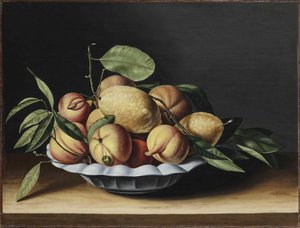
The true genius of Moillon lies in her ability to transform the mundane into the extraordinary. Her compositions are characterized by a serene stillness, a quietude that invites the viewer to linger and observe. She possessed an almost supernatural ability to capture the tactile qualities of her subjects—the waxy skin of a citron, the soft fuzz of a peach, or the translucent juice of a crushed berry. In works such as Still Life of Citrons and Curaçao Oranges in a White Polylobed Dish, one can sense the cool moisture of the fruit against the hard, glazed surface of the porcelain, creating a sensory experience that transcends the two-dimensional plane.

Her technique was deeply influenced by the naturalistic traditions of the Protestant circles in which she moved. This approach favored clarity and precision over the theatrical shadows of the more flamboyant Baroque masters. Instead, Moillon utilized light to sculpt her subjects, using subtle gradations of tone to create volume and depth. Her palette, while often focused on the vibrant hues of nature, was used with such restraint that each color felt luminous, as if lit from within. This mastery allowed her to bridge the gap between mere botanical illustration and high art, imbuing every piece with a sense of life and vitality.

Legacy and Historical Significance

Throughout her long life, which spanned nearly nine decades, Moillon achieved a level of renown that was rare for female artists of her era. Her ability to secure commissions from prestigious patrons, including members of the royal court, speaks to the undeniable quality and sophistication of her oeuvre. While her work often focused on the intimate scale of still life, its impact was expansive, contributing significantly to the development of the French still-life tradition.

The historical significance of Louise Moillon extends beyond her technical skill; she represents a vital link between the Dutch naturalistic tradition and the burgeoning French aesthetic of the 17th century. Her paintings serve as windows into a lost world of Parisian markets and private gardens, capturing a sense of abundance and ephemeral beauty. Today, her works remain cherished treasures in institutions such as the Louvre, standing as enduring testaments to a life dedicated to finding the extraordinary within the ordinary. Her legacy is found in every brushstroke that celebrates the quiet, breathtaking splendor of the natural world.

Quick Facts

  • Subject or theme: Market scene, produce
  • Influences: Flemish painting
  • Location: Louvre, Paris
  • Year: 1631
  • Artist: Louise Moillon
  • Movement: Baroque