Text size

() ·

A painting made for you, by hand

Rearing horse

Hand Made Oil Reproduction

Hand-painted oil on canvas in your size and frame, made to order by our artists. ( Switch to Print Switch to Digital Image)

Collectible Description

Witness Da Vinci's mastery! 'Rearing Horse' (1503) showcases his anatomical genius & dynamic movement study, now available as a hand-painted reproduction.

Artist Biography

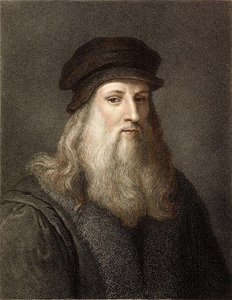
A High Renaissance master of sfumato known for the Mona Lisa. Discover his legendary works and timeless genius today.

from ·

Chapter 1

How large should it be?

Slide to change the size; the picture on the left shows the frame at its real width. The proportions of the original are kept.

Standard
custom
CM
INCH

Pick from our preset sizes that match the artwork's original proportions.

width
height

Type the width and the height you need, to fit your frame or your wall. This is hand-painted, so for a size with a different shape the artist can paint a bit more around the picture, or cut a bit — you choose. We send you a digital mockup to approve before the painting starts. The picture shown on this page does not show the real result — only the mockup does.

Chapter 2

How should it arrive?

Choose the edges of the stretched canvas

Choose your frame

Corner sample of the WhiteWrap canvas edge finish, stretched on solid wood bars
White $1
Corner sample of the BlurSideWrap canvas edge finish, stretched on solid wood bars
Blurside $1
Corner sample of the ExtendedWrap canvas edge finish, stretched on solid wood bars
Extended $1
Corner sample of the P118B picture frame: moulded polystyrene, 5 cm wide and 3 cm thick
P118B $10
Corner sample of the P118H picture frame: moulded polystyrene, 5 cm wide and 3 cm thick
P118H $10
Corner sample of the P118W picture frame: moulded polystyrene, 5 cm wide and 3 cm thick
P118W $10
Corner sample of the P438Z picture frame: moulded polystyrene, 5.5 cm wide and 3.5 cm thick
P438Z $10
Corner sample of the P508JH picture frame: moulded polystyrene, 7 cm wide and 3.5 cm thick
P508JH $12
Corner sample of the P508YH picture frame: moulded polystyrene, 7 cm wide and 3.5 cm thick
P508YH $12
Corner sample of the P805H picture frame: moulded polystyrene, 5 cm wide and 3.5 cm thick
P805H $10
Corner sample of the P805Z picture frame: moulded polystyrene, 5 cm wide and 3.5 cm thick
P805Z $10
Corner sample of the P919BZ picture frame: moulded polystyrene, 7 cm wide and 3.5 cm thick
P919BZ $10
Corner sample of the P919G picture frame: moulded polystyrene, 7 cm wide and 3.5 cm thick
P919G $10
Corner sample of the P919XJ picture frame: moulded polystyrene, 7 cm wide and 3.5 cm thick
P919XJ $10
Corner sample of the P959ZH picture frame: moulded polystyrene, 5 cm wide and 3 cm thick
P959ZH $10
Corner sample of the P968JZ picture frame: moulded polystyrene, 6 cm wide and 4 cm thick
P968JZ $12
Corner sample of the W106C picture frame: solid wood, 5 cm wide and 3 cm thick
W106C $8
Corner sample of the W218G picture frame: solid wood, 5 cm wide and 3 cm thick
W218G $10
Corner sample of the W218JH picture frame: solid wood, 5 cm wide and 3 cm thick
W218JH $8
Corner sample of the W218Y picture frame: solid wood, 5 cm wide and 3 cm thick
W218Y $10
Corner sample of the W307PJ picture frame: solid wood, 6 cm wide and 3 cm thick
W307PJ $10
Corner sample of the W316G picture frame: solid wood, 6 cm wide and 3 cm thick
W316G $10
Corner sample of the W316PJ picture frame: solid wood, 6 cm wide and 3 cm thick
W316PJ $8
Corner sample of the W316Y picture frame: solid wood, 6 cm wide and 3 cm thick
W316Y $10
Corner sample of the W398PJ picture frame: solid wood, 5 cm wide and 3 cm thick
W398PJ $8
Corner sample of the W4111J picture frame: solid wood, 6.5 cm wide and 3.5 cm thick
W4111J $10
Corner sample of the W500HY picture frame: solid wood, 7 cm wide and 5 cm thick
W500HY $15
Corner sample of the W500JH picture frame: solid wood, 7 cm wide and 5 cm thick
W500JH $15
Corner sample of the W692G picture frame: solid wood, 8 cm wide and 4 cm thick
W692G $12
Corner sample of the W849H picture frame: solid wood, 5 cm wide and 3 cm thick
W849H $8
Corner sample of the W940BG picture frame: solid wood, 7.5 cm wide and 4.5 cm thick
W940BG $15
Corner sample of the W953PJ picture frame: solid wood, 6 cm wide and 3.5 cm thick
W953PJ $8
Corner sample of the H24-GOLD picture frame: carved wood with gesso, 10 cm wide and 6 cm thick
H24-GOLD $30
Corner sample of the H24-SILVER picture frame: carved wood with gesso, 10 cm wide and 6 cm thick
H24-SILVER $30
Corner sample of the H36-GOLD picture frame: carved wood with gesso, 15 cm wide and 6.5 cm thick
H36-GOLD $45
Corner sample of the H36-SILVER picture frame: carved wood with gesso, 15 cm wide and 6.5 cm thick
H36-SILVER $45
Frame preview
Framed

Moulding: . Overall size with the frame: .

Chapter 3

Who paints it, and should anything change?

Examples of what can be changed: Replace face with customer photo; Add pet (e.g., replace cat with dog); Include hidden message in background; Change background landscape or elements.
After order, OriginalUniqueArt.com team will email client for instructions and provide a mockup preview

Worldwide Delivery () in 3/4 weeks instead of standard 5 weeks. (9 November). No compromise on quality.

Chapter 4

The finishing touches

A nameplate, as in a museum?

Engraved Bronze Plaque Details

This elegant plaque features the artist's name and the title of the artwork, finely engraved for a timeless presentation.

It is made from bronze with a refined, elegant finish. The text is precisely laser-engraved for a sharp and permanent result. Measuring 9x2 cm, the plaque is compact yet easy to read. It's built to be durable and scratch-resistant, offering a professional, museum-quality look. Mounting is simple thanks to the included adhesive backing.

Transparent Acrylic Plaque Details

The plaque includes essential engraved details such as the artist's name, the title of the artwork, the date it was created, the type of media used-like oil on canvas or watercolor-a brief description of the piece, and a QR code that links to the complete artwork information.

It is crafted from clear acrylic, offering a sleek, modern appearance. The text is UV-engraved in black to ensure strong visual contrast. With a size of 10x15 cm, it ensures optimal readability. It comes equipped with two metal hooks for secure wall mounting. The plaque is designed to be weather-resistant, making it suitable for various environments, and it includes interactive features that work seamlessly with smartphone scanning.

Black Acrylic Plaque Details

This elegant plaque includes engraved information such as the artist's name, the title of the artwork, the date it was created, the type of media used (like oil on canvas or watercolor), a short description of the artwork, and a QR code for quick access to more information.

The plaque itself is made from refined black acrylic with a premium finish. The text is laser-engraved in white for high contrast and readability. Its size is 10x15 cm, designed to be easy to read. It comes with two metal hooks for professional mounting. The design is sleek and fits any interior style. It is also weather-resistant and durable, with built-in digital integration for mobile compatibility.

A protective varnish?

When do you need it?

Chapter 5

Your painting, as you ordered it

Rearing horse

Reproduction Medium

Reproduction Size

-

Elite Senior Artist

More detail, finesse, and extra production time

-

Reproduction Frame

-

-

For artworks or reproductions larger than 105 cm (approximately 41 inches) on any side, the frame will be shipped as a kit, disassembled. This method ensures safe delivery and prevents damage during transport.

Professional assembly required - this is not a DIY product.
The kit must be assembled and the canvas stretched by an experienced professional framer, using wood glue (not supplied), a canvas stretching plier and clamps to hold the bars square while the glue dries. Incorrect assembly or uneven canvas tension can permanently damage the artwork and is not covered by our warranty.

  • All solid wood bars are included, precisely cut to size.

  • Assembled with the screws provided, plus wood glue for the corner joints, which is not supplied and must be sourced by your framer.

  • Professional tools are required and not included: a canvas stretching plier (tensioner) and clamps to hold the bars square while the glue dries.

Important:
The corner joints require wood glue, the bars must be held with clamps until the glue is fully dry, and tightening the canvas on the assembled frame requires a canvas stretching plier. None of these are included in the kit. Please arrange an experienced professional framer before ordering this size.

Nameplate

-

-

Protective Varnish

Glossy Varnish (enhances colors, protects against light/moisture)

-

Customize My Artwork

Examples of what can be changed: Replace face with customer photo; Add pet (e.g., replace cat with dog); Include hidden message in background; Change background landscape or elements.

-

Urgent

Worldwide Delivery () in 3/4 weeks instead of standard 5 weeks. (9 November). No compromise on quality.

-

Express Shipping

Worldwide Delivery () in 5 weeks. (16 November).

Included

Total Price

$ 300

Total Price $ 300

Glass option is only available in size under 110 CM

Included with every order

  • Free Worldwide Express Shipping
  • High-Quality Linen Canvas
  • Full Shipping Insurance
  • Customs Tax Refund Guarantee
  • True Color Matching Guarantee
  • 100-Day Return Policy (Defects Only)
  • 100% Money-Back Guarantee
  • Bulk Discount Offer

The Captivating "Rearing Horse" by Leonardo Da Vinci

The "Rearing Horse," housed within the esteemed Royal Library of Windsor, United Kingdom, stands as a testament to the unparalleled genius of Leonardo Da Vinci. This chalk drawing, meticulously crafted in 1503 and measuring an impressive 153 x 142 cm, offers a glimpse into the mind of one of history's most celebrated polymaths.

A Study of Movement and Anatomy

This artwork isn’t merely a depiction; it is a profound study. The "Rearing Horse" captures a moment of dynamic energy as a horse powerfully raises its head, with its front legs suspended in mid-air. The artist's choice of brown chalk lends an earthy quality to the animal, while the composition directs our gaze towards the left side where the horse’s body is positioned. The visible back legs on the right suggest a forward lean, emphasizing the motion. Da Vinci’s mastery lies not only in representing form but also in conveying movement with remarkable accuracy. His deep understanding of equine anatomy, honed through studies in both art and science, shines through every line. The drawing reveals his fascination with musculature, skeletal structure, and the mechanics of locomotion – a hallmark of Renaissance scientific inquiry.

Historical Significance and Context within the High Renaissance

The "Rearing Horse" is part of Da Vinci’s extensive collection of preparatory drawings, many now residing in the Royal Library of Windsor. These sketches were crucial to his artistic process, serving as explorations for larger works and demonstrating his meticulous approach. Created during the High Renaissance (roughly 1490-1527), a period characterized by renewed interest in classical art and humanism, Da Vinci’s work exemplified the era's innovative spirit. As a polymath – excelling in painting, engineering, science, and architecture – he embodied the ideal of the "Renaissance man." His notebooks, filled with observations and sketches, remain invaluable resources for understanding his creative process and intellectual pursuits.

Symbolism and Emotional Resonance

While seemingly straightforward as an anatomical study, the “Rearing Horse” evokes a sense of power, energy, and controlled force. The rearing pose itself is symbolic – representing strength, defiance, and potential unleashed. Da Vinci’s masterful use of chalk allows for subtle gradations of tone that create depth and volume, imbuing the horse with a palpable presence. Though lacking overt narrative elements, the drawing resonates with an emotional intensity born from its meticulous observation and skillful execution. The image speaks to the beauty and power of nature, reflecting Da Vinci’s profound respect for the natural world.

Relevance for Modern Art Enthusiasts & Reproduction Opportunities

The "Rearing Horse" continues to captivate audiences today, offering a window into Da Vinci's artistic process and his enduring fascination with movement and anatomy. For modern art enthusiasts, it serves as a reminder of the importance of studying the masters and appreciating the historical context that shaped their creations. At OriginalUniqueArt, we are dedicated to preserving this legacy by offering meticulously crafted, handmade oil painting reproductions of Da Vinci's "Rearing Horse." Our skilled artists faithfully recreate every detail, ensuring an authentic representation of this iconic masterpiece for art lovers and collectors alike.

Questions & Answers

How harmonious are the colors of "Rearing horse" by Leonardo da Vinci?

"Rearing horse" by Leonardo da Vinci displays a strong color unity color harmony.

Is "Rearing horse" a good gift idea?

As a present, "Rearing horse" by Leonardo da Vinci is suggested for anniversary. Other occasions can fit as well.

Where in Leonardo da Vinci's career does "Rearing horse" fall, given its date?

Given its 1503 date, "Rearing horse" falls in Leonardo da Vinci's High Renaissance.

More about this painting

Preview AR preview Switch to Print Switch to Digital Image Send
Details Guide Add to favorites Download Similars X-Ray Diaporama Q&A Stats

In numbers

  • 1503the year it was painted
  • 29frames to choose from
  • standard sizes, in its own proportions
  • 5weeks to paint and deliver it
Leonardo da Vinci

Leonardo da Vinci

1452 - 1519, Italy

Quick facts about Leonardo da Vinci

  • Artistic Movement Or Style: High Renaissance
  • Artists Or Movements Influenced By This Artist: ['High Renaissance']
  • Artists Who Influenced This Artist: ['Andrea del Verrocchio']
  • Full Name: Leonardo di ser Piero da Vinci
  • Nationality: Italian
  • Notable Artworks:
    • The Last Supper
    • Mona Lisa
    • Virgin of the Rocks
    • Lady with an Ermine
    • Annunciation
  • Place Of Birth: Vinci, Italy
  • Date Of Birth: 1452
  • Date Of Death: 1519

Artist Biography

The Life and Early Training of Leonardo da Vinci

Leonardo da Vinci was born on 15 April 1452 near the small Tuscan village of Anchiano. He was the illegitimate son of Piero da Vinci and Caterina di Meo Lippi. His early years were spent in this rural setting, far from the busy streets of the larger cities. This beginning shaped the way he would later observe the natural world.

At fourteen, he entered the workshop of Andrea del Verrocchio in Florence. This apprenticeship provided the foundation for his ability to capture the human form. In the studio, he learned the discipline of drawing and the mechanics of sculpture. He absorbed the methods of his teacher, working alongside others who sought to master the physical reality of the world. These formative years in Florence established the technical grounding he would carry into his later life.

Activity in Milan and the Sforza Court

Leonardo spent much of his time in Milan, working in the service of Ludovico Sforza. His presence in the city was part of a career that saw him moving between Milan, Florence, and a brief period in Rome. In the Sforza court, his work took on a different weight, moving between the demands of a patron and his own restless investigations. He did not stay in one place, shifting his focus as the needs of his patrons and his own interests changed.

Between 1495 and 1498, he painted The Last Supper. This work is located in the refectory of the Convent of Santa Maria delle Grazie in Milan, Italy. He chose to use an oil-based paint mixed with mastic, a resin intended to allow for slow, layered adjustments. This choice was an experiment in how color and light might be handled differently than with traditional fresco, though the technique proved difficult to maintain over time.

  • The Last Supper (c. 1495–1498)
>

Key Works and Artistic Achievements

His early work shows a developing hand, such as the Portrait of Ginevra de' Benci from 1474. By 1478, the Annunciation was finished, showing a careful eye for the Tuscan landscape. He moved toward more complex compositions with the Adoration of the Magi in about 1481. Later, the Virgin of the Rocks was worked on between about 1483 and 1486, a piece that highlights his interest in how light and shadow interact with stone and skin.

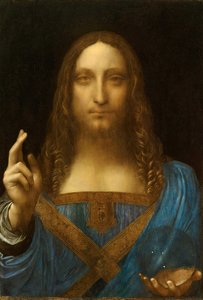
The 1490s brought the Lady with an Ermine, where he captured a specific, quiet moment. His work in Milan led to the creation of The Last Supper, a large mural in the refectory of the Convent of Santa Maria delle Grazie. In 1503, he began the Mona Lisa, a portrait that has become one of his most recognized subjects. His output also included the Salvator Mundi, though the question of whether he painted it remains a subject of debate among scholars.

  • Vitruvian Man (undated)

Mastery of Technique and Artistic Style

Leonardo’s hand moved with a specific intent, seeking to dissolve the hard edges of the world. He pioneered sfumato, a method of applying thin, translucent glazes to create smoky, seamless transitions between light and shadow. This technique allowed him to move away from harsh outlines, favoring subtle gradations of tone that mimic how the eye actually perceives form. He was a master of chiaroscuro, using the interplay of light and dark to sculpt figures and give them a sense of weight and presence. In his work, the boundary between a subject and the air surrounding it becomes blurred, creating an atmosphere that feels lived-in and soft.

His approach to depth relied heavily on atmospheric perspective. By observing how light scatters through the air, he could render distant landscapes with a pale, hazy quality that pulled the viewer's eye toward the horizon. This was not merely a visual trick but a result of his scientific inquiry into optics. He sought to marry aesthetic brilliance with a precise understanding of how light and shadow function in nature. This marriage of observation and application is visible in his handling of complex scenes, where every gesture is shaped by a deep knowledge of human anatomy and the way light falls upon a surface.

The way he applied his materials was often experimental. For The Last Supper, he chose to work with an oil-based paint mixed with mastic, a resin intended to allow for slow, careful layering. While this choice was meant to provide greater control over the drying process, it changed the way the paint interacted with the wall. His technical choices were often driven by a desire to capture the precise psychological tension of a moment, using the softness of his brushwork to mirror the complexity of human emotion.

Scientific Inquiry and Intellectual Legacy

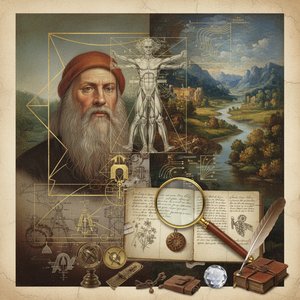
Leonardo’s mind moved between the studio and the laboratory, rarely settling on a single discipline. He was a polymath of the High Renaissance, working as a painter, draughtsman, engineer, scientist, theorist, sculptor, and architect. His curiosity was not a series of separate interests but a single, continuous effort to understand how things function. This drive is most visible in his eleven surviving manuscripts of notes and drawings. These pages contain a vast range of observations, from the mechanics of flight to the way light hits a surface. He spent much of his time dissecting the world to see its hidden parts.

His notebooks reveal a man obsessed with the details of the natural world. He filled them with sketches and notes on anatomy, astronomy, botany, cartography, and palaeontology. He did not merely look at a leaf or a bone; he sought to map the logic behind its shape and growth. This habit of recording everything—from the flow of water to the structure of a muscle—shows a mind that treated every observation as a way to decode the universe. His drawings were often as much about scientific accuracy as they were about art.

  • The leg muscles and bones of man and horse (1506)
  • Map of Tuscany and the Chiana Valley (1502)
  • Vitruvian Man (undated)

The Enduring Influence of a Renaissance Icon

Leonardo da Vinci helped shape the High Renaissance, leaving a mark on the way artists approached the canvas. His influence reached through the generations, affecting how painters understood the human form and the space it occupies. In many ways, the scale of his contribution to European art is matched only by the work of Michelangelo. He did not simply paint figures; he used religious iconography to weave complex narratives, changing how much emotion could be felt within a sacred scene. This shift allowed for a deeper psychological presence in art, where a gesture or a look could carry the weight of a story.

His approach to light and shadow, specifically the way colors blend without harsh borders, changed the visual language of his time. By observing how light moves across a surface, he moved away from the rigid lines of his predecessors. This method allowed for a sense of atmosphere that made his subjects feel as though they were breathing within a real, tangible environment. The way he handled the transition between light and dark helped define a new standard for realism in Western painting.

  • The Last Supper (c. 1495–1498)
  • Mona Lisa (1503)
  • The Virgin and Child with Saint Anne

Quick Facts

  • Location: Royal Library of Windsor
  • Subject or theme: Horse in motion
  • Movement: High Renaissance
  • Artist: Leonardo da Vinci
  • Notable elements or techniques:
    • Anatomy study
    • Equine movement
  • Dimensions: 153 x 142 cm

Art Quiz

There is only one correct answer for each question.

Question 1:
What is the primary medium used to create "Rearing Horse"?
Question 2:
In what institution is the 'Rearing Horse' currently housed?
Question 3:
What artistic period does "Rearing Horse" belong to?
Question 4:
According to the description, what was Leonardo da Vinci known for besides painting?
Question 5:
What is a key characteristic of the horse's posture depicted in the artwork?