 Preview
 Send
Send Share
Share
 Details
 Guide
Guide

 Download
 Similars
 X-Ray
X-Ray Diaporama
 Q&A
Q&A Stats
StatsThe Broken Ring


 Read More
The artwork displayed on this page is protected by copyright law, which means we cannot legally create or sell an identical reproduction. This protection is enforced under international agreements such as the Berne Convention and by national laws, including those outlined by the U.S. Copyright Law - Title 17.
This method fully complies with copyright regulations because it does not involve copying or duplicating the protected artwork. Instead, it is a creative reinterpretation - a new painting that is influenced by the original but not identical to it.
Giclée / Art Print
Museum-quality giclée or canvas print with fast production and flexible finish options. ( Buy Hand Made Painting Switch to Digital Image)




































Pick from our preset sizes that match the artwork's original proportions.

Type the width and the height you need, to fit your frame or your wall. A print can only be cut, never made bigger than the picture, so a size with a different shape loses a part of the image. We send you a digital mockup to approve before we print anything. The picture shown on this page does not show the real cut — only the mockup does.
Worldwide Delivery () in 2 weeks instead of standard 4/5 weeks. (16 November)

Free Worldwide Express Shipping

High-Quality Linen Canvas

Full Shipping Insurance

Customs Tax Refund Guarantee

True Color Matching Guarantee

100-Day Return Policy (Defects Only)

100% Money-Back Guarantee

Bulk Discount Offer
 Glass option is only available in size under 110 CM

The Broken Ring
Giclée / Art Print
Reproduction Size
-


Total Price
$ 81
The Broken Ring: A Study in Color and Fragmentation
- Artist: Kenneth Noland (1924-2010)
- Date: 2000
- Medium: Likely oil or acrylic on canvas
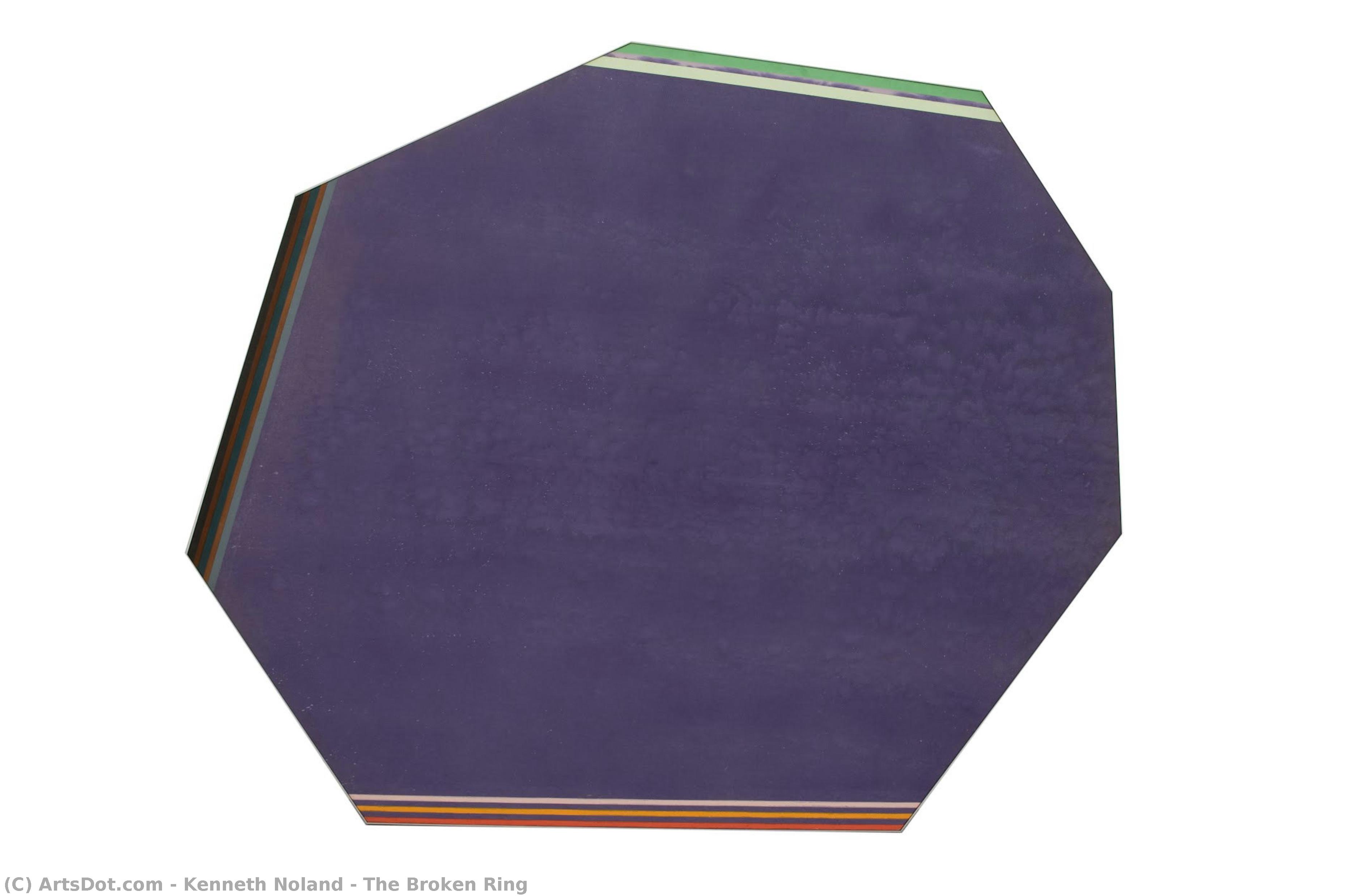
“The Broken Ring,” created in 2000 by the renowned American Color Field painter Kenneth Noland, is a captivating abstract artwork that explores themes of fragmentation and harmony through vibrant color relationships. This piece exemplifies Noland's later work, building upon his established exploration of geometric forms and chromatic interplay.
Composition and Style: Echoes of Minimalism
The painting’s composition centers around a large, irregular octagon that dominates the canvas. This shape isn't perfectly symmetrical; its slight imperfections contribute to the artwork’s dynamic energy. The central area within the octagon is filled with a deep, resonant purple hue, providing a grounding visual anchor. A striking border of thin bands in orange, yellow, green, and blue encircles the octagon, creating a vibrant frame that draws the viewer's eye around the composition. Noland’s style aligns firmly with Abstract Expressionism and Color Field painting, movements characterized by non-representational forms and an emphasis on color as the primary subject matter. There are echoes of Minimalism in its reduction to essential shapes and colors, yet it retains a distinct expressive quality.
Technique and Materials: Layering and Staining
Noland’s technique involved layering paint to achieve the depth and richness within the purple field. The subtle texture visible suggests multiple applications or variations in pigment density. The color bands along the edges are applied with a controlled hand, creating crisp lines that define their boundaries. While the precise materials used aren't definitively documented, it is highly probable that oil or acrylic paints were employed on canvas, given the appearance and texture of the surface. Noland was known for experimenting with staining techniques, allowing paint to soak into the canvas rather than sitting thickly on top, which contributes to the painting’s luminous quality.
Symbolism and Emotional Impact: Fragmentation and Harmony
The title "The Broken Ring" immediately introduces a sense of incompleteness or disruption. This is visually reflected in the irregular form of the octagon and the fragmented nature of the color bands, which don't flow seamlessly but rather exist as distinct segments. However, despite this fragmentation, there’s an underlying harmony achieved through the carefully chosen color palette. The purple evokes feelings of calmness and introspection, while the vibrant orange, yellow, green, and blue inject energy and optimism. The interplay between these colors creates a complex emotional landscape – one that acknowledges disruption but ultimately seeks balance and visual resolution. Noland's work invites viewers to contemplate the relationship between order and chaos, wholeness and fragmentation, within the realm of pure color and form.
Questions & Answers
What colors dominate "The Broken Ring" by Kenneth Noland?
"The Broken Ring" by Kenneth Noland uses a neutrals palette, with espresso (#4c4260) as the dominant color.
Where can I find statistics about "The Broken Ring" by Kenneth Noland?
Statistics about "The Broken Ring" by Kenneth Noland are on the artwork's Stats page: monthly visits of the artwork, visits of the artist's works, and country and language breakdowns of recent visitors.
Who created "The Broken Ring" and in what year?
The author of "The Broken Ring" is Kenneth Noland, and the work is dated 2000.
Artist Biography
A Life Immersed in Color: The World of Kenneth Noland
Kenneth Clifton Noland, a name synonymous with the vibrant energy of Color Field painting and a pivotal figure in the Washington Color School, dedicated his life to distilling art down to its most essential elements – color, form, and spatial relationships. Born in Asheville, North Carolina, in 1924, Noland’s journey was one of constant exploration and innovation, evolving from early engagements with Abstract Expressionism to a groundbreaking embrace of shaped canvases that redefined the boundaries of abstract painting. His work wasn't merely about what he *painted*, but how he revealed color itself, allowing it to breathe and resonate within carefully considered compositions.
Early Influences and Artistic Formation
Noland’s artistic inclinations were nurtured from a young age, growing up in a household where music and art held value. This early exposure laid the foundation for his lifelong pursuit of aesthetic expression. His formal training began after serving in the U.S. Air Force during World War II, utilizing the G.I. Bill to attend Black Mountain College – an institution renowned as a crucible of artistic experimentation. It was here that Noland encountered transformative influences. Instructors like Ilya Bolotowsky introduced him to the principles of Neo-plasticism and the work of Piet Mondrian, while Josef Albers instilled in him a deep understanding of Bauhaus theory and the profound impact of color perception. These foundational lessons would become cornerstones of his artistic philosophy.
A subsequent period studying sculpture with Ossip Zadkine in Paris further broadened Noland’s horizons, marking his first solo exhibition and exposing him to the European art scene. However, it was a pivotal encounter back in America that truly set him on the path toward his signature style. In 1953, Clement Greenberg introduced Noland – along with Morris Louis – to Helen Frankenthaler's revolutionary “soak-stain” technique. This method, involving applying thinned paint directly onto unprimed canvas, proved a watershed moment, liberating color from the constraints of traditional brushwork and allowing it to become an integral part of the fabric itself.
The Evolution of Style: Circles, Chevrons, and Shaped Canvases
Noland and Louis enthusiastically embraced Frankenthaler’s technique, embarking on a shared exploration of color field painting. Noland's early works during this period are characterized by striking concentric circles – often referred to as “targets.” These weren’t simply depictions of targets; they were investigations into the relationship between image and canvas edge, utilizing unexpected and bold color combinations to create visual tension and optical effects. Beginning (1958) stands as a prime example of this phase, showcasing his mastery of color interaction and spatial dynamics.
Around 1958, Noland began to diverge from Louis’s artistic trajectory, venturing into explorations with chevrons and stripes. This marked a shift towards more structured compositions while retaining the emphasis on pure color. However, it was his pioneering use of shaped canvases that truly cemented his place in art history. Initially experimenting with diamonds or chevrons, Noland progressively evolved toward highly irregular forms, emphasizing the canvas edges not as boundaries but as integral structural elements – actively participating in the overall composition and challenging traditional notions of pictorial space.
Recognition and Lasting Legacy
Noland’s innovative work garnered significant recognition throughout his career. He was prominently featured in Clement Greenberg’s influential 1964 exhibition, Post-Painterly Abstraction, which solidified Color Field painting as a major force in the contemporary art world. That same year, he occupied half of the American pavilion at the Venice Biennale, demonstrating international acclaim. Major retrospective exhibitions followed, including one at the Solomon R. Guggenheim Museum in 1977 that traveled to other prestigious institutions like the Hirshhorn Museum and Sculpture Garden and the Toledo Museum of Art. Further exhibitions internationally, including a showing at the Tate in London in 2006, continued to celebrate his contributions.
Throughout the 1970s and 80s, Noland relentlessly refined his shaped canvas approach, creating increasingly complex structures with sophisticated color control. He remained committed to pushing the boundaries of abstraction, inspiring generations of artists. Kenneth Noland passed away in 2010, leaving behind a legacy as a central figure in Color Field painting, a leader of the Washington Color School, and an innovator who fundamentally expanded the possibilities of abstract art. His work continues to resonate today, reminding us of the power of color to evoke emotion, challenge perception, and redefine our understanding of space.
A Lasting Impact
- Noland’s influence extends beyond his immediate contemporaries, inspiring artists exploring abstraction, color theory, and spatial relationships even now.
- His pioneering use of shaped canvases challenged conventional notions of painting, opening up new avenues for artistic expression.
- As a key figure in the Washington Color School, he helped establish a distinct American voice within the broader context of abstract art.

Kenneth Noland
1924 - 2010 , United States
Quick Facts
- Full Name: Kenneth Clifton Noland
- Nationality: American
- Date Of Birth: 1924
- Date Of Death: 2010
- Place Of Birth: Asheville, United States of America
- Notable Artworks:
- Beginning
- Magic Box
- October
- Artistic Movement Or Style: Color Field painting
- Artists Who Influenced This Artist:
- Ilya Bolotowsky
- Josef Albers
- Helen Frankenthaler
- Artists Or Movements Influenced By This Artist: ['Washington Color School']
Related Articles
The Poetics of Stillness: Exploring Serenity as Subject & Aesthetic Quality in Visual Art
Explore the profound beauty of serenity in art history & contemporary works. Discover how artists evoke calm through color, composition & minimalism. Find artwork to cultivate peace and wellbeing.

Fragmented Beauty: A Professional Guide to Deconstructed Forms and Cubist Masterpieces for Architectural Design
Elevate hospitality interiors with professional-grade Cubist reproductions. Our expert guide explores deconstructed forms for designers, offering high-volume, hand-painted oil masterpieces, custom multi-panel sets, and seamless global procurement for hotels and corporate spaces.

Mastering Abstraction: The Top 25 Iconic Artworks by Piet Mondrian
Explore 25 iconic Piet Mondrian masterpieces of Neoplasticism. Discover the beauty of De Stijl on OriginalUniqueArt.com.

The Geometry of Balance: Decoding Equilibrium and Rhythm in Mondrian’s Neo-Plasticism
Master the logic of Mondrian's Neo-Plasticism through expert analysis of balance and rhythm. Decode the geometry of modern art today.

Oil on Board: A Historical Survey of Technique, Aesthetic Qualities & Enduring Appeal
Explore the rich history of oil on board painting! Discover techniques, aesthetic qualities & enduring appeal from early masters to modern practice. Expert insights for collectors and art enthusiasts.


