Preview
 Send
Send Share
Share
 Details
 Guide
Guide

 Download
 Similars
 X-Ray
X-Ray Diaporama
 Q&A
Q&A Stats
StatsOn the Boulevard 1


 Read More
Giclée / Art Print
Museum-quality giclée or canvas print with fast production and flexible finish options. ( Buy Hand Made Painting Switch to Digital Image)




P118B $10

P118H $10

P118W $10

P438Z $10

P508JH $12

P508YH $12

P805H $10

P805Z $10

P919BZ $10

P919G $10

P919XJ $10

P959ZH $10

P968JZ $12

W106C $8

W218G $10

W218JH $8

W218Y $10

W307PJ $10

W316G $10

W316PJ $8

W316Y $10

W398PJ $8

W4111J $10

W500HY $15

W500JH $15

W692G $12

W849H $8

W940BG $15

W953PJ $8




Pick from our preset sizes that match the artwork's original proportions.

Type the width and the height you need, to fit your frame or your wall. A print can only be cut, never made bigger than the picture, so a size with a different shape loses a part of the image. We send you a digital mockup to approve before we print anything. The picture shown on this page does not show the real cut — only the mockup does.
Worldwide Delivery () in 2 weeks instead of standard 4/5 weeks. (5 November)

Free Worldwide Express Shipping

High-Quality Linen Canvas

Full Shipping Insurance

Customs Tax Refund Guarantee

True Color Matching Guarantee

100-Day Return Policy (Defects Only)

100% Money-Back Guarantee

Bulk Discount Offer
 Glass option is only available in size under 110 CM

On the Boulevard 1
Giclée / Art Print
Reproduction Size
-


Total Price
$ 81
A Fragmented Gaze: The Vibrant Soul of On the Boulevard
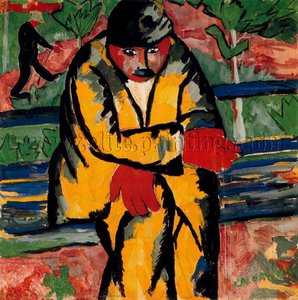
In the bustling transition between the nineteenth and twentieth centuries, few artists captured the electric tension of modernity quite like Kazimir Malevich. His masterpiece, On the Boulevard, serves as a breathtaking window into an era defined by radical change and the breaking of traditional boundaries. At first glance, the viewer is met with a striking portrait of a gentleman, seated with a quiet, contemplative gravity upon a park bench. Dressed in a vivid yellow jacket that commands immediate attention, his presence is anchored by the bold contrast of red gloves, creating a focal point that feels both intimate and monumental. Yet, as one lingers on the canvas, the scene begins to dissolve and reform; the man is not merely a subject in a landscape, but a central figure within a complex, geometric dance of color and form.
The technique employed here is a masterful dialogue between Fauvism and the burgeoning language of Cubism. Malevich does not seek to replicate the photographic reality of a Parisian or Russian street scene; instead, he utilizes fragmented planes and a daringly saturated palette to evoke the sensory experience of urban life. The brushwork, though controlled, possesses an energetic texture that breathes life into the composition. By deconstructing the environment into essential shapes—squares, rectangles, and sweeping curves—Malevich invites the collector to look beyond the surface. This approach transforms a simple moment of repose into a profound exploration of how light, color, and structure intersect to create our perception of reality.
The Intersection of Tradition and Avant-Garde
To understand On the Boulevard is to understand the heartbeat of the Russian avant-garde. Created during a period when Malevich was experimenting with various European influences, the painting acts as a bridge between the representational traditions of the past and the pure abstraction of his later Suprematist period. The presence of secondary figures in the background—subtly integrated into the rhythmic patterns of the composition—adds a layer of narrative depth, suggesting the collective pulse of a society in motion. There is a deliberate tension here: the subject’s stillness contrasts sharply with the dynamic, almost aggressive, application of color, mirroring the psychological state of an era caught between old-world stability and new-world chaos.
For the discerning interior designer or art enthusiast, this piece offers more than mere decoration; it provides a sophisticated focal point that stimulates intellectual curiosity. The bold interplay of primary hues—the sun-drenched yellow and the passionate red—makes it an ideal centerpiece for modern, minimalist, or eclectic spaces. A high-quality reproduction of this work allows the heavy textures and emotive power of Malevich’s vision to inhabit a contemporary home, bringing with it a sense of historical weight and artistic rebellion. It is an invitation to dwell within a moment of fragmented beauty, where every stroke tells a story of a world being reimagined.
Questions & Answers
What emotion does "On the Boulevard 1" by Kazimir Malevich convey?
The emotional tone recorded for "On the Boulevard 1" by Kazimir Malevich is reflective. It summarizes the feeling the work expresses.
Where does "On the Boulevard 1" by Kazimir Malevich sit in art history?
Historically, "On the Boulevard 1" is a Cubism work of the broader Modern era.
How many people view "On the Boulevard 1"?
The Stats page of "On the Boulevard 1" by Kazimir Malevich presents public visit statistics: monthly visits of this artwork, a comparison with the artist's most viewed works, and where its visitors come from.
Artist Biography
Kazimir Malevich: A Pioneer of Abstract Art
Early Life and Influences
- Born in Kyiv Oblast, Ukraine in 1878 to a Polish family, Kazimir Severinovich Malevich’s early life was shaped by the rural Ukrainian landscape and its rich folk culture.
- His upbringing instilled in him an appreciation for traditional artistic expressions that would later subtly influence his work.
- Formal training began in Kyiv, but Malevich quickly sought broader artistic horizons, moving towards Moscow and eventually engaging with the burgeoning avant-garde movements of Europe.
- Key Influences: Early exposure to folk art, combined with a desire for modern expression, formed the foundation of his unique style.
Artistic Development & Key Movements
- Initially, Malevich explored various styles including Impressionism, Symbolism, Fauvism, and Cubism. A pivotal trip to Paris in 1912 exposed him to the latest developments in European art.
- He gradually moved away from representational forms, seeking a purely artistic language based on geometric shapes and color.
- This led to the development of Suprematism around 1915 – an abstract movement focused on “the supremacy of pure feeling” in art.
- Suprematism rejected any attempt to depict objects from the visible world, instead prioritizing basic geometric forms like squares, circles, and rectangles.
Major Achievements & Notable Works
- Black Square (1915): Arguably his most famous work, it represents a radical departure from traditional art and is considered a foundational piece of abstract painting.
- White on White (1918): A series exploring the purity of form and color, featuring white geometric shapes against a white background – pushing abstraction to its limits.
- Stroyuschiysya dom [House under Construction] (1916): An early example of Suprematism showcasing his unique perspective on Ukrainian culture through abstract forms.
- He also wrote extensively on art theory, articulating the philosophical principles behind Suprematism and advocating for a new artistic consciousness.
Historical Significance & Legacy
- Malevich’s work profoundly impacted the development of 20th-century abstract art, influencing movements like Minimalism and Constructivism.
- He challenged conventional notions of representation and paved the way for non-objective art.
- His ideas about pure feeling and geometric abstraction continue to resonate with artists today.
- Despite facing political persecution under Stalin – initially supported, then suppressed – Malevich persevered in his practice and teaching.
- Influence on Later Artists: He directly influenced artists like El Lissitzky and indirectly shaped countless others through the enduring legacy of Suprematism.
Later Life & Death
- In his later years, Malevich revisited figurative painting, attempting to synthesize his abstract principles with representational forms.
- He continued to teach and write about art until his death in Leningrad (now St. Petersburg) in 1935.
- His work remained relatively obscure for decades after his death but experienced a resurgence of interest in the latter half of the 20th century, solidifying his place as one of the most important figures in modern art history.

Kazimir Malevich
1878 - 1935 , Ukraine
Related Articles

Crimson Threads of Narrative: Exploring Symbolism & Representation in Artworks Featuring the Red Dress
Explore the rich symbolism of the red dress in art history! From ancient power displays to iconic portraits like Cézanne’s 'Madame Cezanne', discover the cultural and artistic significance behind this captivating color. Expert analysis & insights.
Golden Hues: Top 10 Paintings Dominated by Yellow Ochre |
Explore 10 iconic paintings bathed in golden yellow ochre! From Van Gogh's sunflowers to Monet’s haystacks, discover the stories behind these masterpieces. Find museum-quality art reproductions & elevate your home decor on .
Golden Hues: 10 Masterpieces Dominated by Chrome Yellow | OriginalUniqueArt
Immerse yourself in golden light! Explore 10 famous paintings dominated by 'Chrome Yellow', from Van Gogh’s Sunflowers to Monet's Haystacks. Discover the stories behind these iconic Impressionist & Post-Impressionist masterpieces and find museum-quality art reproductions at OriginalUniqueArt.com.

Mastering Emotion: The 25 Most Iconic Mark Rothko Artworks
Explore 25 iconic Mark Rothko masterpieces of Color Field painting. Discover museum-quality art on OriginalUniqueArt.com.

Geometric Abstraction's 10 Defining Masterpieces | Art for Your Home - OriginalUniqueArt
Explore 10 defining masterpieces of Geometric Abstraction! Discover Kandinsky, Mondrian & Malevich’s iconic works. Find museum-quality art reproductions and curated decor ideas to elevate your home at OriginalUniqueArt.com.


![Black circle [1913] State Russian Museum,](/media/artworks/images-thumb/62/67/6267e452b0c8476772a6511e19ce1616.jpg)