Switch to Print
 Read More







































 For artworks or reproductions larger than 105 cm (approximately 41 inches) on any side, the frame will be shipped as a kit, disassembled. This method ensures safe delivery and prevents damage during transport.


A Haunting Encounter with Fear: Exploring Kazimir Malevich’s “Demon”
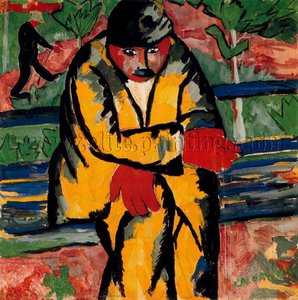
Kazimir Malevich’s “Demon,” painted in 1914, stands as a cornerstone of Suprematism—a revolutionary artistic movement that sought to liberate painting from representational constraints and delve into pure geometric abstraction. This striking black and white print captures the essence of Malevich's vision: an unsettling confrontation with primal terror rendered in uncompromising simplicity.
- Subject Matter: The artwork depicts a monumental bird-like creature dominating the frame, positioned on a single leg—a posture that imbues it with dynamism and conveys a palpable sense of unease.
- Style & Technique: Malevich’s masterful use of monochrome elevates “Demon” beyond mere visual depiction; it embodies Suprematism's core principle – reducing art to its fundamental elements, namely geometric forms. The bold black and white palette amplifies the artwork’s dramatic impact.
The photograph itself offers clues about Malevich’s artistic journey. A book nestled in the upper left corner hints at intellectual engagement alongside visual expression—a reflection of Malevich's broader interest in exploring philosophical concepts within his art.
Historical Context: Suprematism and Its Roots
Born in Kyiv Oblast, Ukraine in 1878, Kazimir Malevich’s formative years instilled in him a deep appreciation for Ukrainian folk traditions. However, he swiftly embraced the burgeoning avant-garde currents of Europe, particularly Parisian Impressionism and Symbolism, propelling him toward groundbreaking experimentation.
“Demon” emerged during a period marked by intense artistic debate regarding the role of art in conveying emotion and confronting existential anxieties. Suprematism responded directly to these concerns, rejecting illusionistic representation in favor of pure abstraction—a bold assertion against academic conventions.
Symbolism Within Geometric Form
Malevich’s deliberate simplification of form isn't merely stylistic; it carries profound symbolic weight. The bird-like figure embodies primal fear and represents the subconscious mind grappling with anxieties about mortality. Its stance—a solitary leg—suggests vulnerability and emphasizes the artwork’s focus on internal psychological states.
Emotional Resonance: A Legacy of Bold Expression
"Demon" continues to resonate powerfully with viewers today, demonstrating Malevich's enduring influence on 20th-century art. Its stark monochrome palette and geometric abstraction evoke a visceral response—a reminder that art can transcend literal depiction to communicate fundamental human emotions. Reproductions like this allow us to experience the raw power of Suprematism’s vision.
Questions & Answers
Where does "Demon" sit within Kazimir Malevich's body of work?
"Demon" shares with Kazimir Malevich's other works its Suprematism style and the recorded themes: geometric abstraction, russian art, fearful symbolism, spiritual quest, revolutionary ideas, visual impact, bold form, suprematism pioneer.
How do I download the image of "Demon" by Kazimir Malevich?
"Demon" by Kazimir Malevich can be downloaded from the artwork's Download page, as a high-resolution digital image download.
Which artistic current is "Demon" by Kazimir Malevich part of?
The movement associated with "Demon" by Kazimir Malevich is Suprematism. This classification situates the work among related artists and artworks.
More about this painting
 Preview
 Send
Send Share
Share
 Details
 Guide
Guide

 Download
 Similars
 X-Ray
X-Ray Diaporama
 Q&A
Q&A Stats
Stats







![Black circle [1913] State Russian Museum,](/media/artworks/images-thumb/62/67/6267e452b0c8476772a6511e19ce1616.jpg)