Preview
 Send
Send Share
Share
 Details

 Download
 Similars
 X-Ray
X-Ray Diaporama
 Stats
StatsMan walking


 Read More
Giclée / Art Print
Museum-quality giclée or canvas print with fast production and flexible finish options. ( Buy Hand Made Painting Switch to Digital Image)




P118B $10

P118H $10

P118W $10

P438Z $10

P508JH $12

P508YH $12

P805H $10

P805Z $10

P919BZ $10

P919G $10

P919XJ $10

P959ZH $10

P968JZ $12

W106C $8

W218G $10

W218JH $8

W218Y $10

W307PJ $10

W316G $10

W316PJ $8

W316Y $10

W398PJ $8

W4111J $10

W500HY $15

W500JH $15

W692G $12

W849H $8

W940BG $15

W953PJ $8




Pick from our preset sizes that match the artwork's original proportions.

You may enter your own dimensions to fit a specific frame or space. If your selected size does not match the original image's proportions, we will either crop the artwork or extend the image with a mirrored or solid-fill edge. A digital mockup will be sent for your approval before production begins.
Please note that the on-screen preview does not reflect the actual cropping or extension. Only the mockup will accurately show the final composition.
While custom sizes are available, we recommend selecting a dimension from the predefined list to preserve the original proportions.
Worldwide Delivery () in 2 weeks instead of standard 4/5 weeks. (9 September)

Free Worldwide Express Shipping

High-Quality Linen Canvas

Full Shipping Insurance

Customs Tax Refund Guarantee

True Color Matching Guarantee

100-Day Return Policy (Defects Only)

100% Money-Back Guarantee

Bulk Discount Offer
 Glass option is only available in size under 110 CM

Man walking
Giclée / Art Print
Reproduction Size
-


Total Price
$ 81
A Moment Frozen in Time: The Nostalgia of Júlio Resende
In the quiet, evocative strokes of "Man walking," created in 1949, we encounter a profound sense of mid-century serenity. This piece, a masterful work by the celebrated Portuguese painter Júlimo Resende, captures more than just a solitary figure; it captures an era. The painting depicts a man, perhaps lost in thought, navigating a verdant landscape while carrying a baseball bat—a detail that introduces a subtle, rhythmic tension to the otherwise peaceful scene. Through a delicate watercolor-inspired style, Resende breathes life into a moment of mundane existence, elevating a simple stroll into a poetic meditation on movement and solitude.
The technique employed here is nothing short of enchanting. Utilizing a soft, fluid approach reminiscent of classic watercolor, the artist employs a palette that feels both vibrant and aged, as if viewing the world through the hazy, golden lens of memory. The edges of the figure and the surrounding greenery bleed softly into one another, creating a dreamlike atmosphere that softens the boundaries between the subject and his environment. This painterly diffusion allows the background figures to linger like ghosts of a summer afternoon, ensuring that while the man remains our focal point, he is inextricably linked to the communal pulse of the outdoor setting.
For the discerning collector or interior designer, this artwork offers a unique emotional resonance. It possesses a vintage charm that speaks to the soul, making it an ideal centerpiece for spaces designed to evoke warmth, nostalgia, and intellectual depth. The composition’s balance of color and light provides a sophisticated touch to any gallery wall or curated living space, offering a window into the post-war European aesthetic where simplicity and expressive freedom began to intertwine. To possess a reproduction of this work is to invite a sense of timelessness into one's home, celebrating the beauty found in life's most quiet, unscripted transitions.
Artist Biography
A Life Immersed in Art: The Journey of Júlio Resende
Júlio Martins da Silva Dias, known to the art world as Júlio Resende, emerged from the vibrant cultural landscape of Porto, Portugal, in 1917. Born into a family that nurtured creativity – his mother a music teacher and his father a trader with an appreciation for aesthetics – Resende’s artistic inclinations were evident from a young age. This early immersion in both disciplined study and expressive freedom would profoundly shape his trajectory as one of Portugal's most significant modern painters. Though initially drawn to commercial pursuits, the pull of art proved irresistible, leading him to the Silva Porto Academy under the tutelage of Alberto Silva, where he honed his foundational skills in drawing and painting. Even during these formative years, a pragmatic side persisted; Resende supported his artistic ambitions through illustration work for periodicals like *Jornal de Notícias* and *O Primeiro de Janeiro*, crafting comic strips such as *Matulinho e Matulão* that showcased his versatility and narrative flair. This early experience instilled in him not only technical proficiency but also a deep understanding of visual communication, qualities that would resonate throughout his career.Forging a Unique Style: Influences and Artistic Development
Resende’s artistic evolution was marked by a relentless exploration of form and expression. A pivotal moment arrived with a scholarship to the Institute for Advanced Culture in 1947, enabling him to study in Paris – a crucible of modern art. There, at the Académie de Grande Chaumière and the Paris Academy of Fine Arts, he delved into fresco and engraving techniques, expanding his technical repertoire. The Parisian experience exposed him to the avant-garde movements reshaping the artistic landscape, particularly the powerful works of Picasso and Goya. These encounters ignited a fascination with abstractionism, yet Resende never fully abandoned figuration. Instead, he embarked on a path toward a distinctive style that gracefully navigated the space between representation and non-representation. His work became characterized by a lyrical quality, incorporating elements of Expressionism, Neo-Realism, Gesturalism, and Non-figuration – a syncretic approach reflecting his diverse influences and personal vision. Recurring themes emerged: the evocative power of the sea, the sun-drenched landscapes of Alentejo, and the lives of its people, all rendered with an emotional depth that resonated deeply with viewers.Landmarks in a Celebrated Career: Major Works and Achievements
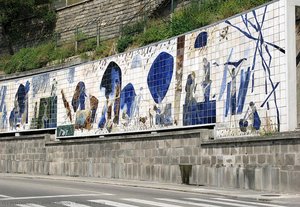
Throughout his career, Júlio Resende left an indelible mark on both the Portuguese artistic scene and beyond. Perhaps his most recognizable work is *Ribeira Negra*, a monumental tile panel adorning the area near the D. Luís I Bridge in Porto. This striking piece exemplifies his ability to integrate art into public spaces, transforming urban environments with its evocative imagery. Beyond this iconic creation, Resende’s ceramic panels grace significant architectural landmarks such as the Palace of Justice in Lisbon and Hospital de São João in Porto, demonstrating his mastery of diverse media. His talent garnered widespread recognition through numerous individual exhibitions held across Portugal, Spain, Belgium, Norway, and Brazil. The accolades followed: a Special Prize at the 1951 São Paulo Art Biennial, an Honorable Mention in 1959, and the prestigious Graphic Arts Prize in 1969 for his illustrations accompanying Vergílio Ferreira’s novel *Aparição*. Further honors included membership in the Belgian Royal Academy of Sciences, Letters and Fine Arts (1972) and the Comendador de Mérito Civil de España (1982), solidifying his international reputation.A Lasting Legacy: Historical Significance and Enduring Influence
Júlio Resende occupies a crucial position in Portuguese art history, representing a pivotal transition from traditional styles to the burgeoning possibilities of modern abstraction. His work wasn’t merely an adoption of foreign trends; it was a thoughtful synthesis of diverse influences filtered through his own unique sensibility and deeply rooted connection to Portugal's cultural identity. He masterfully captured the social realities and landscapes of his time, offering poignant reflections on the human condition. Resende’s ability to seamlessly blend disparate artistic elements into a cohesive personal style inspired subsequent generations of artists, encouraging them to explore new avenues of expression. The Júlio Resende Foundation stands as a testament to his enduring legacy, preserving over two thousand drawings that offer invaluable insights into his creative process and the evolution of his vision. His work continues to be celebrated and exhibited, ensuring that his place as an important figure in Portuguese art remains secure for years to come. He was truly a painter who bridged worlds – between figuration and abstraction, tradition and modernity, Portugal and the international stage.
Júlio Resende
1917 - 2011 , Portugal
Quick Facts
- Artistic Movement Or Style: Abstractionism, Expressionism
- Artists Or Movements Influenced By This Artist: ['Portuguese artists']
- Artists Who Influenced This Artist:
- Picasso
- Goya
- Sam Francis
- Date Of Birth: October 23, 1917
- Date Of Death: 2011
- Full Name: Júlio Resende
- Nationality: Portuguese
- Notable Artworks:
- Ribeira Negra
- Self-portrait
- Solemnity
- Place Of Birth: Porto, Portugal
Related Articles
Ephemeral Echoes: Exploring the Aesthetic & Historical Significance of Vintage Watercolor Painting
Explore the captivating world of vintage watercolor painting! Discover its rich history, techniques, influential artists & collecting tips. Expert insights for enthusiasts and collectors at OriginalUniqueArt.

Ephemeral Visions: Exploring the Artistic Legacy & Nuances of Watercolor Painting
Explore the captivating world of watercolor painting! Discover its rich history, essential techniques, influential artists & collecting tips from art experts. A comprehensive guide for enthusiasts.

Watercolor Wonders: 10 Masterpieces That Redefined Art History | OriginalUniqueArt
Journey through 10 legendary watercolor masterpieces by Sargent, Turner & Homer! Explore iconic landscapes, portraits & floral art that redefined history. Find museum-quality reproductions and curated decor ideas at OriginalUniqueArt.com.

Ephemeral Visions: Exploring the History & Emotional Resonance of Watercolor Painting
Explore the captivating history of watercolor painting, from ancient techniques to modern masters like Kandinsky & Blake. Discover essential artists, collecting tips & the emotional power of this luminous medium. Expert insights for art enthusiasts.

Ephemeral Visions: Exploring the Artistic Legacy & Contemporary Practice of Watercolor Painting
Explore the captivating world of watercolor painting! Discover its rich history, essential techniques, influential artists & collecting tips. A comprehensive guide for art enthusiasts from OriginalUniqueArt.